I was eight months pregnant when People Power happened.
I wasn’t on EDSA. I was home, enormous and exhausted, listening to the radio with my husband while we tried to figure out if what was happening was actually happening. Every update felt like it could be the one that ended badly. We didn’t sleep much. We prayed — genuinely, desperately, the kind you only manage when you’ve run out of everything else to do. What I remember isn’t the jubilation people describe. It’s the moment the dread lifted. And what came flooding in after it was this strange, almost physical hope. Not for the country in the abstract. For our first baby. For whoever she was going to grow up to be in a place that had just, improbably, chosen something better.
She will be forty this year. And God help us, we are still asking the same questions.
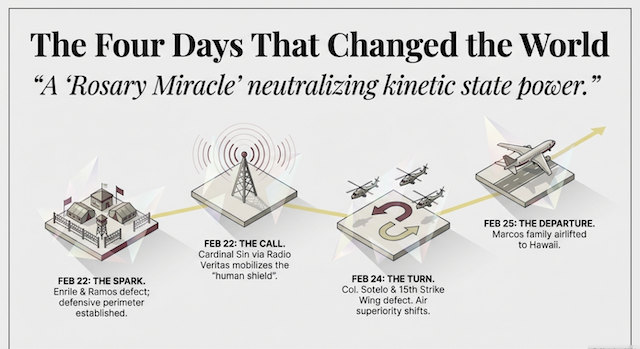
The Ruby Year and what it’s actually asking us
Forty years is the Ruby anniversary. Some analysts have called this moment a reckoning — a chance to hold the country up to the light and see what four decades of democracy actually produced. And then you get to the part that’s hard to say without flinching: the person in Malacañang right now is Ferdinand “Bongbong” Marcos Jr. The son. His family was literally on the presidential palace the night the regime collapsed, and now he runs the country. Anyone standing on EDSA in 1986 would have found that scenario genuinely unthinkable. In 2026 we’ve somehow gotten used to it. I think that’s worth worrying about.
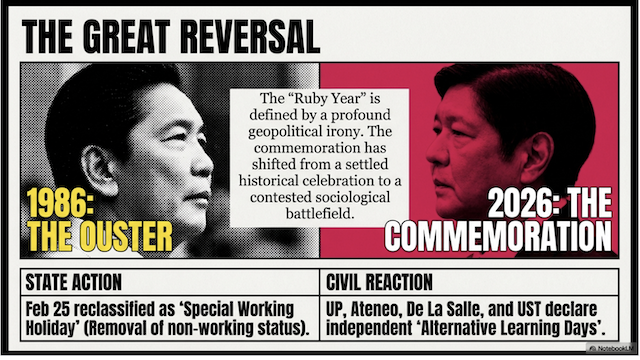
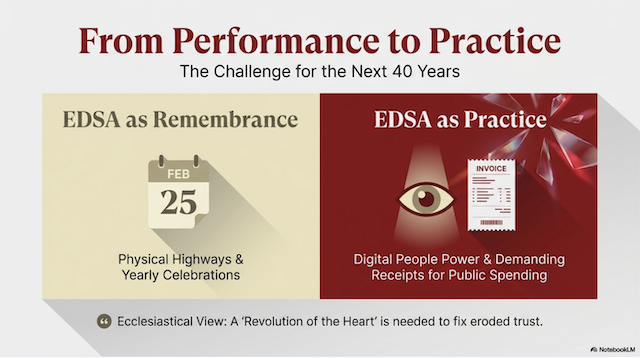
The reclassification of February 25 as a “special working holiday” instead of a regular non-working one didn’t happen with fanfare. It was quiet, administrative, and easy to miss. Human rights groups and student organizations named it anyway: this is what erasure looks like when it wears a bureaucratic face. The palace responded that history wouldn’t be erased. Fine. But history was never stored in palace statements. It lives in what teachers are allowed to say, in what streets are allowed to remember, in what one generation decides is worth handing to the next.
UP, Ateneo, De La Salle, UST — they didn’t wait to be told what to do. They declared their own holidays. Some will call that symbolic. I think symbols are doing a lot of work right now.
The numbers we need to sit with
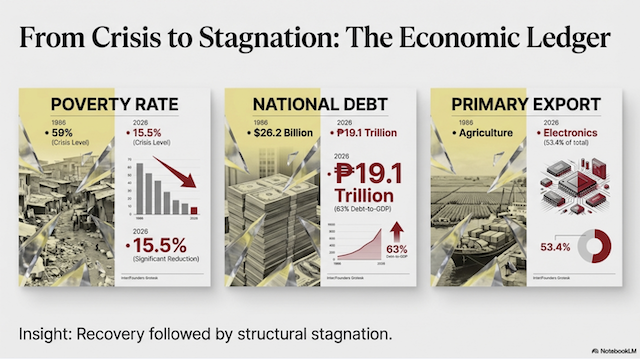
I want to be fair about this. Poverty did come down. From 59 percent in 1986 to 15.5 percent by 2023 is not a small thing, and I’m not going to pretend otherwise. But the national debt has crossed ?19 trillion, and an estimated ?8.8 trillion disappeared into graft and elite capture in the last decade alone. Ten years. That figure is larger than the entire 2026 national budget. What it produces on the ground is a 165,000-classroom shortage and 44.1 percent of Filipinos who are still, in 2026, not consistently sure about their next meal.
The 2022 Asian Barometer Survey asked Filipinos to choose between political freedom and economic equality. Sixty-seven percent chose the economy. Commentators reach for the word apathy. I don’t think that’s honest. What you’re actually looking at is the accumulated frustration of people who spent four decades watching democratic institutions mostly work for the same families while everyone else stayed put. That’s not indifference to freedom. That’s people who did the math and got a result nobody wanted to see.
Archbishop Gilbert Garcera put it in plain language at the National Shrine of Mary Queen of Peace this year: we are treating freedom like a memory instead of a living obligation, and the spirit of EDSA is fading because of it. Cardinal Pablo Virgilio David, who was in the streets as a student activist during the dictatorship, keeps returning to what he calls the “underestimated greed” of post-1986 politicians who ran governance like a family inheritance. Constitutional framer Rene Sarmiento says it himself: the 1987 Constitution had loose threads. Forty years later there is still no anti-political dynasty law. We didn’t even get close.
What’s happening in the classrooms
This is the part I keep returning to. The marches matter, the protests matter, the accountability demands absolutely matter. But the longer battle is in textbooks and most of us aren’t watching it closely enough.
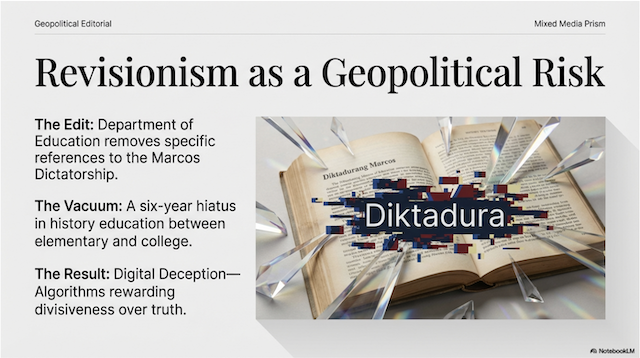
When the Alliance of Concerned Teachers raised the alarm about DepEd scrubbing “Diktadurang Marcos” from the curriculum and replacing it with the generic “Diktadura,” it didn’t get the outrage it deserved. No name. No family. Just a floating noun that could describe any government, anywhere, at any point in history. Critics call it a rehabilitation strategy. That’s exactly right.
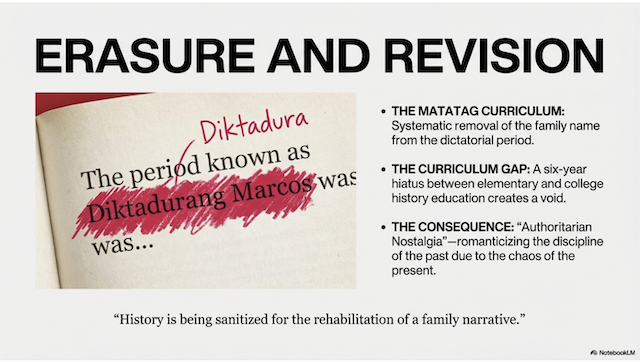
The timing makes it worse because there’s already a six-year gap in the formal curriculum where Philippine history simply isn’t taught — the stretch between grade school and college. Six years. What fills that gap isn’t a teacher with primary sources. It’s TikTok, YouTube, and the group chat. Manny Mogato, the Pulitzer-winning journalist who was a young reporter covering the revolution, says the selflessness he witnessed in 1986 has been replaced by what he simply calls “digital deception”, platforms built to keep people scrolling, which means built to reward the most inflammatory version of any story.
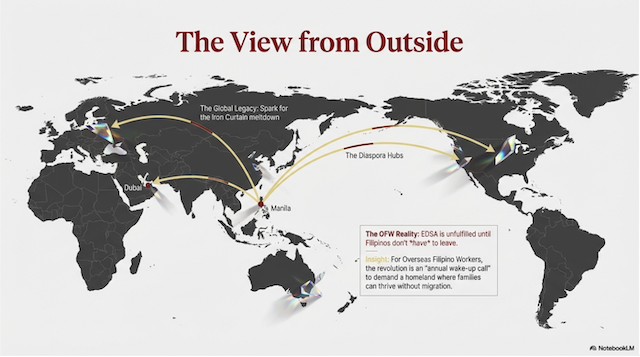
Rappler’s analysis this year makes the stakes clear: when collective memory fragments, so does accountability. And the real danger isn’t a generation that argues in defense of the dictatorship. It’s a generation that just doesn’t engage. That finds EDSA remote and irrelevant. That scrolls past it.
What we can actually do
The Trillion Peso March will have more than 30 youth formations into the streets on February 25. Not to remember. To demand. Political scientist Kiko Aquino Dee said something I’ve been thinking about since: history is only sad when all it does is look backward.
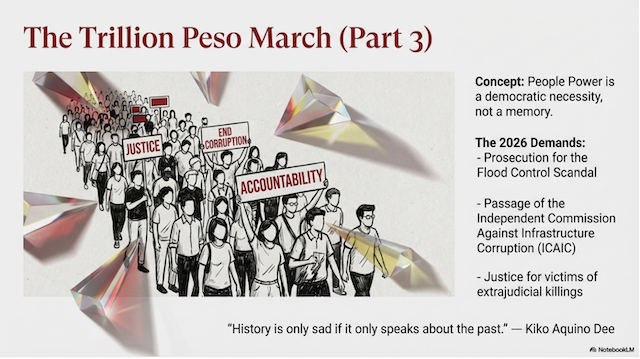
For those of us who weren’t marching, here is the work:
- Say the full name. Diktadurang Marcos. Not “that era” or “a difficult chapter in our history.” The name matters because the family is not generic. They are specific people with specific power, and they are still here.
- Get into the group chats. Posting on Twitter reaches people who already agree with you. The Viber thread with your tito, the old batchmate group where someone keeps sharing revisionist content — that’s the real battleground. Bring sources there. Have the uncomfortable conversation.
- Find the teachers in your life and ask them what they’re dealing with. The curriculum revision is being implemented right now, in actual classrooms, by real educators navigating real pressure. Support the ones holding the line.
- Look at the actual budget. The Makati Business Club and People’s Budget Coalition flagged 633 billion in the 2026 GAA sitting in line items they consider vulnerable to plunder. That is public money. Ask your representative what’s in there.
- Ask your senator directly about the ICAIC bill. The Independent Commission Against Infrastructure Corruption is a core demand of the march. It is not a complicated question. Where do you stand?
She’s forty now
The baby I carried through those February days in 1986 will soon be forty years old. She grew up inside the democracy we won back, inside institutions that were rebuilt from scratch. She also grew up inside the corruption we somehow normalized along the way, and I think about that more than I probably should. I feel sad that the hope I carried bore almost nothing.
Jaime Paglinawan, the labor organizer from Cebu who insists People Power didn’t begin on a highway but on factory picket lines, has called 1986 an “unfinished revolution” for as long as I’ve been paying attention. He’s right. The conditions that made the dictatorship possible — entrenched political families, workers with no leverage, powerful people facing no real consequences — those structures were never taken apart. We got the door open. Nobody cleaned what was behind it.
The CBCP has asked that this Ruby Anniversary be treated as an examination of conscience. Not a party, not a ceremony, not a nostalgic slideshow. An examination.
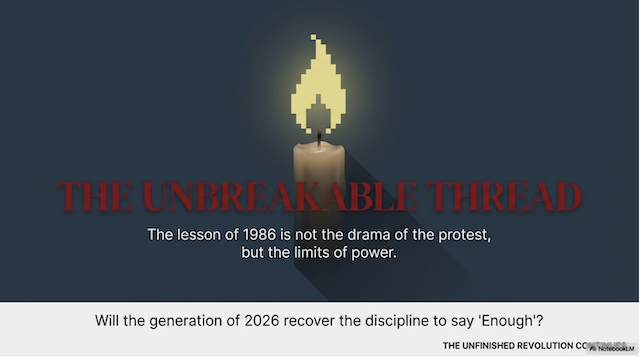
We didn’t fill that highway forty years ago so our children could inherit different names doing identical things.
How much more familiar does it have to get before we say: this is enough?
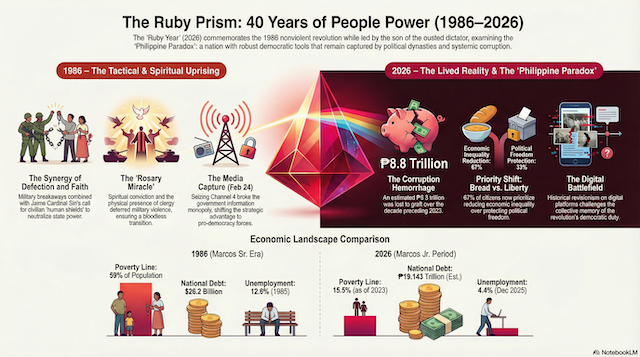
Images and infographics generated on NotebookLM from the sources of this post.
About The Author

Noemi Lardizabal-Dado
Noemi Lardizabal-Dado is a content strategist with over 19 years of experience in blogging, content management, citizen advocacy, and media literacy, and over 30 years in web development. Otherwise known as @MomBlogger on social media, she believes in making a difference in the lives of her children by advocating for social change that benefits the greater good.
She is a co-founder and a member of the editorial board of Blog Watch . She is a resource speaker on media literacy, social media, blogging, digital citizenship, good governance, transparency, parenting, women’s rights, wellness, and cyber safety.
Her personal blogs such as aboutmyrecovery.com (parenting) , pinoyfoodblog.com (recipes), techiegadgets.com (gadgets) and benguetarabica.coffee keep her busy outside of Blog Watch.
Disclosure:
I am an advocate. I am NOT neutral. I will NOT give social media mileage to members of political clans, epal, a previous candidate for the same position and those I believe are a waste of taxpayers' money.
I do not support or belong to any political party. I was part of accredited media covering the Office of the Vice President and Leni Robredo as she ran as a presidential aspirant in the 2022 National and local elections.
On August 5, 2021, YouTube announced that I was selected as one of 50 Program participants of its Creator Program for Independent Journalists
She was a Senior Consultant for ALL media engagements for the PCOO-led Committee on Media Affairs & Strategic Communications (CMASC) under the ASEAN 2017 National Organizing Council from January 4 -July 5, 2017. Having been an ASEAN advocate since 2011, she has written extensively about the benefits of the ASEAN community and as a region of opportunities on Blog Watch and aboutmyrecovery.com.
Organization affiliation includes Consortium on Democracy and Disinformation
Updated June 6, 2022
The promise we carried: Forty years after EDSA
I was eight months pregnant when People Power happened.
I wasn’t on EDSA. I was home, enormous and exhausted, listening to the radio with my husband while we tried to figure out if what was happening was actually happening. Every update felt like it could be the one that ended badly. We didn’t sleep much. We prayed — genuinely, desperately, the kind you only manage when you’ve run out of everything else to do. What I remember isn’t the jubilation people describe. It’s the moment the dread lifted. And what came flooding in after it was this strange, almost physical hope. Not for the country in the abstract. For our first baby. For whoever she was going to grow up to be in a place that had just, improbably, chosen something better.
She will be forty this year. And God help us, we are still asking the same questions.
The Ruby Year and what it’s actually asking us
Forty years is the Ruby anniversary. Some analysts have called this moment a reckoning — a chance to hold the country up to the light and see what four decades of democracy actually produced. And then you get to the part that’s hard to say without flinching: the person in Malacañang right now is Ferdinand “Bongbong” Marcos Jr. The son. His family was literally on the presidential palace the night the regime collapsed, and now he runs the country. Anyone standing on EDSA in 1986 would have found that scenario genuinely unthinkable. In 2026 we’ve somehow gotten used to it. I think that’s worth worrying about.
The reclassification of February 25 as a “special working holiday” instead of a regular non-working one didn’t happen with fanfare. It was quiet, administrative, and easy to miss. Human rights groups and student organizations named it anyway: this is what erasure looks like when it wears a bureaucratic face. The palace responded that history wouldn’t be erased. Fine. But history was never stored in palace statements. It lives in what teachers are allowed to say, in what streets are allowed to remember, in what one generation decides is worth handing to the next.
UP, Ateneo, De La Salle, UST — they didn’t wait to be told what to do. They declared their own holidays. Some will call that symbolic. I think symbols are doing a lot of work right now.
The numbers we need to sit with
I want to be fair about this. Poverty did come down. From 59 percent in 1986 to 15.5 percent by 2023 is not a small thing, and I’m not going to pretend otherwise. But the national debt has crossed ?19 trillion, and an estimated ?8.8 trillion disappeared into graft and elite capture in the last decade alone. Ten years. That figure is larger than the entire 2026 national budget. What it produces on the ground is a 165,000-classroom shortage and 44.1 percent of Filipinos who are still, in 2026, not consistently sure about their next meal.
The 2022 Asian Barometer Survey asked Filipinos to choose between political freedom and economic equality. Sixty-seven percent chose the economy. Commentators reach for the word apathy. I don’t think that’s honest. What you’re actually looking at is the accumulated frustration of people who spent four decades watching democratic institutions mostly work for the same families while everyone else stayed put. That’s not indifference to freedom. That’s people who did the math and got a result nobody wanted to see.
Archbishop Gilbert Garcera put it in plain language at the National Shrine of Mary Queen of Peace this year: we are treating freedom like a memory instead of a living obligation, and the spirit of EDSA is fading because of it. Cardinal Pablo Virgilio David, who was in the streets as a student activist during the dictatorship, keeps returning to what he calls the “underestimated greed” of post-1986 politicians who ran governance like a family inheritance. Constitutional framer Rene Sarmiento says it himself: the 1987 Constitution had loose threads. Forty years later there is still no anti-political dynasty law. We didn’t even get close.
What’s happening in the classrooms
This is the part I keep returning to. The marches matter, the protests matter, the accountability demands absolutely matter. But the longer battle is in textbooks and most of us aren’t watching it closely enough.
When the Alliance of Concerned Teachers raised the alarm about DepEd scrubbing “Diktadurang Marcos” from the curriculum and replacing it with the generic “Diktadura,” it didn’t get the outrage it deserved. No name. No family. Just a floating noun that could describe any government, anywhere, at any point in history. Critics call it a rehabilitation strategy. That’s exactly right.
The timing makes it worse because there’s already a six-year gap in the formal curriculum where Philippine history simply isn’t taught — the stretch between grade school and college. Six years. What fills that gap isn’t a teacher with primary sources. It’s TikTok, YouTube, and the group chat. Manny Mogato, the Pulitzer-winning journalist who was a young reporter covering the revolution, says the selflessness he witnessed in 1986 has been replaced by what he simply calls “digital deception”, platforms built to keep people scrolling, which means built to reward the most inflammatory version of any story.
Rappler’s analysis this year makes the stakes clear: when collective memory fragments, so does accountability. And the real danger isn’t a generation that argues in defense of the dictatorship. It’s a generation that just doesn’t engage. That finds EDSA remote and irrelevant. That scrolls past it.
What we can actually do
The Trillion Peso March will have more than 30 youth formations into the streets on February 25. Not to remember. To demand. Political scientist Kiko Aquino Dee said something I’ve been thinking about since: history is only sad when all it does is look backward.
For those of us who weren’t marching, here is the work:
She’s forty now
The baby I carried through those February days in 1986 will soon be forty years old. She grew up inside the democracy we won back, inside institutions that were rebuilt from scratch. She also grew up inside the corruption we somehow normalized along the way, and I think about that more than I probably should. I feel sad that the hope I carried bore almost nothing.
Jaime Paglinawan, the labor organizer from Cebu who insists People Power didn’t begin on a highway but on factory picket lines, has called 1986 an “unfinished revolution” for as long as I’ve been paying attention. He’s right. The conditions that made the dictatorship possible — entrenched political families, workers with no leverage, powerful people facing no real consequences — those structures were never taken apart. We got the door open. Nobody cleaned what was behind it.
The CBCP has asked that this Ruby Anniversary be treated as an examination of conscience. Not a party, not a ceremony, not a nostalgic slideshow. An examination.
We didn’t fill that highway forty years ago so our children could inherit different names doing identical things.
How much more familiar does it have to get before we say: this is enough?
Images and infographics generated on NotebookLM from the sources of this post.
Related Posts
And the OWS?car Goes to … People and Events that Raise Your BrOWS
Senators as Judges – The importance of voting properly #CJtrialWatch
Credit Card: To use or not
About The Author
Noemi Lardizabal-Dado
Noemi Lardizabal-Dado is a content strategist with over 19 years of experience in blogging, content management, citizen advocacy, and media literacy, and over 30 years in web development. Otherwise known as @MomBlogger on social media, she believes in making a difference in the lives of her children by advocating for social change that benefits the greater good. She is a co-founder and a member of the editorial board of Blog Watch . She is a resource speaker on media literacy, social media, blogging, digital citizenship, good governance, transparency, parenting, women’s rights, wellness, and cyber safety. Her personal blogs such as aboutmyrecovery.com (parenting) , pinoyfoodblog.com (recipes), techiegadgets.com (gadgets) and benguetarabica.coffee keep her busy outside of Blog Watch. Disclosure: I am an advocate. I am NOT neutral. I will NOT give social media mileage to members of political clans, epal, a previous candidate for the same position and those I believe are a waste of taxpayers' money. I do not support or belong to any political party. I was part of accredited media covering the Office of the Vice President and Leni Robredo as she ran as a presidential aspirant in the 2022 National and local elections. On August 5, 2021, YouTube announced that I was selected as one of 50 Program participants of its Creator Program for Independent Journalists She was a Senior Consultant for ALL media engagements for the PCOO-led Committee on Media Affairs & Strategic Communications (CMASC) under the ASEAN 2017 National Organizing Council from January 4 -July 5, 2017. Having been an ASEAN advocate since 2011, she has written extensively about the benefits of the ASEAN community and as a region of opportunities on Blog Watch and aboutmyrecovery.com. Organization affiliation includes Consortium on Democracy and Disinformation Updated June 6, 2022