
Day 7 impeachment trial of Sara Duterte: The subpoena finally came through
July 20, 2026

Francis “Chiz” Escudero remembered something on the sixth day of Vice President Sara Duterte’s impeachment trial. Weighing whether the Senate could compel a sitting VP to open her bank records, he told his fellow senator-judges: “We have a precedent that I think, if I remember correctly, involves the good gentleman himself.” He meant Renato Corona. In 2012, the Senate subpoenaed the former chief justice’s financial records over his objections, and it became one of the reasons he was removed from the bench.
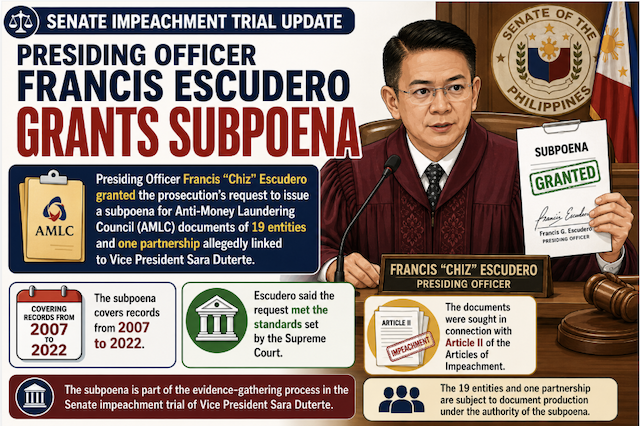
Fourteen years later, the same body reached for the same tool. On Monday, July 20, the seventh day of Duterte’s trial, the Senate impeachment court granted the House prosecution panel’s request to subpoena the bank, tax, and Anti-Money Laundering Council records of the Vice President and her husband, Atty. Manases “Mans” Carpio.
What the vote required
The threshold was a simple majority of senators present, 50 percent plus one. With 21 senators in attendance, that meant 11 votes to approve. The request itself was not new. Prosecutors first asked for it on Day 6, July 15, and the court spent more than an hour in a closed-door caucus without ruling, with Escudero saying senator-judges needed more time because “not everyone has actually completed reading the memoranda submitted by the parties.” The ruling was pushed to Monday. It came through.
What the record says

The documents at stake include the so-called “BIR box,” a sealed container of income tax returns for Duterte, Carpio, and their businesses that has been sitting in Senate custody since the trial’s opening day, July 6. Escudero had ordered it returned to the Bureau of Internal Revenue, still sealed, because the court had no lawful order compelling its release. Monday’s ruling changes that.
House prosecutor Rep. Chel Diokno argued the records were not a fishing expedition, pointing to AMLC figures already surfaced during House hearings: Duterte’s financial activity from 2007 to 2013, her years as Davao City vice mayor and then mayor, topped ?3.02 billion, with a single-year peak of ?704.93 million in 2009. Diokno also cited a broader AMLC tally of roughly ?6.7 billion in flagged transactions tied to the couple over a longer stretch of years. He argued that impeachment proceedings are explicitly exempted from bank secrecy protections under Republic Act 1405, and that the confidentiality provisions in anti-money laundering law exist to protect ongoing investigations, not to block a constitutionally created impeachment court from doing its job.
Defense counsel Michael Poa pushed back with the same word prosecutors keep having to answer to: fishing expedition. “When a subpoena becomes oppressive, unreasonable, and merely issued for the very purpose that is a hope that somewhere, somehow, something incriminating will come out, it ceases to be an instrument of justice,” he told the court. He also argued the House filed its impeachment complaint before it had the financial documents to back it up, calling that a due process problem.
Five things Day 7 actually settled

- The subpoena is granted. The court ruled the financial records “prima facie relevant” to the unexplained wealth allegations under Article II of the Articles of Impeachment, over the defense’s objections.
- Padilla and Tulfo clashed over what the trial is for. Senator-judge Robin Padilla used part of the session to deny an Ombudsman finding that he’d ignored a summons tied to Sen. Ronald “Bato” dela Rosa’s escape from Senate premises. Senator-judge Erwin Tulfo pushed back, saying time spent on senators’ personal legal troubles was “an injustice to the Vice President.” Escudero kept Padilla’s statement on the record but referred the underlying issue to the Senate acting in its regular legislative capacity, not the impeachment court.
- Escudero drew a line around the trial’s focus. By separating personal senator matters from the evidentiary record, the presiding officer signaled the court would not let collateral political disputes eat into trial time going forward.

- The “fishing expedition” argument got its full airing. Senator-judge Pia Cayetano’s questions sparked an hour of debate over where a legitimate evidentiary request ends and an unconstitutional dragnet begins, with Diokno’s pre-existing AMLC figures ultimately carrying the argument.
- Escudero’s own memory did some of the legal work. His invocation of the Corona precedent, a sitting Senate compelling disclosure from a sitting official, gave the ruling a direct institutional lineage rather than treating it as a novel expansion of power.
What’s still unresolved
The prosecution and defense have not settled how the “BIR box” itself gets inventoried, whether in a public, supervised process or strictly behind closed doors, and neither side has laid out exactly how far back the subpoenaed records go or what use records predating Duterte’s national office can be put to. Those questions weren’t fully resolved by Monday’s vote and are still developing.
Ready for what comes next
NBI Director Melvin Matibag was scheduled to testify Tuesday on the cybercrime investigation into threats against the Marcos family, the last scheduled witness on Article IV. With the financial subpoena now granted, the trial’s center of gravity shifts toward Article II, unexplained wealth, and the documents that are supposed to prove or disprove it.
Duterte has said her record is clean, that every peso she owns has a paper trail. Her legal team spent two hearings arguing the Senate shouldn’t be allowed to check.


Fourteen out of twenty: What Day 29 changed in the Sara Duterte Impeachment trial

Day 23 Sara Duterte Impeachment Trial : The trial turns to Sara Duterte

Day 13 of the Sara Duterte impeachment trial: 849 acknowledgment receipts, no official receipts
About The Author

Noemi Lardizabal-Dado
Noemi Lardizabal-Dado is a content strategist with over 19 years of experience in blogging, content management, citizen advocacy, and media literacy, and over 30 years in web development. Otherwise known as @MomBlogger on social media, she believes in making a difference in the lives of her children by advocating for social change that benefits the greater good. She is a co-founder and a member of the editorial board of Blog Watch . She is a resource speaker on media literacy, social media, blogging, digital citizenship, good governance, transparency, parenting, women’s rights, wellness, and cyber safety. Her personal blogs such as aboutmyrecovery.com (parenting) , pinoyfoodblog.com (recipes), techiegadgets.com (gadgets) and benguetarabica.coffee keep her busy outside of Blog Watch. Disclosure: I am an advocate. I am NOT neutral. I will NOT give social media mileage to members of political clans, epal, a previous candidate for the same position and those I believe are a waste of taxpayers' money. I do not support or belong to any political party. I was part of accredited media covering the Office of the Vice President and Leni Robredo as she ran as a presidential aspirant in the 2022 National and local elections. On August 5, 2021, YouTube announced that I was selected as one of 50 Program participants of its Creator Program for Independent Journalists She was a Senior Consultant for ALL media engagements for the PCOO-led Committee on Media Affairs & Strategic Communications (CMASC) under the ASEAN 2017 National Organizing Council from January 4 -July 5, 2017. Having been an ASEAN advocate since 2011, she has written extensively about the benefits of the ASEAN community and as a region of opportunities on Blog Watch and aboutmyrecovery.com. Organization affiliation includes Consortium on Democracy and Disinformation Updated June 6, 2022