Day 8 of the Sara Duterte impeachment trial: The bombshell that wasn’t
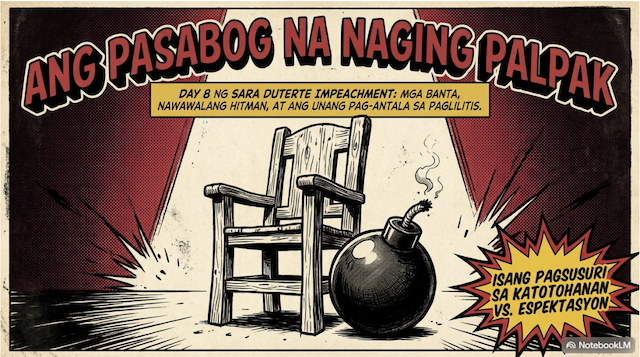
The House prosecution spent the day before promising a payoff. Its legal spokesperson told reporters that National Bureau of Investigation Director Melvin Matibag would bring important new information, and said, “You wouldn’t want to miss his testimony.” By the time the eighth day of Vice President Sara Duterte’s impeachment trial ended on July 21, the witness had not named the assassin the prosecution had teased, and the grave-threats charge sat unfinished.

Article IV covers grave threats and inciting to sedition. It stems from a November 2024 online press conference where Duterte said she had hired someone to kill President Ferdinand Marcos Jr., First Lady Liza Araneta-Marcos and former House Speaker Martin Romualdez if she herself were killed. Matibag was the prosecution’s last scheduled witness on the charge, after the panel dropped eight others to save time. Day 8 was supposed to close the grave-threats phase, but it ran long and stayed open.
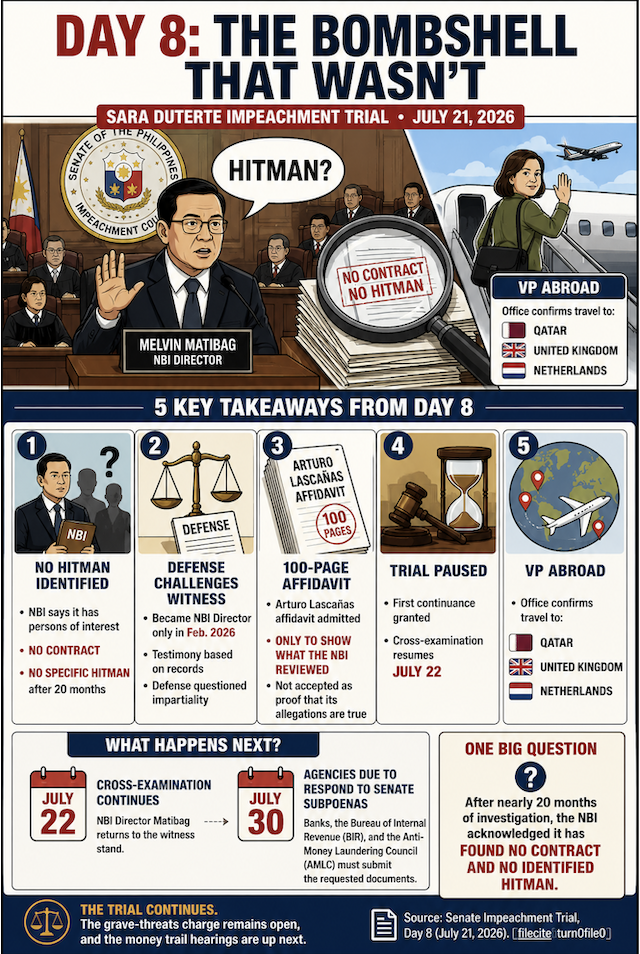
Five highlights of Day 8
- Matibag recast Duterte’s statements as a national security matter, arguing her words crossed from warning into intent, and applied a five-part test the NBI drew from US Secret Service protective-intelligence work.
- The promised reveal fell short. Matibag confirmed the NBI has persons of interest but would not name them, then admitted that after a year and eight months it has found no actual contract and no specific hitman.
- The defense turned the day into a fight over the witness’s credibility, drawing out that Matibag became NBI director only in February 2026, that his wife endorsed the impeachment resolution, and that he wrote columns criticizing Duterte in 2024.
- A surprise 100-page affidavit by former Davao Death Squad member Arturo Lascañas was admitted only to show what the NBI reviewed, “not as to the truth of the allegations,” and it forced the trial’s first continuance.
- Duterte skipped the proceedings entirely, with her office confirming she had flown out for a trip to Qatar, the United Kingdom and the Netherlands.
What the NBI argued
On direct examination, Matibag recast Duterte’s statements as a security problem rather than loose talk. He said her words had crossed from warning into intent, which for the bureau turned the matter into a national security issue. To assess the danger, he described a five-part method the NBI drew from US Secret Service protective-intelligence work, weighing pattern of violence, gravity, identity, capacity and motive.

What the NBI could not show
The prosecution had signaled a reveal. Matibag confirmed the NBI has identified persons of interest who could lead to whoever Duterte allegedly spoke with, but he would not name them, calling the inquiry open and continuing. Then, under questioning from Senate President Sherwin Gatchalian, Matibag acknowledged that after a year and eight months, the NBI had not found an actual contract or a specific hitman. The promised name never came, and the security framing was left resting on the bureau’s evaluation rather than a conspirator in hand.
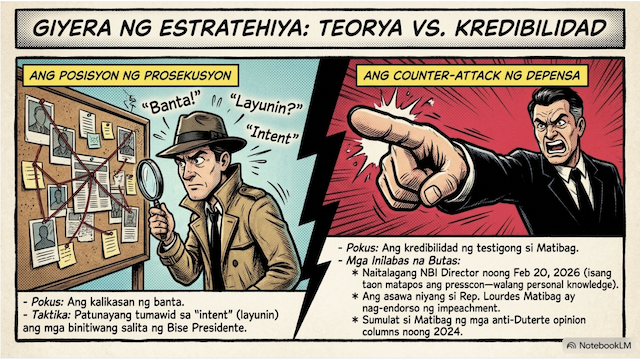
The defense went at the witness instead of the theory. Lead counsel Mark Vinluan drew out that Matibag became NBI director only on February 20, 2026, more than a year after the press conference, so his account came from official records and a February affidavit rather than personal knowledge. Vinluan also confirmed that Matibag’s wife, Rep. Lourdes Matibag, was among the endorsers of the impeachment resolution, and showed the court opinion columns Matibag wrote in 2024 criticizing Duterte.
The Lascañas affidavit, and the pause it forced
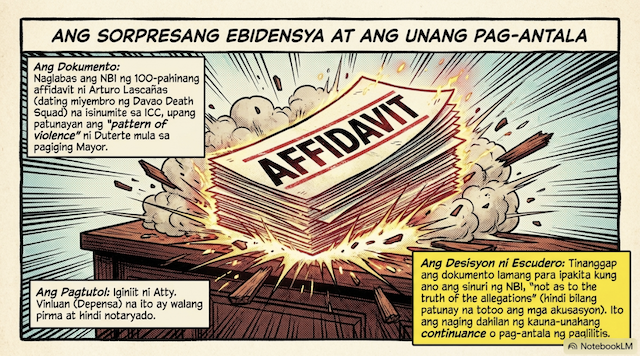
The longest argument of the day was over a roughly 100-page affidavit by Arturo Lascañas, a self-confessed member of the Davao Death Squad, which the NBI had reviewed as part of its pattern-of-violence assessment. The document, submitted to the International Criminal Court, names Duterte over killings during her years as Davao City mayor. Vinluan objected that the copy shown was unsigned and never notarized. Escudero let prosecutors present it, but only to show what the bureau had examined, “not as to the truth of the allegations,” and he repeated that limit as Matibag read passages aloud. The surprise introduction of the affidavit is what led the defense to ask for a pause, and Escudero granted the trial’s first continuance, moving the cross-examination to the next day.
Around the courtroom

Two other shifts stood out. Escudero told senator-judges to hold their questions until after each witness’s cross-examination and redirect, a change from the earlier days when senators broke in freely. And the clash many expected between Matibag and Senator-Judge Alan Peter Cayetano, who had earlier called him “the Minion” amid a dispute tied to an NBI probe into the 2019 Southeast Asian Games, did not happen.
Duterte followed none of this from Manila. Her office confirmed she had left for an overseas trip with stops in Qatar, the United Kingdom and the Netherlands, saying the travel mixed official and personal engagements and that “No government funds will be used by the Vice President” for the trip.
The prosecution asked the public to wait for a name on Day 8. What it produced was an admission that, twenty months in, there is no contract and no hitman to point to, and a charge that now spills into another hearing. Both deadlines ahead are close and dated. Matibag returns for cross-examination when the trial resumes on July 22, with the grave-threats record still open. Then the trial turns to the money, where the court’s July 20 ruling opened the peso accounts and tax records of Duterte and her husband but kept dollar deposits off-limits under the Foreign Currency Deposit Act and put the AMLC reports under the presiding officer’s private review. The banks, the Bureau of Internal Revenue and the Anti-Money Laundering Council are due to answer the court on July 30. Those returns will show whether the case rests on documents the prosecution can produce, or on reveals it keeps promising.



Day 12 of the Sara Duterte impeachment trial: What the audit papers showed, and what they did not

Day 22 Sara Duterte impeachment trial: When the confidential-fund names met the PSA

Day 27: What SEC records revealed about Sara Duterte’s business roles
About The Author

Noemi Lardizabal-Dado
Noemi Lardizabal-Dado is a content strategist with over 19 years of experience in blogging, content management, citizen advocacy, and media literacy, and over 30 years in web development. Otherwise known as @MomBlogger on social media, she believes in making a difference in the lives of her children by advocating for social change that benefits the greater good. She is a co-founder and a member of the editorial board of Blog Watch . She is a resource speaker on media literacy, social media, blogging, digital citizenship, good governance, transparency, parenting, women’s rights, wellness, and cyber safety. Her personal blogs such as aboutmyrecovery.com (parenting) , pinoyfoodblog.com (recipes), techiegadgets.com (gadgets) and benguetarabica.coffee keep her busy outside of Blog Watch. Disclosure: I am an advocate. I am NOT neutral. I will NOT give social media mileage to members of political clans, epal, a previous candidate for the same position and those I believe are a waste of taxpayers' money. I do not support or belong to any political party. I was part of accredited media covering the Office of the Vice President and Leni Robredo as she ran as a presidential aspirant in the 2022 National and local elections. On August 5, 2021, YouTube announced that I was selected as one of 50 Program participants of its Creator Program for Independent Journalists She was a Senior Consultant for ALL media engagements for the PCOO-led Committee on Media Affairs & Strategic Communications (CMASC) under the ASEAN 2017 National Organizing Council from January 4 -July 5, 2017. Having been an ASEAN advocate since 2011, she has written extensively about the benefits of the ASEAN community and as a region of opportunities on Blog Watch and aboutmyrecovery.com. Organization affiliation includes Consortium on Democracy and Disinformation Updated June 6, 2022