Duterte Impeachment Day 6: Whose secrets outrank the truth?

“The truth is not confidential.”
Rep. Chel Diokno said that to the Senate impeachment court on Wednesday, July 15, the sixth day of Vice President Sara Duterte’s trial. No witness took the stand that day. Instead, the session turned into a straight legal fight over whether senator-judges can force open the Vice President’s bank accounts, tax records, and anti-money laundering reports.
We have been here before, in smaller form, since the trial opened on July 6. The “BIR Box,” a sealed container holding the tax records of Duterte and her husband, lawyer Manases “Mans” Carpio, went back to the Bureau of Internal Revenue on the trial’s first day because the court had not yet ruled the documents admissible. Day 6 was the prosecution’s attempt to get those records back, this time through a formal subpoena covering banks, the BIR, and the Anti-Money Laundering Council.

The stakes trace to Article II of the impeachment complaint, which accuses Duterte of amassing wealth she cannot explain and misrepresenting her assets in her Statement of Assets, Liabilities and Net Worth. Without the financial paper trail, the prosecution has no way to test that charge. The defense argues that opening the records without limits turns the court into a fishing expedition against a sitting official.
What the record says
House prosecutor Diokno told the court that the Constitution gives the Senate sole power to try impeachment cases, and that no statute can narrow that power once the Senate sits as an impeachment court. He pointed to the Law on Secrecy of Bank Deposits, which lists impeachment cases as an express exception to bank confidentiality. He also cited the 2022 Supreme Court ruling in Republic v. Rabusa, which allowed examination of bank accounts in unexplained wealth cases, and the 2012 Corona trial, where the Senate subpoenaed records that predated Renato Corona’s appointment as chief justice.

Diokno backed the argument with numbers. Reading from a pre-marked AMLC report, he told the court that Duterte’s financial transactions stood at roughly ?28.15 million when she became Davao City vice mayor in 2007. By 2009 her transactions had surged to more than ?704 million in a single year. Cumulative transactions from 2007 to 2013, across her terms as vice mayor and mayor, exceeded ?3.02 billion, a figure Diokno called disproportionate to her government salary at the time.
Defense counsel Michael Poa did not dispute that the court holds subpoena power. He argued instead that exercising it here skips due process. Poa cited the Supreme Court’s 2025 ruling in Duterte v. House of Representatives, which held that impeachable conduct must relate to acts committed while the official held an impeachable office. Records from 2007, when Duterte was a local official, fall outside that window, he argued. He also objected to reaching into the finances of Carpio, who holds no public office and is, in Poa’s words, not an impeachable officer.

Both sides got 15 minutes to argue their position and 10 minutes to rebut, an extension senator-judges approved after Alan Peter Cayetano moved for more time. After the arguments, senator-judges went into a caucus. As of this writing, they have not ruled.
An institutional clash that had nothing to do with subpoenas
Before the legal arguments even began, three senator-judges used the floor to confront someone who was not in the room. On July 14, NBI Director Melvin Matibag announced that his agency had opened a task force to investigate roughly ?10 billion in alleged funding irregularities tied to the 2019 SEA Games sports complex in New Clark City. Matibag is due to testify before the impeachment court on July 20. Alan Peter Cayetano chaired the SEA Games organizing committee in 2019.
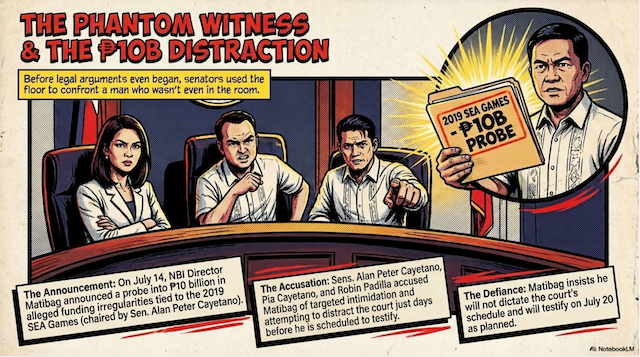
Pia Cayetano asked why a witness scheduled to testify the following week would publicly announce an investigation into a project connected to a sitting senator-judge. She called the timing an attempt to distract and pressure the court. Alan Peter Cayetano told Matibag directly that the NBI had not broken the Senate before and would not do so now, and maintained that the SEA Games infrastructure was funded privately, not through public money. Robin Padilla asked whether the probe was coincidence or a targeted move, noting that two senators, Jinggoy Estrada and Rodante Marcoleta, already face separate criminal cases while the trial is underway. Matibag has said he is not dictating the court’s schedule and intends to testify on July 20 as planned.
No witnesses, in two rounds
The prosecution trimmed its Article IV witness list twice in two days. On July 14, Day 5, it dropped Atty. Zuleika Lopez and Capt. Belinda Bello, saying their testimony had become redundant once the defense acknowledged the November 2024 press conference took place. On July 15, Day 6 itself, lead prosecutor Gerville Luistro withdrew six more: a representative of the PNP Firearms and Explosives Office, Reuters correspondent Mikhail Flores, former Rappler reporter Bonz Magsambol, Sheriff Abe Andres (the Davao City sheriff Duterte punched during a 2011 demolition dispute), a family member of an alleged threat victim, and a psychiatrist who was to testify on Duterte’s state of mind. That leaves NBI Director Melvin Matibag as the last scheduled witness for Article IV, set to testify July 20, the same day senator-judges are expected to rule on the subpoena question.

What else changed heading into Day 6
- Senate President Sherwin Gatchalian, reacting to the Day 5 withdrawals, did the math out loud: 57 prosecution witnesses plus 45 defense witnesses total 102, and at the pace of about two trial days per witness, the trial could run 17 months.
- NBI testimony from July 14 undercut the defense’s “Oplan Romanov” narrative. NBI-Bangsamoro Regional Director Jeremy Lotoc testified the term traces to a rally speech by Duterte’s brother, Davao City Mayor Sebastian “Baste” Duterte, not to any verified security threat, and that the NBI’s inquiry into it stalled because Duterte’s camp would not cooperate.
- The prosecution moves next to Article I, the P612.5-million confidential funds charge. Its first witnesses on that article, expected next week, are House legislative archivist Marivic Pareja and former Land Bank branch managers Violeta Constantino and Nenita Camposano.

Five highlights from Day 6
- The subpoena showdown: Diokno and Poa argued whether the court can compel disclosure of Duterte’s bank, tax, and AMLC records for Article II.
- The ?3.02-billion disclosure: AMLC figures placed her 2007–2013 financial transactions far above her declared government income.
- The Matibag-Cayetano clash: three senator-judges accused the NBI director of trying to intimidate the court days before his own scheduled testimony.
- No witnesses, by design: Article IV lost eight names in two days — Lopez and Bello on Day 5, six more on Day 6 — leaving Matibag as the prosecution’s last witness on that charge.
- The caucus and the countdown: senator-judges recessed without ruling; a decision is expected around July 20, the same day Matibag testifies.
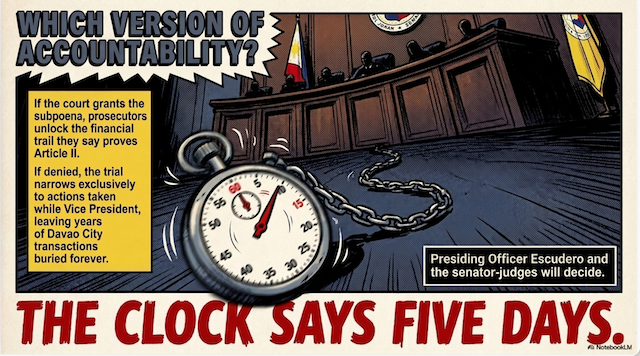
Senator-judges are set to rule on the subpoena question around July 20, the same day Matibag is scheduled to take the stand under the cloud he created for himself. If the court grants the subpoena, prosecutors get the financial trail they say proves Article II. If it denies the request, the trial narrows to what Duterte did as Vice President alone, and years of Davao City transactions stay sealed. Escudero and the senator-judges will decide which version of accountability this country gets. The clock says five days.
Day 4 of the Duterte Impeachment Trial: The Paperwork Cracks, the Assassin Still Missing

Day 13 of the Sara Duterte impeachment trial: 849 acknowledgment receipts, no official receipts

Day 24 Sara Duterte Impeachment Trial: The trial paused, the financial records moved forward
About The Author

Noemi Lardizabal-Dado
Noemi Lardizabal-Dado is a content strategist with over 19 years of experience in blogging, content management, citizen advocacy, and media literacy, and over 30 years in web development. Otherwise known as @MomBlogger on social media, she believes in making a difference in the lives of her children by advocating for social change that benefits the greater good. She is a co-founder and a member of the editorial board of Blog Watch . She is a resource speaker on media literacy, social media, blogging, digital citizenship, good governance, transparency, parenting, women’s rights, wellness, and cyber safety. Her personal blogs such as aboutmyrecovery.com (parenting) , pinoyfoodblog.com (recipes), techiegadgets.com (gadgets) and benguetarabica.coffee keep her busy outside of Blog Watch. Disclosure: I am an advocate. I am NOT neutral. I will NOT give social media mileage to members of political clans, epal, a previous candidate for the same position and those I believe are a waste of taxpayers' money. I do not support or belong to any political party. I was part of accredited media covering the Office of the Vice President and Leni Robredo as she ran as a presidential aspirant in the 2022 National and local elections. On August 5, 2021, YouTube announced that I was selected as one of 50 Program participants of its Creator Program for Independent Journalists She was a Senior Consultant for ALL media engagements for the PCOO-led Committee on Media Affairs & Strategic Communications (CMASC) under the ASEAN 2017 National Organizing Council from January 4 -July 5, 2017. Having been an ASEAN advocate since 2011, she has written extensively about the benefits of the ASEAN community and as a region of opportunities on Blog Watch and aboutmyrecovery.com. Organization affiliation includes Consortium on Democracy and Disinformation Updated June 6, 2022