
Day 31 Sara Duterte Impeachment trial : Baste Duterte takes the stand as GenCorp ties come under scrutiny
“I would not allow it.”
That was Davao City Mayor Sebastian “Baste” Duterte’s answer when Senate impeachment court presiding officer Francis “Chiz” Escudero asked whether he would have allowed the Davao City government to transact with GenCorp Industries Inc. had he known that his sister, Vice President Sara Duterte, had declared an interest in the company.
That exchange captured the central issue on Day 31 of the impeachment trial on September 29: what did the Davao City government know about GenCorp, and how close can prosecutors connect its contracts to the Vice President?

The trial is now hearing Article II, which covers allegations of unexplained wealth, inaccurate or incomplete Statements of Assets, Liabilities and Net Worth (SALNs), and failure to divest from business interests.
Day 31 put the Vice President’s brother on the witness stand. But his testimony also showed the distinction the prosecution still has to establish. Evidence about GenCorp’s dealings with Davao City does not by itself prove wrongdoing by Sara Duterte.
Here are five highlights.
1. Baste Duterte was declared a hostile witness
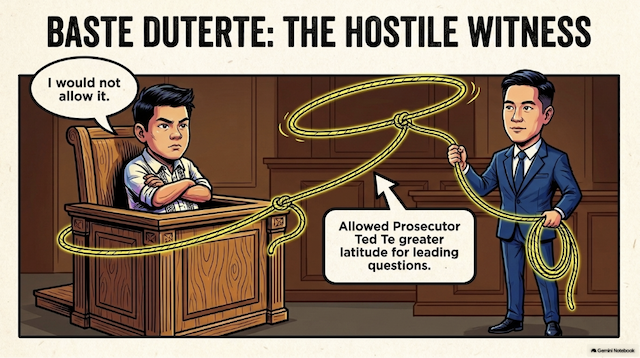
Mayor Duterte appeared pursuant to a subpoena directing him to testify and produce Davao City records involving GenCorp and other companies. The impeachment court declared him a hostile witness, allowing prosecutor Theodore “Ted” Te to use leading questions. Sara Duterte Trial Day 31 MindaNews independently reported that Duterte took his oath at 10:11 a.m. and was declared a hostile witness.
The designation does not mean the court found him dishonest. In this context, it allowed the prosecution greater latitude in questioning a witness considered to have an adverse interest.
That distinction matters. Duterte is the respondent’s brother and was being questioned about transactions undertaken by the city government he heads.
2. Nineteen GenCorp contracts became the focus

Davao City had 19 contracts with GenCorp worth about P33.26 million, according to Mayor Duterte’s own accounting. He had previously said that four were secured through competitive public bidding and 15 through small-value procurement.
There is an important correction to the research here.
The research says that all 15 small-value procurement contracts “dispensed with competitive public bidding.” Sara Duterte Trial Day 31 But reporting on the previous day’s testimony by PhilGEPS division chief Rendell Sopeña said 11 of the 15 contracts were negotiated small-value procurements without public bidding, accounting for roughly P7 million to P8 million.
For that reason, I would not describe all 15 as contracts “without bidding.”
The larger issue remains relevant to Article II because Sara Duterte declared GenCorp as a business interest in her SALNs. GMA reported that GenCorp’s SEC filings did not list her as an incorporator or director, even though her SALN declared the company as a business interest.
That mismatch is one of the questions prosecutors are trying to explain.
3. Baste said he did not know about Sara’s GenCorp interest
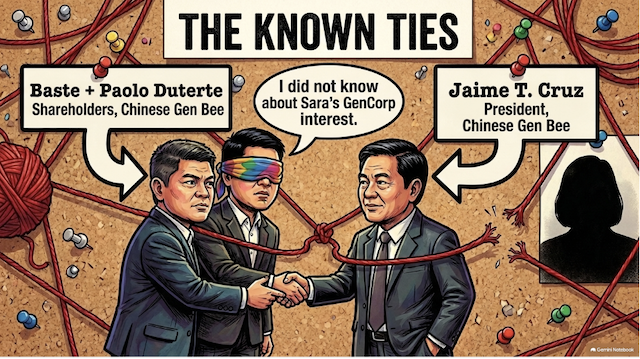
Mayor Duterte maintained that he did not know his sister had declared an interest in GenCorp. He had already made the same assertion publicly before taking the stand.
According to the research, he told the impeachment court that members of the Duterte family generally kept their finances private. Sara Duterte Trial Day 31
The prosecution then turned to businessman Jaime T. Cruz.
Mayor Duterte acknowledged knowing Cruz and confirmed that they were business partners. A 2026 General Information Sheet for Chinese Gen Bee Foods Corporation listed Cruz as president and Baste Duterte and Paolo Duterte as shareholders, according to documents presented during the hearing. Sara Duterte Trial Day 31
GMA’s coverage of the hearing likewise reported Duterte’s acknowledgment that he knew Cruz, whom he described as a friend of his father.
This does not establish that Mayor Duterte knew about Sara Duterte’s interest in GenCorp. What it does establish is another documented business connection that prosecutors can examine as they try to trace the relationships surrounding the company.
4. “The buck stops” with the mayor, but that does not settle Sara Duterte’s liability
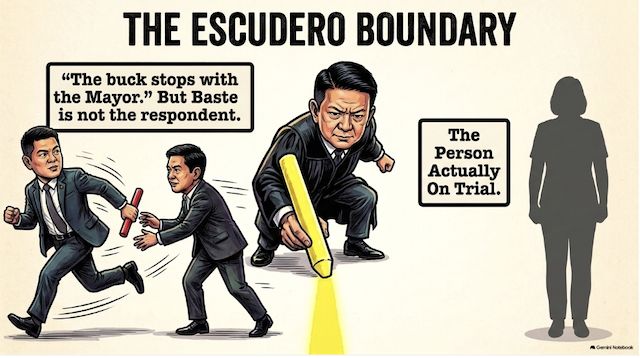
Mayor Duterte testified that he had authorized Davao City Assistant City Administrator Tristan Dwight Domingo to sign procurement documents on his behalf. According to the research, he said he did not personally examine every contract, but acknowledged that responsibility ultimately remained with him as head of the procuring entity. Sara Duterte Trial Day 31
That prompted questions from senator-judges about how much a mayor can reasonably be expected to know about every procurement transaction.
The discussion also brought up the Arias v. Sandiganbayan doctrine, under which heads of offices may, under certain circumstances, rely in good faith on the work of subordinates rather than personally verify every detail of a transaction. Sara Duterte Trial Day 31
But Escudero repeatedly brought the hearing back to a more basic point: Baste Duterte is not the person on trial.
That is an important boundary for Article II. The prosecution can establish how Davao City dealt with GenCorp, who knew whom and who approved what. It must still connect that evidence to the allegations against Vice President Duterte herself.
5. The court put limits on the prosecution’s bank-record strategy
Another important development did not involve Mayor Duterte at all.
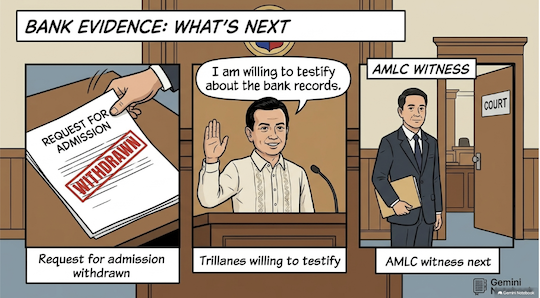
Earlier this month, prosecutors filed 104 requests for admission, asking the defense to admit or deny matters including the authenticity of bank records and whether particular accounts belonged to Sara Duterte individually or jointly with others. The existence and purpose of those requests are independently documented.
The Day 31 research says the impeachment court rejected the prosecution’s attempt to use the request to compel admissions concerning private bank accounts and tax records, citing the constitutional right against self-incrimination and the prosecution’s burden to prove its case independently.
The court also declined, for the time being, to issue a subpoena compelling former senator Antonio Trillanes IV to testify about alleged undisclosed accounts. The research says Escudero wanted the prosecution to first establish the documentary foundation through AMLC evidence.
Reporting before the hearing had already confirmed that the court had held off on issuing Trillanes a subpoena and that an AMLC official was among the upcoming witnesses.
Trillanes nevertheless appeared at the Senate and said he was willing to testify voluntarily.
The practical message to prosecutors was clear: allegations about bank accounts have to be supported by admissible records and witnesses who can establish where those records came from.
What netizens were watching
Online discussion did not settle around a single interpretation of the testimony.
In the r/Philippines Day 31 megathread, some commenters questioned Mayor Duterte’s claim that he did not know every contract handled under delegated authority. Others questioned whether the prosecution had actually established enough through his testimony, while several commenters focused on the anticipated testimony of Trillanes.
A separate discussion was more skeptical of the prosecution. One poster described Te’s examination as “underwhelming” and asked what had actually been established by putting Mayor Duterte on the stand. Other commenters similarly said they had expected stronger evidence connecting the testimony to the case against Sara Duterte.
There was also the usual social-media spectacle around the hearing, including discussion of Mayor Duterte’s demeanor, clothing and gestures.
Those reactions are useful as a snapshot of online discussion, but they are not evidence. The trial record and authenticated documents remain the basis on which the impeachment court must decide the case.

The question after Day 31
Day 31 produced several pieces of the GenCorp story: 19 Davao City contracts, Sara Duterte’s SALN declaration, SEC records that do not list her as an incorporator or director, Baste Duterte’s denial that he knew of her interest, and another corporate record linking Baste and Paolo Duterte to Jaime Cruz.
But pieces are not yet proof of the allegation against the Vice President.
For citizens following the trial, the next documents matter more than the day’s viral clips. Watch what the AMLC and other records actually establish. Watch whether the prosecution can trace an ownership or financial interest to Sara Duterte during the period covered by Article II. And watch whether the defense can explain the apparent gap between her SALN declaration and GenCorp’s corporate records.
The impeachment court has now made the evidentiary test fairly concrete: show the records, establish who owns what, and connect them to the person actually on trial.
That is the standard by which the next phase of Article II should be read.

Day 27: What SEC records revealed about Sara Duterte’s business roles

Day 36 of Sara Duterte’s impeachment trial: PHP 85 million in income, PHPPHP98 million in wealth, and the questions behind the figures

The Impeachment court granted the subpoenas the spliced Cayetano video framed as baseless
About The Author

Noemi Lardizabal-Dado
Noemi Lardizabal-Dado is a content strategist with over 19 years of experience in blogging, content management, citizen advocacy, and media literacy, and over 30 years in web development. Otherwise known as @MomBlogger on social media, she believes in making a difference in the lives of her children by advocating for social change that benefits the greater good. She is a co-founder and a member of the editorial board of Blog Watch . She is a resource speaker on media literacy, social media, blogging, digital citizenship, good governance, transparency, parenting, women’s rights, wellness, and cyber safety. Her personal blogs such as aboutmyrecovery.com (parenting) , pinoyfoodblog.com (recipes), techiegadgets.com (gadgets) and benguetarabica.coffee keep her busy outside of Blog Watch. Disclosure: I am an advocate. I am NOT neutral. I will NOT give social media mileage to members of political clans, epal, a previous candidate for the same position and those I believe are a waste of taxpayers' money. I do not support or belong to any political party. I was part of accredited media covering the Office of the Vice President and Leni Robredo as she ran as a presidential aspirant in the 2022 National and local elections. On August 5, 2021, YouTube announced that I was selected as one of 50 Program participants of its Creator Program for Independent Journalists She was a Senior Consultant for ALL media engagements for the PCOO-led Committee on Media Affairs & Strategic Communications (CMASC) under the ASEAN 2017 National Organizing Council from January 4 -July 5, 2017. Having been an ASEAN advocate since 2011, she has written extensively about the benefits of the ASEAN community and as a region of opportunities on Blog Watch and aboutmyrecovery.com. Organization affiliation includes Consortium on Democracy and Disinformation Updated June 6, 2022