
Fourteen out of twenty: What Day 29 changed in the Sara Duterte Impeachment trial
September 23, 2026
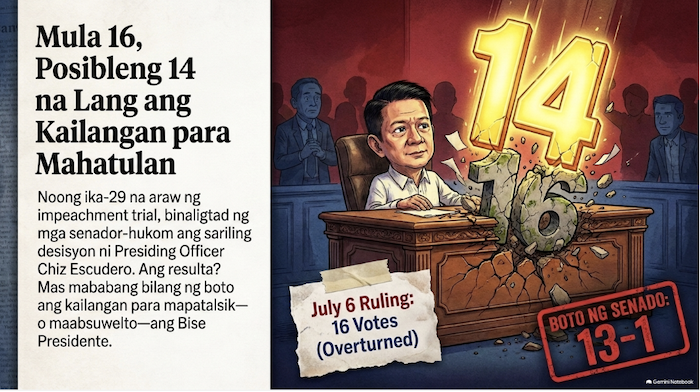
“The presiding officer, after all, is not the court.” Presiding Officer Chiz Escudero said this on Wednesday, right after his fellow senator-judges voted 13-1 to overturn a ruling he himself had handed down on the first day of Vice President Sara Duterte’s impeachment trial. He cast the lone vote to keep his own ruling, then said he was bound to give the court’s decision effect.
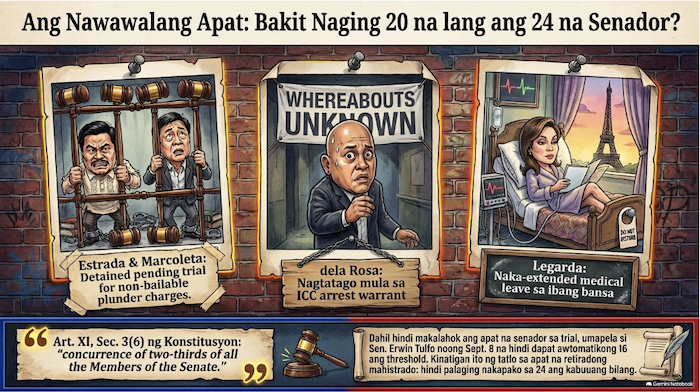
The ruling in question dates back to July 6, when Escudero ruled that 16 affirmative votes are needed to convict, based on the Senate’s 24-member composition. The Constitution itself names no number. Article XI, Section 3(6) only says no one shall be convicted without the concurrence of two-thirds of all the Members of the Senate. Since July, four senator-judges have been unable to sit in the trial. Jinggoy Estrada and Rodante Marcoleta are detained on nonbailable plunder charges before the Sandiganbayan, Ronald “Bato” dela Rosa is in hiding from an International Criminal Court arrest warrant, and Loren Legarda is abroad on extended medical leave.
Senator-judge Erwin Tulfo appealed the 16-vote ruling on September 8. On September 16, the court heard from four retired Supreme Court justices as friends of the court. Three of them, former Chief Justices Hilario Davide Jr., Artemio Panganiban and Reynato Puno, said the threshold is not automatically fixed at 16 (Davide sent a written memorandum that was read in court). Retired Justice Adolfo Azcuna held that the full 24 should count, and called a failed conviction under those conditions the price of a supermajority rule. Day 29 was set aside for oral arguments from both sides and the vote.
Know what happened on Day 29
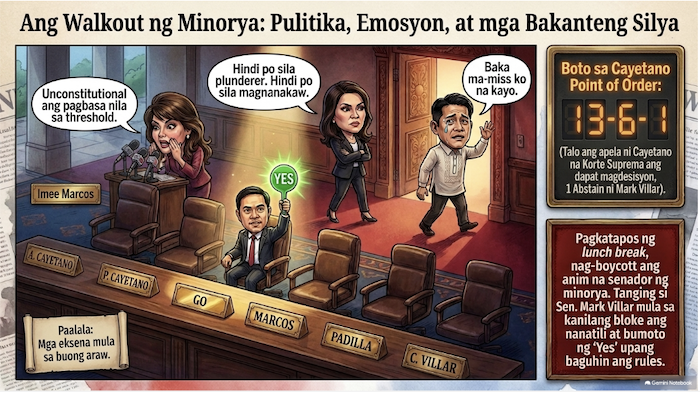
- Cayetano’s bid to stop the vote failed. Minority Leader Alan Peter Cayetano raised a point of order arguing the court had no authority to reopen the threshold mid-trial and that the question belonged to the Supreme Court. Senator-judges rejected it 13-6, with one abstention. The abstention came from Sen. Mark Villar, a member of Cayetano’s own bloc.
- The prosecution warned of an “acquittal by default.” Chel Diokno, arguing for the House panel, said keeping senators who cannot act as judges in the count could produce an “acquittal by default”, where the threshold is missed simply because of who sits in the denominator. He added that a smaller base changes the arithmetic for both conviction and acquittal and does not guarantee a guilty verdict.
- The defense held the line at 16. Defense counsel Michael Poa argued that Escudero had ruled on July 6, no senator-judge appealed at the time, and no “supervening event” justified a change more than two months into the trial. He also raised due process. Senator-judge Panfilo Lacson later called out both panels for statements he found misleading, including Diokno’s claim that all four justices agreed 16 was not absolute. Lacson pointed out that Azcuna had been emphatic: “All means all.”
- The floor turned personal. Tulfo argued the framers of the 1987 Constitution never anticipated senators facing plunder charges. Sen. Camille Villar answered with a rare emotional interjection: “Hindi po sila plunderer. Hindi po sila magnanakaw.” (They are not plunderers. They are not thieves.) Tulfo later said he had called no one a convicted plunderer. Sen. Robin Padilla, facing a hearing on an obstruction of justice complaint on Friday, told his colleagues this might be his last day in the chamber: “Baka ma-miss ko na kayo.” (I might miss you.)
- The vote: 13 yes, 1 no, 6 out of the room. After the lunch break, six minority senators stayed out of the chamber: Alan Peter Cayetano, Pia Cayetano, Bong Go, Imee Marcos, Robin Padilla and Camille Villar. Marcos told reporters they sat out because they consider the court’s reading of the threshold unconstitutional. Mark Villar was the only minority senator who took part, and he voted yes. Escudero voted no.

Read the new formula closely
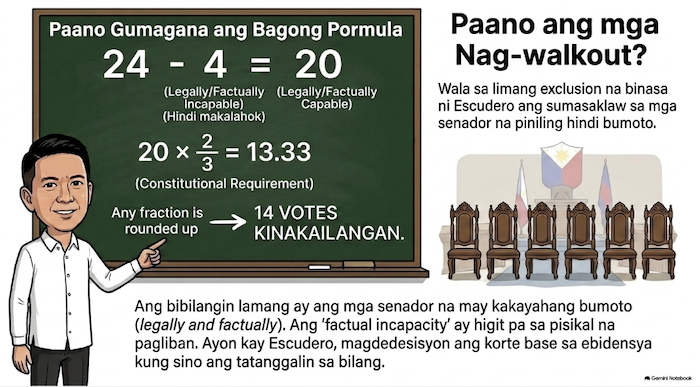
Under the ruling, “all the Members of the Senate” now refers only to senators who are “legally and factually capable” of taking part at the time of the vote. The count leaves out senators who are detained, suspended or otherwise legally barred; those sought by authorities whose whereabouts are unknown; those with a physical or medical incapacity; those beyond the Senate’s coercive processes; and others similarly situated.
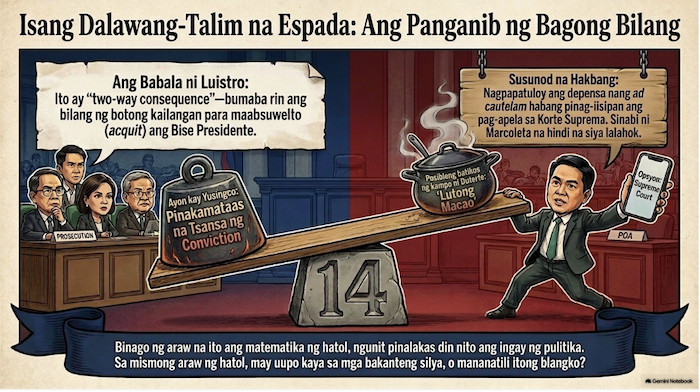
Nobody drops out of the count automatically. Escudero said the court will decide who falls under these categories based on competent and sufficient evidence, and any fraction is rounded up. If 20 senators remain, two-thirds is 13.33, so conviction would need 14 votes. Escudero also made clear the ruling applies “for this occasion only” and does not bind future impeachment courts.
The prosecution is not celebrating. Lead prosecutor Gerville Luistro called it a two-way consequence, since the smaller base also lowers the number needed to acquit. The defense told the court it would keep taking part ad cautelam (with caution) and reserve every legal remedy, and Poa said he would talk to the Vice President first before deciding on a Supreme Court appeal. Marcoleta, one of the four absent senators, said the same day that he no longer saw it fit to take part in the trial.
Listen to what people are saying
- The prosecution: Diokno described the job as building a house of evidence while the defense only has to tear it down. “It never gets easier.”
- An analyst: Michael Henry Yusingco of the Ateneo told Reuters, “This is the best chance to secure a conviction.” Reuters also noted the vote may hint at how the final verdict could go, though nothing is assured.
- Netizens, before Day 29: As early as July, online users questioned minority senator-judges who left the session hall for long stretches during the trial, with some asking whether any mechanism exists to act on senator-judges whose fairness the public doubts.
- The “rigged” framing, anticipated: A Manila Times opinion column in August warned that a 14-vote threshold, even if legally defensible, could look like the goalposts had moved and let Duterte supporters brand the process “lutong macao”.
Count who stays in the room
Diokno asked the court not to let “empty chairs and cold desks” decide the fate of an impeached official, and the new formula takes the four absent senators out of the count. None of the five exclusions Escudero read into the record covers a senator-judge who is free to vote and walks out instead. Six did exactly that on Wednesday afternoon.
When Escudero calls the verdict, will Alan Peter Cayetano, Pia Cayetano, Bong Go, Imee Marcos, Robin Padilla and Camille Villar be in their seats to be counted, or will they leave six more chairs empty on purpose?

Day 10 of Sara Duterte’s impeachment trial: What “unusual but not suspicious” really means

Day 20 Sara Duterte Impeachment Trial: Certificates without a money trail
Day 9 of Sara Duterte Impeachment trial: The prosecution rests its threat case on the NBI’s word
About The Author

Noemi Lardizabal-Dado
Noemi Lardizabal-Dado is a content strategist with over 19 years of experience in blogging, content management, citizen advocacy, and media literacy, and over 30 years in web development. Otherwise known as @MomBlogger on social media, she believes in making a difference in the lives of her children by advocating for social change that benefits the greater good. She is a co-founder and a member of the editorial board of Blog Watch . She is a resource speaker on media literacy, social media, blogging, digital citizenship, good governance, transparency, parenting, women’s rights, wellness, and cyber safety. Her personal blogs such as aboutmyrecovery.com (parenting) , pinoyfoodblog.com (recipes), techiegadgets.com (gadgets) and benguetarabica.coffee keep her busy outside of Blog Watch. Disclosure: I am an advocate. I am NOT neutral. I will NOT give social media mileage to members of political clans, epal, a previous candidate for the same position and those I believe are a waste of taxpayers' money. I do not support or belong to any political party. I was part of accredited media covering the Office of the Vice President and Leni Robredo as she ran as a presidential aspirant in the 2022 National and local elections. On August 5, 2021, YouTube announced that I was selected as one of 50 Program participants of its Creator Program for Independent Journalists She was a Senior Consultant for ALL media engagements for the PCOO-led Committee on Media Affairs & Strategic Communications (CMASC) under the ASEAN 2017 National Organizing Council from January 4 -July 5, 2017. Having been an ASEAN advocate since 2011, she has written extensively about the benefits of the ASEAN community and as a region of opportunities on Blog Watch and aboutmyrecovery.com. Organization affiliation includes Consortium on Democracy and Disinformation Updated June 6, 2022