The Senate hearing on fake news, and the question it barely touched
The recent Senate Committee on Public Information and Mass Media hearing on fake news attempted to address an issue that most people intuitively sense. False information spreads quickly. Platforms reward whatever gets attention. And ordinary readers are left to pick through what’s real and what isn’t.
On paper, the intentions were sensible. Lawmakers talked about ways to limit false content and require social media platforms to be more transparent. The language throughout leaned hard on ideas like protection, responsibility, and the public interest.
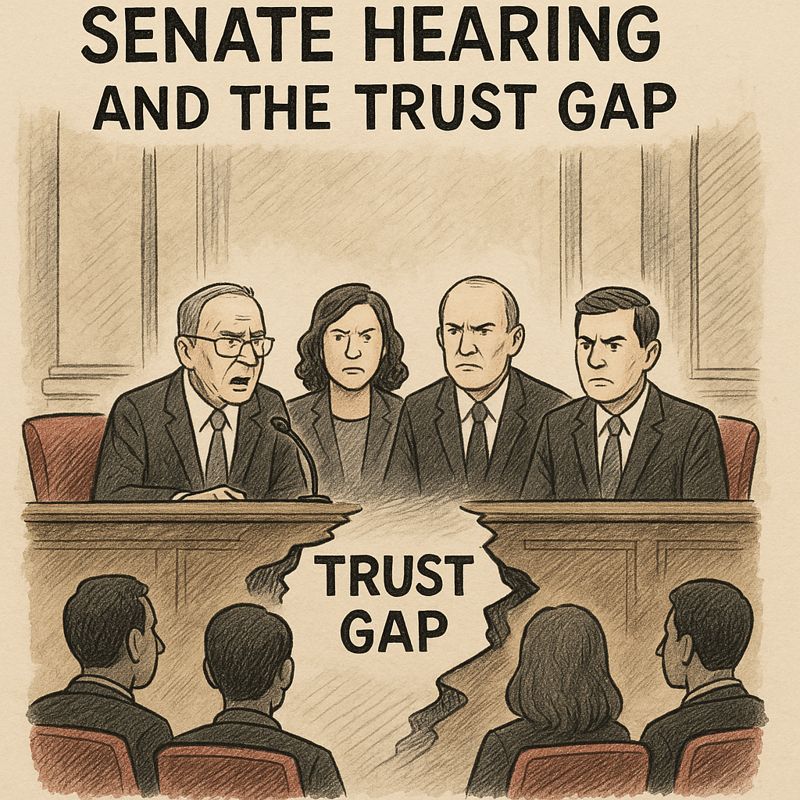
The longer you listened, the clearer it got that there was something else underneath the policy talk. Public trust has been wearing down for years, and it’s not limited to what people see online. Confidence in institutions, in authority, even in so-called official accounts of events, has taken a hit too.
That erosion of trust carries more weight than any single piece of legislation ever could.
Why fake News isn’t just a tech issue
Much of the hearing focused on setting boundaries. Lawmakers spent time debating what should count as “false content” and what penalties or responsibilities ought to come with it. That line of thinking assumes misinformation can be clearly spotted, labeled, and kept in check.
Journalists and media advocates, though, have been questioning that assumption for years.
As one media academic noted in earlier discussions on fake news legislation, “We do not need new laws to police; we need stronger institutions and media literacy to help people evaluate information for themselves.”
That argument sticks because it reflects real behavior. Filipinos don’t share misleading content just because they were taken in. Often, it spreads because trust in traditional sources has worn thin, or because official explanations have let people down before.
Seen from that angle, regulation alone can’t rebuild credibility.
The Work That Rarely Goes Viral
Fact-checking groups like Vera Files weren’t the main focus of the hearing, but their work still sits in the background of this whole debate. They’re guided by a simple idea: misinformation causes the most harm when nobody bothers to challenge it.
Their process is slow. Careful. Often thankless. It doesn’t chase trends or clicks. But over time, it creates something no law can mandate—**a habit of checking before believing**.
This is how trust comes back, if it does at all. Not through punishment or fear, but through consistency.
The empty seats that said plenty
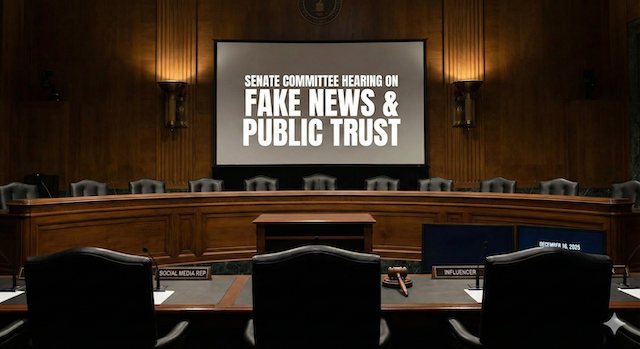
One of the most telling moments of the hearing had nothing to do with speeches. It was the absence of several invited social media personalities and platform representatives.
These are the people who influence what gets seen, shared, and believed every day. Their empty chairs highlighted a familiar problem: policies about information are often discussed without the full participation of those who profit most from its circulation.
For the public, this feeds a familiar frustration. Rules are talked about. Responsibility is mentioned. But accountability still feels distant.
And when power feels distant, trust slips even further away.
Knowing when to slow down
Media groups have repeatedly warned that loosely written “fake news” laws can backfire. When definitions are vague and enforcement uneven, opinion, satire, dissent, and investigative reporting are often the first casualties.
This concern isn’t abstract. Filipinos have seen how laws introduced in the name of protection can later be used to silence. The caution coming from journalism educators and press advocates comes from experience, not paranoia.
If the goal is to strengthen public information, restraint deserves as much attention as action.
What real civic impact looks like
Public trust doesn’t return just because a committee meets or a bill advances. It comes back slowly, when people start to feel that:
* Institutions are willing to question themselves, not just regulate others
* Media can be held to standards without being intimidated
* Platforms practice transparency as a habit, not only under pressure
* Citizens are treated as participants in democracy, not passive recipients of information
The Senate hearing is part of an ongoing conversation, not its endpoint. It shows awareness, which matters. But awareness isn’t the same as resolution.
If lawmakers want lasting civic impact, the discussion can’t stop at controlling content. It also has to face a harder question: why so many Filipinos no longer know who to trust—and why that uncertainty often feels reasonable rather than reckless.
That’s not an easy thing to legislate. But it’s the question that matters most.
The fight vs disinformation intensifies
Fake news: 7 types of mis- and disinformation (Part 1)
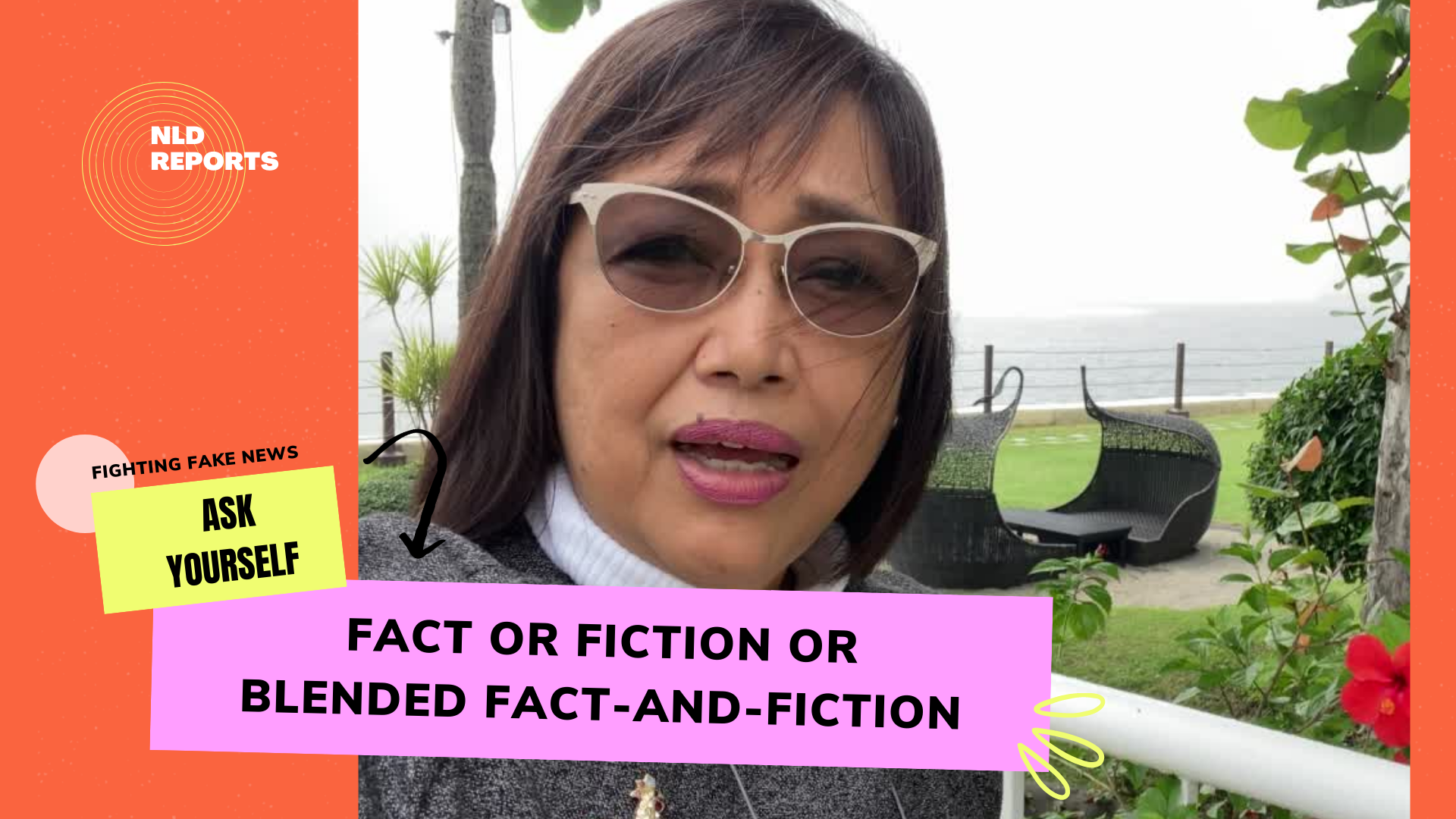
Be vigilant with fact-and-fiction blended content
About The Author

Noemi Lardizabal-Dado
Noemi Lardizabal-Dado is a content strategist with over 19 years of experience in blogging, content management, citizen advocacy, and media literacy, and over 30 years in web development. Otherwise known as @MomBlogger on social media, she believes in making a difference in the lives of her children by advocating for social change that benefits the greater good. She is a co-founder and a member of the editorial board of Blog Watch . She is a resource speaker on media literacy, social media, blogging, digital citizenship, good governance, transparency, parenting, women’s rights, wellness, and cyber safety. Her personal blogs such as aboutmyrecovery.com (parenting) , pinoyfoodblog.com (recipes), techiegadgets.com (gadgets) and benguetarabica.coffee keep her busy outside of Blog Watch. Disclosure: I am an advocate. I am NOT neutral. I will NOT give social media mileage to members of political clans, epal, a previous candidate for the same position and those I believe are a waste of taxpayers' money. I do not support or belong to any political party. I was part of accredited media covering the Office of the Vice President and Leni Robredo as she ran as a presidential aspirant in the 2022 National and local elections. On August 5, 2021, YouTube announced that I was selected as one of 50 Program participants of its Creator Program for Independent Journalists She was a Senior Consultant for ALL media engagements for the PCOO-led Committee on Media Affairs & Strategic Communications (CMASC) under the ASEAN 2017 National Organizing Council from January 4 -July 5, 2017. Having been an ASEAN advocate since 2011, she has written extensively about the benefits of the ASEAN community and as a region of opportunities on Blog Watch and aboutmyrecovery.com. Organization affiliation includes Consortium on Democracy and Disinformation Updated June 6, 2022