Day 3 of Sara Duterte’s impeachment trial: what the NBI witness proved, and what he did not
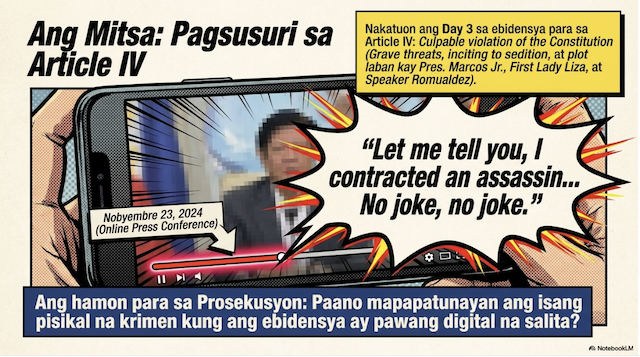
“No joke, no joke.”
Those three words are now part of the Senate impeachment record.
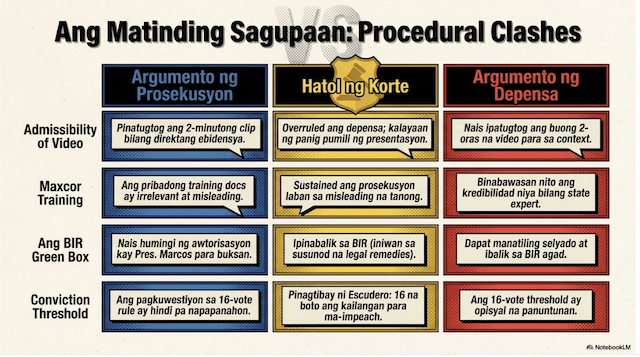
On the second day of Vice President Sara Duterte’s impeachment trial, prosecutors played a two-minute and 18-second excerpt from her November 2024 online press conference, where she said she had talked to someone who would kill President Ferdinand Marcos Jr., First Lady Liza Araneta-Marcos, and former House Speaker Martin Romualdez if she herself were killed. The Senate impeachment court allowed the prosecution to present the excerpt, over defense objections that the full two-hour video should be shown for context.
Day 3 was where the defense began testing what that video actually proves.
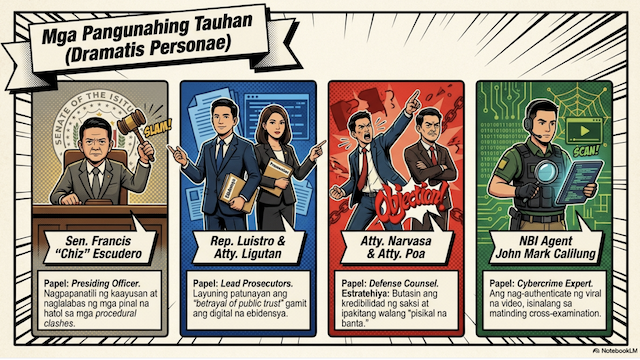
The trial had moved into Article IV, the charge built around alleged grave threats and an alleged assassination plot. The first witness on this article was NBI Senior Agent John Mark Calilung, whose role was to identify and authenticate the video evidence. By Wednesday, July 8, the question was no longer simply whether the clip existed. It was whether the prosecution had enough to connect those words to an impeachable act beyond the video itself.
The video is evidence. It is not the whole case.
That distinction matters.
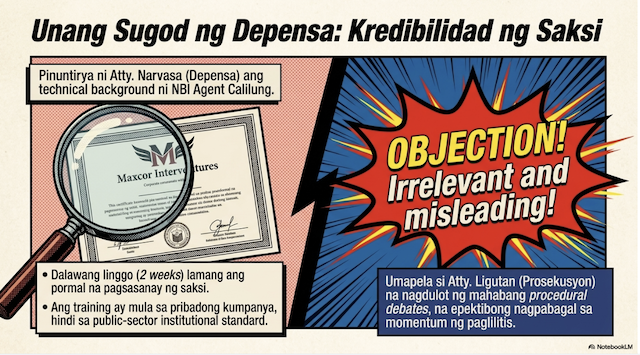
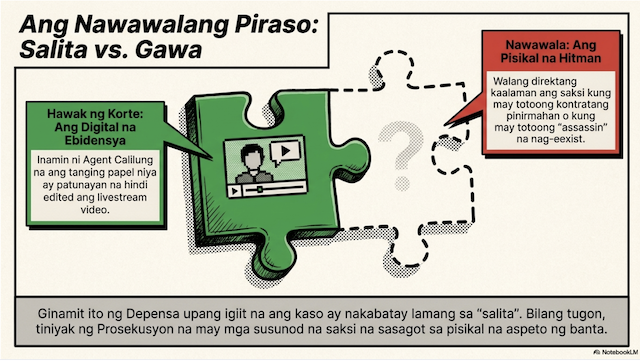
The NBI witness helped establish where the videos came from and whether they were examined by investigators. The prosecution needed that foundation because Article IV depends heavily on recorded statements made online. Calilung testified that the videos were taken from official sources and manually verified by the NBI.
But under cross-examination, the defense pressed a different point: did Calilung personally know of any hired assassin? Did he investigate the alleged “hitman” mentioned in Duterte’s statement?
His answer exposed the limit of his testimony. He examined the videos. He did not personally establish the identity or existence of a hired person.
That does not end the prosecution’s case. It only tells us what Calilung was there to prove.
He was a technical witness, not the witness who could prove every element of the alleged plot. The prosecution can still present other witnesses to build the rest of Article IV. In fact, the impeachment court has already been told that former OVP chief of staff Zuleika Lopez is expected to testify on July 14, with the defense saying her detention and transfer in 2024 formed part of the context behind Duterte’s remarks.
So Day 3 gave both sides something to work with.
For the prosecution, the video is now part of the record.
For the defense, the first witness did not prove the physical side of the alleged plot.
For the public, the lesson is simple: do not confuse authentication with completion. A verified video can prove that words were said. It does not automatically prove what those words legally mean.
Why the defense kept objecting
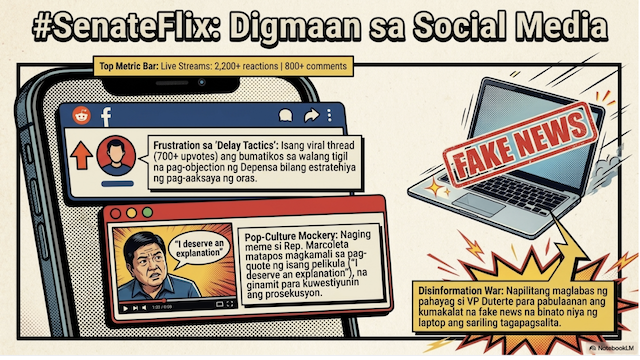
Many viewers saw the repeated objections and called them delay tactics. Defense spokesperson Michael Poa rejected that framing, saying objections are part of trial work and that failure to object can waive a party’s right to raise the issue later.
That is legally true. But public perception is also part of this trial.
The Senate is a courtroom and a national stage. Every objection, clipped video, senator-judge question, and viral reaction becomes part of how people understand the case.
This is where citizens have to be careful. We should not treat every objection as bad faith. We should also not pretend procedure is neutral when it is used to slow down, narrow, or reframe the record.
A fair trial needs both: the right to object and the discipline to move the case forward.
The question senators should keep asking
Day 3 made the legal burden clearer.
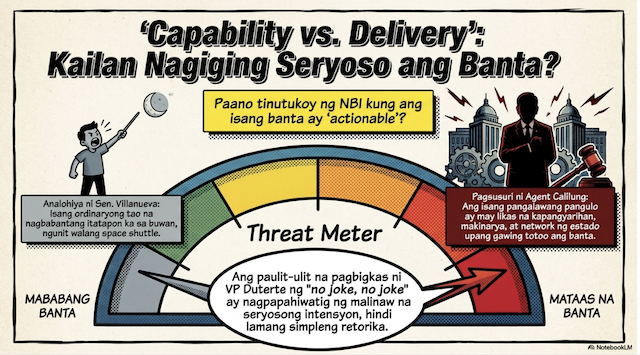
The prosecution is trying to show that Duterte’s words were not reckless talk. It wants the Senate to see them as an impeachable abuse of power, a betrayal of public trust, or a threat serious enough to justify removal from office.
The defense is trying to show that the words were conditional, emotional, and tied to the treatment of Duterte’s staff. It will keep arguing context, free expression, and lack of physical proof.
That is why senator-judges should keep asking direct questions:
- What exactly does the video prove?
- What does it not prove?
- Who can testify on the alleged capability to carry out the threat?
- What standard will the Senate use to distinguish political speech from an impeachable threat?
- How much context must be considered before judging Duterte’s intent?
These are not side issues. They go to the heart of Article IV.
The Supreme Court fight is still hanging over the trial
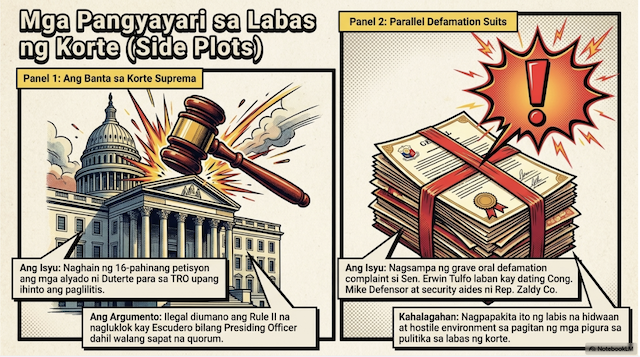
Outside the Senate floor, Duterte’s allies also brought the fight to the Supreme Court. A petition questioned the authority of Senator Francis “Chiz” Escudero to preside over the impeachment trial and challenged the Senate proceedings that allowed a presiding officer other than the Senate President.
That challenge has not stopped the trial as of Day 3.
This is the second time the impeachment fight has landed before the Court. In 2025, the Supreme Court declared the earlier impeachment articles unconstitutional because of the one-year bar and due process issues, while making clear that the ruling did not absolve the Vice President and that a new complaint could be filed after February 6, 2026.
That history matters because it explains why both camps are fighting over procedure so hard. In impeachment, procedure is not a minor matter. It can decide whether the case proceeds, whether evidence is admitted, and whether the public ever gets a full reckoning.
The 16-vote question
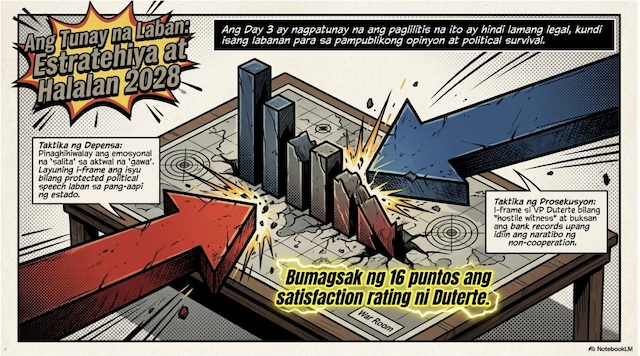
The Constitution gives the Senate the sole power to try impeachment cases. It also says no person may be convicted without the concurrence of two-thirds of all members of the Senate. In a 24-member Senate, that means 16 votes.
That number will shape every move from here.
The prosecution does not only have to prove its case in public. It has to convince 16 senator-judges.
The defense does not have to win everyone over. It only has to keep at least nine senators from voting to convict.
This is why every ruling, witness, and procedural challenge matters. The trial is legal, but the math is political.
What citizens should watch next
We do not need to be lawyers to follow this trial responsibly. But we do need to stop watching it as if it were only a teleserye with robes.
Here is what we should track:
- Whether the prosecution presents witnesses who can go beyond video authentication.
- Whether the defense can show context without excusing the language used.
- Whether senator-judges ask questions that clarify the law, or questions that merely perform for their base.
- Whether the Supreme Court challenge changes the pace or authority of the trial.
- Whether viral clips match the actual record.
This is where disinformation thrives: in the gap between what was said, what was proved, and what was clipped for sharing.
Day 3 showed us that the video is real enough to be argued over. It also showed us that one authenticated clip does not carry the whole case by itself.
Before sharing the next viral moment, ask one question: did this prove the threat, the speaker, the capability, or only the upload?
Because in this trial, the difference matters.

Day 34 Sara Duterte Impeachment trial: The P4.4-billion question moves from AMLC summaries to bank records

Day 16 of Sara Duterte’s impeachment trial: Who handled the 500 million?

Day 22 Sara Duterte impeachment trial: When the confidential-fund names met the PSA
About The Author

Noemi Lardizabal-Dado
Noemi Lardizabal-Dado is a content strategist with over 19 years of experience in blogging, content management, citizen advocacy, and media literacy, and over 30 years in web development. Otherwise known as @MomBlogger on social media, she believes in making a difference in the lives of her children by advocating for social change that benefits the greater good. She is a co-founder and a member of the editorial board of Blog Watch . She is a resource speaker on media literacy, social media, blogging, digital citizenship, good governance, transparency, parenting, women’s rights, wellness, and cyber safety. Her personal blogs such as aboutmyrecovery.com (parenting) , pinoyfoodblog.com (recipes), techiegadgets.com (gadgets) and benguetarabica.coffee keep her busy outside of Blog Watch. Disclosure: I am an advocate. I am NOT neutral. I will NOT give social media mileage to members of political clans, epal, a previous candidate for the same position and those I believe are a waste of taxpayers' money. I do not support or belong to any political party. I was part of accredited media covering the Office of the Vice President and Leni Robredo as she ran as a presidential aspirant in the 2022 National and local elections. On August 5, 2021, YouTube announced that I was selected as one of 50 Program participants of its Creator Program for Independent Journalists She was a Senior Consultant for ALL media engagements for the PCOO-led Committee on Media Affairs & Strategic Communications (CMASC) under the ASEAN 2017 National Organizing Council from January 4 -July 5, 2017. Having been an ASEAN advocate since 2011, she has written extensively about the benefits of the ASEAN community and as a region of opportunities on Blog Watch and aboutmyrecovery.com. Organization affiliation includes Consortium on Democracy and Disinformation Updated June 6, 2022