
Are minors “untouchable” under the Juvenile Justice law? What RA 9344 actually says about accountability
On the morning of June 22, two teenagers walked into a school in Tacloban City and opened fire. Three people were killed and eleven wounded. Within hours the shooting had pulled an old argument back into the open.
Sen. Robin Padilla again pushed to lower the minimum age of criminal responsibility. Sen. Francis “Kiko” Pangilinan, who wrote the Juvenile Justice and Welfare Act, pushed back. The law, he said, does not let children who commit crimes off the hook.
“Iligal ang pakawalan ang menor de edad na nasangkot sa krimen at may parusa sa mga gagawa nito,” Pangilinan said in a statement carried by GMA News on June 22.
So which senator is right? You don’t have to take either of them on faith. The text of Republic Act 9344 is public, and it answers the question section by section.
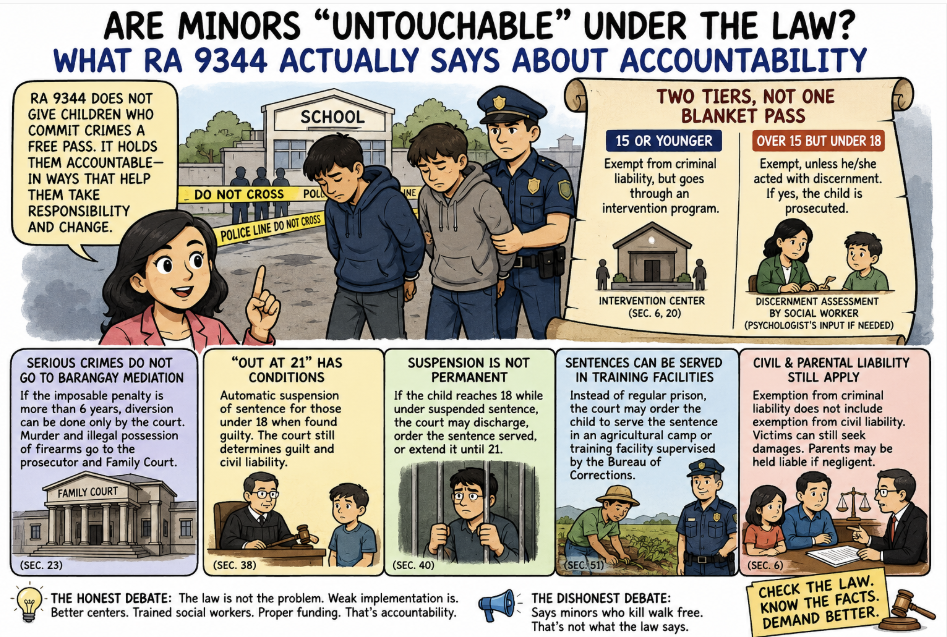
The law sets two tiers, not one blanket pass
Section 6 puts the minimum age of criminal responsibility at 15. A child who is 15 or younger when the offense happens is exempt from criminal liability, but the same section sends that child into an intervention program under Section 20. The youngest offenders stay out of jail, but the law still puts them through that program.
It’s the older group that trips people up. A child above 15 but below 18 is also exempt, with one condition written into the same section: “unless he/she has acted with discernment, in which case, such child shall be subjected to the appropriate proceedings in accordance with this Act.”
Everything turns on that one word, discernment. It means the child understood what the act would do and knew it was wrong. A social worker handles that assessment. They look at how the crime happened and how the child has been doing in school, plus the way the child behaved before and after. If that still isn’t clear, they can call in a psychologist. Once discernment is established, the child is prosecuted.
Serious crimes do not go to barangay mediation
People picture every case under this law ending in a quiet settlement at the barangay, but that is not how Section 23 reads. When the penalty for the crime runs higher than six years, only a court can allow diversion. Murder and illegal possession of firearms sit far above that line, so those cases move to the prosecutor and the Family Court.
“Out at 21” comes from the statute, and it has conditions
Section 38 calls for automatic suspension of sentence once a child who was under 18 at the time of the offense is found guilty. The court still settles guilt and civil liability. What it holds back is the judgment of conviction. In its place, the child goes under a disposition program.
That suspension has an end date. Section 40 says that if the child turns 18 while the sentence is suspended, the court can discharge the child or order the sentence carried out, and where neither fits it can extend the hold “until the child reaches the maximum age of twenty-one (21) years.” For a grave offense where the program fails, the court can bring the child back for execution of judgment.
So a minor convicted of a serious crime can be held and rehabilitated, and can still be made to answer well past the age of 18. Section 51 even lets that sentence be served in an agricultural camp or training facility run by the Bureau of Corrections, rather than an ordinary prison.
Civil and parental liability survive the exemption
Section 6 ends with a line critics almost never quote: “The exemption from criminal liability herein established does not include exemption from civil liability.” A victim’s family can still go after damages. Pangilinan made the same point when he noted that parents can be held liable where negligence is shown, and that the DSWD is required to support victims and their families.
Why the framing matters
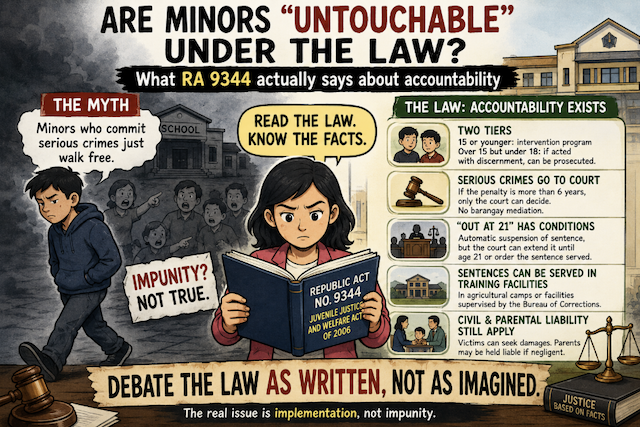
The debate worth having is about whether the law is actually being carried out. Bahay Pag-asa centers remain unbuilt or underfunded in many provinces. The social workers who assess discernment are stretched thin. Children who reoffend sometimes cycle back because the intervention was never paid for in the first place. Those are real failures, and they deserve a full Senate hearing.
What does not deserve airtime is the claim that a child who kills simply strolls out the schoolhouse gate a free person. Sections 6, 23, 38, 40, and 51 say plainly that he does not.
We can argue about whether 15 is the right age, and Congress has every power to move it. What we owe each other in that argument is honesty about the law as it actually stands, because the version going around online, the one where the gate just swings open, was never written into RA 9344. Before you share the next post telling you minors walk free, will you read the sections yourself?
Sources: Republic Act No. 9344 (Juvenile Justice and Welfare Act of 2006), full text via the LawPhil Project. “Kiko Pangilinan says minors accountable under juvenile justice law,” GMA News, June 22, 2026.
Various Statements re Willie Revillame Alleged Child Abuse
Landmark Adolescent Pregnancy Prevention Act gets green light from House Committee
Is Willie Revillame Really Helping the Poor?
About The Author

Noemi Lardizabal-Dado
Noemi Lardizabal-Dado is a content strategist with over 19 years of experience in blogging, content management, citizen advocacy, and media literacy, and over 30 years in web development. Otherwise known as @MomBlogger on social media, she believes in making a difference in the lives of her children by advocating for social change that benefits the greater good. She is a co-founder and a member of the editorial board of Blog Watch . She is a resource speaker on media literacy, social media, blogging, digital citizenship, good governance, transparency, parenting, women’s rights, wellness, and cyber safety. Her personal blogs such as aboutmyrecovery.com (parenting) , pinoyfoodblog.com (recipes), techiegadgets.com (gadgets) and benguetarabica.coffee keep her busy outside of Blog Watch. Disclosure: I am an advocate. I am NOT neutral. I will NOT give social media mileage to members of political clans, epal, a previous candidate for the same position and those I believe are a waste of taxpayers' money. I do not support or belong to any political party. I was part of accredited media covering the Office of the Vice President and Leni Robredo as she ran as a presidential aspirant in the 2022 National and local elections. On August 5, 2021, YouTube announced that I was selected as one of 50 Program participants of its Creator Program for Independent Journalists She was a Senior Consultant for ALL media engagements for the PCOO-led Committee on Media Affairs & Strategic Communications (CMASC) under the ASEAN 2017 National Organizing Council from January 4 -July 5, 2017. Having been an ASEAN advocate since 2011, she has written extensively about the benefits of the ASEAN community and as a region of opportunities on Blog Watch and aboutmyrecovery.com. Organization affiliation includes Consortium on Democracy and Disinformation Updated June 6, 2022