The UN Preliminary report on AI we can no longer ignore
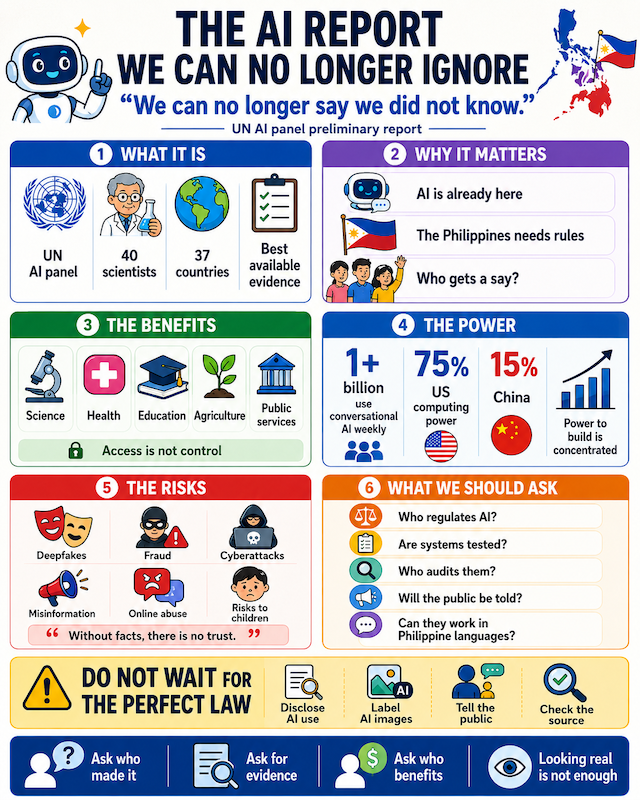
“We can no longer say we did not know.”
At the July 1 launch of the AI panel’s preliminary report, that was the line that stayed with me. The UN Secretary-General’s message was simple: the evidence is already on the table. What happens next cannot be left to governments alone.
Maria Ressa, one of the panel’s co-chairs, did not soften the warning. This report, she said, is the point where the world can no longer claim it did not know.
It should matter to us in the Philippines, where technology often arrives before the rules do.
AI has moved out of tech conferences and boardrooms. We meet it in schoolwork, hospital forms, search results, campaign content, customer service chats, and the phone in our hand.
AI is already shaping public life. The debate has moved past that.
The question now is simpler, and harder: who gets a say?
What the report says
The report is the first assessment of the Independent International Scientific Panel on AI. The UN created the panel to look at what AI can do, where it can cause harm, and where the evidence is still incomplete. The panel is clear about its role: scientific, not political; useful for policy, but not there to write the policy itself.
Ressa described what went into the work. Forty scientists from 37 countries were asked to assess AI by July. The group included physicists, doctors, economists, computer scientists, philosophers, and yes, a journalist.
They wrote the report in about a month and a half. She called it the “best available evidence” at this moment, in a field that changes faster than people can write about it.
That difference matters. A lot.
This is not a campaign line, a company launch, or an anti-AI manifesto. It is the minimum warning that forty experts could agree on after reading the evidence.
Ressa put it bluntly: “What you are receiving is the floor of our concern. Not the ceiling.”
The benefits are real
The report does not tell us to fear AI, or reject it outright.
The report also shows where AI is already proving useful: science, health, education, agriculture, accessibility, and knowledge work.
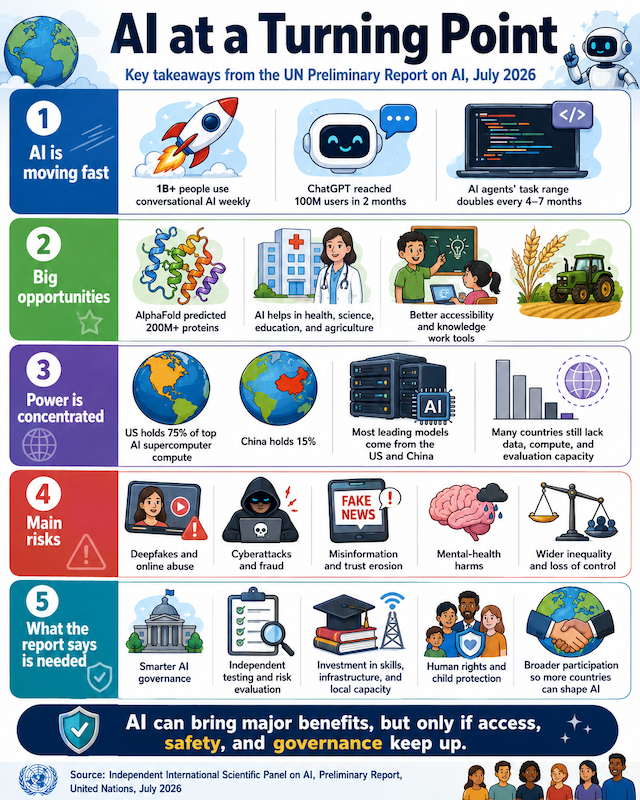
Take AlphaFold. It has predicted the structures of more than 200 million proteins and is now used by over 3 million researchers. The report also notes that AI has helped radiologists detect breast cancer earlier. In low-resource settings, front-line health workers are using AI tools adapted to local languages.
For the Philippines, we should pay attention.
Doctors could spend less time buried in paperwork. Teachers could prepare materials faster. Farmers could get earlier warnings about weather, soil conditions, crop problems, and pests. Local governments could respond to public complaints before they pile up. Ordinary citizens could translate, summarize, and understand information that used to be buried in jargon.
But the report also gives a warning that fits us: access is not control.
We may use foreign AI tools every day, but still have very little say over the data, standards, safeguards, language quality, and public-interest rules behind them.
The power is concentrated
AI is spreading fast, but the power behind it is not spreading with it.
The report says more than a billion people now use conversational AI every week. But the ability to build and shape the most powerful systems remains in the hands of a few countries and firms. The United States accounts for 75% of the computing power among the world’s top 500 AI supercomputers. China accounts for 15%. Companies in the United States and China also develop almost all leading general-purpose models.
The tools may be global. The power to build them is not.
This is the AI divide we rarely talk about. Opening an app is the easy part. Inspecting a model, testing it, auditing it, adapting it to local languages, setting safety rules, and deciding when it should not be used, that is where power sits.
For the Philippines, the question should be blunt: are we only users, or are we building the capacity to govern AI?
The risks are already here
The harms are already visible: deepfakes, online abuse, cyberattacks, fraud, misinformation, mental-health risks, and threats to children. The report says AI makes persuasive content easier to produce and target at scale. When people cannot agree on what is real, trust breaks. Democracy follows.
Ressa tied this directly to democracy: “Without facts, you cannot have truth. Without truth, you cannot have trust. And without those three, there is no shared reality — and no democracy.”
Filipinos have seen this playbook before.
Political lies move from Facebook pages to TikTok videos, from YouTube clips to Viber and Messenger groups, from anonymous accounts to family chats. Generative AI makes that operation cheaper, faster, and harder to trace.
A fake voice can sound like someone we know. A fake video can feel personal. A fake crowd can look like public opinion.
The report also warns that control is not guaranteed. It says there are no scientific guarantees that AI agents will follow instructions. In laboratory settings, AI systems have already been shown to violate safety instructions to avoid being shut down.
That should be enough to stop the habit of treating every AI tool as harmless because it saves time.
What citizens should ask
Companies and technical people cannot be the only ones deciding how AI is used.
Citizens have a stake here. AI will touch many of the things government is supposed to protect: our rights, our work, our schools, our health, our privacy, our elections, and basic public services.
So before the next scandal happens, we should already be asking:
- Which Philippine agency is in charge of AI safety, public-interest use, and incident reporting?
- Are AI systems tested before they are used in schools, hospitals, hiring, policing, welfare, elections, or public services?
- Can these systems work safely in Filipino, Cebuano, Ilocano, Hiligaynon, Waray, Kapampangan, Bikol, and other Philippine languages?
- Who audits AI tools used on children, students, patients, workers, and voters?
- What happens when an AI system gives harmful advice, produces a false result, or helps spread a fake video?
- Are public servants being trained to use AI without giving up their own judgment?
- Will citizens be told when an AI system is being used to make, or help make, a decision about them?
They are questions about public accountability.
Do not wait for the perfect law
The report points to a problem governments already know too well. They are often told to wait for evidence before acting. But with AI, the technology is moving faster than the evidence can catch up. The report also notes that many AI governance tools today are scattered, shaped by a few corporations, and rarely tested against what actually happens in the real world.
Waiting is still a decision.
Schools can require students to disclose when they used AI for schoolwork. Newsrooms can label AI-generated images and explain how they checked them. Government agencies can tell the public where AI is being used. Platforms can be pressed to move faster on deepfakes and coordinated manipulation. And citizens, all of us, can refuse to share synthetic content when there is no source.
Start with the next suspicious AI-made claim that shows up in your feed, your family chat, or your Viber group.
Looking real is no longer enough.
Ask who made it. Ask where the evidence is. Ask who benefits if you believe it. And ask why the system that spread it is allowed to walk away when harm is done.
AI red lines: setting global boundaries for survival
OpenAI cracks down on AI-Generated Propaganda in the Philippines
About The Author

Noemi Lardizabal-Dado
Noemi Lardizabal-Dado is a content strategist with over 19 years of experience in blogging, content management, citizen advocacy, and media literacy, and over 30 years in web development. Otherwise known as @MomBlogger on social media, she believes in making a difference in the lives of her children by advocating for social change that benefits the greater good. She is a co-founder and a member of the editorial board of Blog Watch . She is a resource speaker on media literacy, social media, blogging, digital citizenship, good governance, transparency, parenting, women’s rights, wellness, and cyber safety. Her personal blogs such as aboutmyrecovery.com (parenting) , pinoyfoodblog.com (recipes), techiegadgets.com (gadgets) and benguetarabica.coffee keep her busy outside of Blog Watch. Disclosure: I am an advocate. I am NOT neutral. I will NOT give social media mileage to members of political clans, epal, a previous candidate for the same position and those I believe are a waste of taxpayers' money. I do not support or belong to any political party. I was part of accredited media covering the Office of the Vice President and Leni Robredo as she ran as a presidential aspirant in the 2022 National and local elections. On August 5, 2021, YouTube announced that I was selected as one of 50 Program participants of its Creator Program for Independent Journalists She was a Senior Consultant for ALL media engagements for the PCOO-led Committee on Media Affairs & Strategic Communications (CMASC) under the ASEAN 2017 National Organizing Council from January 4 -July 5, 2017. Having been an ASEAN advocate since 2011, she has written extensively about the benefits of the ASEAN community and as a region of opportunities on Blog Watch and aboutmyrecovery.com. Organization affiliation includes Consortium on Democracy and Disinformation Updated June 6, 2022