
Day 35 Sara Duterte Impeachment Trial : The ?96 Million Question and the Missing Signatures in Sara Duterte’s Impeachment Trial
Day 35 of Vice President Sara Duterte’s impeachment trial put bank records at the center of Article II, which alleges unexplained wealth, asset growth disproportionate to lawful income, and failure to properly disclose assets.
The prosecution tried to show how tens of millions of pesos connected to accounts bearing Duterte’s name moved through time deposits and manager’s checks without appearing in year-end bank balances. The defense, however, pointed to an important detail in the records: Sara Duterte’s signature did not appear on the transactions involving a ?41.7 million BPI time deposit and subsequent manager’s checks.
Day 35 showed plenty of money moving through the accounts. What prosecutors still need to show is how much of it can actually be tied to Sara Duterte.
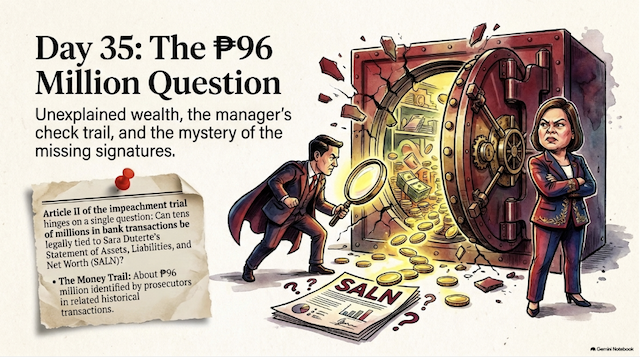
The October 7 hearing focused heavily on testimony from banking officials and the prosecution’s effort to compare Duterte’s declared assets with financial transactions presented before the impeachment court.
Five highlights from Day 35
1. Prosecutors traced a ?41.7 million time deposit that became a manager’s check
BPI Central Metro Manila Division Head Marwin Galvez testified that a joint peso time deposit was opened at BPI’s Julia Vargas branch on January 22, 2010 under the designation “Rodrigo Roa Duterte or Rodrigo Roa Duterte and Sara Z. Duterte.”
The initial principal was ?40.65 million. It went through 12 rollovers and reached about ?41.72 million by February 2011.
When the deposit matured in March 2011, its proceeds were used to purchase a manager’s check. The prosecution also presented a separate ?55 million time deposit that was converted in a similar manner, bringing the total amount in question to roughly ?96 million.
Private prosecutor James Bryan Ibrahim Alih argued that the repeated use of manager’s checks allowed the funds to remain outside the originating deposit accounts during year-end reporting periods.
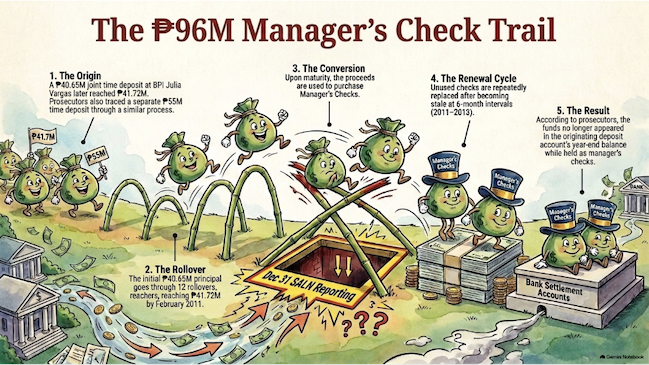
According to the prosecution’s presentation, unused manager’s checks were repeatedly replaced after becoming stale, with renewals occurring at six-month intervals between 2011 and 2013. Prosecutors argued that because the funds were sitting in the bank’s settlement accounts rather than the original deposit accounts, they did not appear as December 31 deposit balances.
The testimony explained how the transactions worked. It did not, by itself, prove that the arrangement was designed to avoid SALN disclosure. That is still part of the prosecution’s case to establish.
Senator-judge Tito Sotto also raised the term “Tinikling,” which he said a banker friend used to describe repeatedly converting funds into manager’s checks around the end of the year.
Galvez said he was unfamiliar with the term in banking and knew “Tinikling” only as the traditional Filipino dance.
2. Sara Duterte’s signature was missing from the transactions
During cross-examination, the defense focused on who actually authorized the BPI transactions.
The original BPI documents examined during the hearing did not show Sara Duterte’s signature on the time deposit applications, rollover instructions or manager’s check requisitions.
Presiding Officer Francis Escudero confirmed this after examining the bank records.
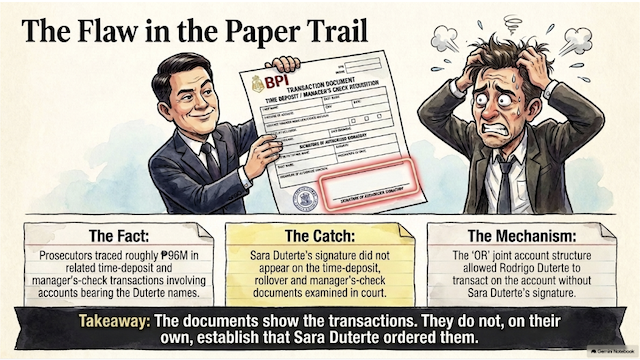
The defense also pointed out that the underlying joint account was structured so that Rodrigo Duterte could transact without Sara Duterte’s signature.
The absence of her signature does not answer every question about ownership or disclosure. But it does mean the records shown on Day 35 did not prove that Sara Duterte personally ordered or executed those transactions.
The prosecution will still have to establish whether she owned, controlled, benefited from or was required to disclose the funds.
3. The prosecution says the ?96 million pattern matters because of SALN disclosure
The prosecution’s case is not simply that large amounts of money existed.
Its argument is that the transactions should be examined alongside Duterte’s Statements of Assets, Liabilities and Net Worth to determine whether assets were omitted from required disclosures.
When the defense objected to the admission of transactions dating from 2010 to 2016, it argued that transactions occurring years before Duterte became vice president were irrelevant to the current impeachment charges.
The prosecution countered that the historical transactions were necessary to establish a financial baseline and an alleged continuing pattern of asset accumulation and concealment.
Escudero allowed the evidence, ruling that the historical accounts could be considered as part of that financial baseline rather than as separate offenses.
A large transaction does not prove unexplained wealth on its own. Prosecutors still have to show Duterte’s connection to the funds, whether she was required to declare them and whether any omission can be attributed to her.
4. Other bank records widened the Article II inquiry
Day 35 was not limited to BPI.
Metrobank Anti-Money Laundering Division Head Niña Ferren Aguilar presented records involving an account in the name of one of the minor children of Duterte and her husband, Manases Carpio.
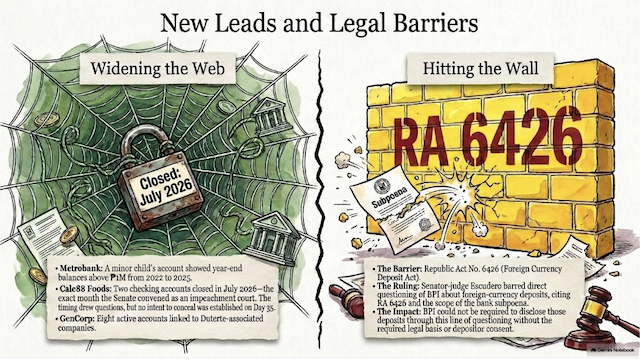
The account showed year-end balances of ?1.8 million in 2022, ?1.3 million in 2023, ?1.458 million in 2024 and ?1.459 million in 2025.
Aguilar also explained how banks determine whether transactions warrant Suspicious Transaction Reports to the Anti-Money Laundering Council.
She said reporting decisions are not based simply on news reports or allegations. Banks assess factors such as transaction patterns, whether there is an apparent commercial justification and whether activity differs significantly from a customer’s declared profile.
BPI’s Galvez separately confirmed that Duterte and Carpio held nine active BPI accounts with combined ending balances of about ?8 million as of 2025.
These records give the impeachment court more material to compare with Duterte’s SALNs. The prosecution still has to show which assets were legally reportable and whether they were omitted.
5. Two Cale88 bank accounts were closed in July 2026
Security Bank Branch Banking Group Head Leslie Cham testified about accounts belonging to Cale88 Foods Corporation, a company linked to Carpio.
The company had two checking accounts opened in August 2024 and October 2025.
Both were closed in July 2026, the same month the Senate convened as an impeachment court. Cham also testified about eight active accounts belonging to another Duterte-associated company, GenCorp.
The timing of the Cale88 closures drew attention during the hearing.
But the testimony established only when the accounts were closed. It did not establish why they were closed or whether the closures were intended to conceal assets or avoid scrutiny.
If prosecutors want to use the closures as evidence under Article II, they will need to show more than timing.
The foreign currency question hits a legal barrier
The prosecution also attempted to ask BPI whether Duterte and Carpio maintained foreign currency accounts.
The defense objected, citing Republic Act No. 6426, or the Foreign Currency Deposit Act.
Escudero sustained the objection. He ruled that foreign currency deposits were outside the scope of the subpoena issued to BPI and were covered by statutory confidentiality protections.
Section 8 of the law generally treats foreign currency deposits as confidential unless the depositor gives written permission for disclosure.
That ruling limits what prosecutors can obtain directly from BPI on foreign currency holdings.
For the defense, it was one of the clearer procedural wins of the day.
What netizens were saying
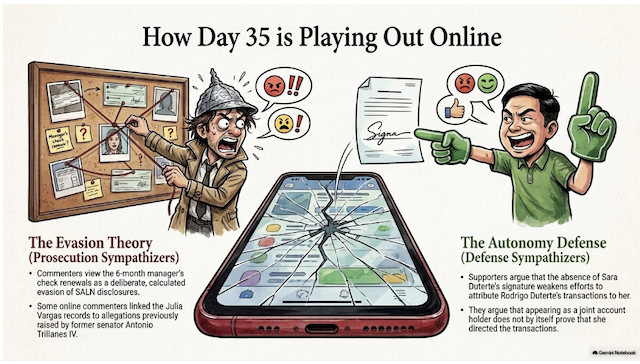
Online discussion quickly focused on the manager’s checks.
Some commenters treated the repeated conversion of deposits into manager’s checks as evidence that money was intentionally kept away from December 31 account balances. Others questioned whether such transactions could have been used to avoid SALN disclosure.
The research also recorded online discussions linking the BPI Julia Vargas transactions to financial allegations previously raised by former senator Antonio Trillanes IV.
These remain online interpretations, not findings of the impeachment court.
Duterte supporters, meanwhile, focused on the absence of Sara Duterte’s signature on the BPI documents.
Their argument is that if Rodrigo Duterte could transact independently from the joint account, prosecutors cannot simply assume that every transaction involving the account was controlled or even known by Sara Duterte.
The documents shown in court support one part of that argument: Sara Duterte’s signature was not on the transactions examined.
But the impeachment court still has to decide whether she had an ownership interest, control over the funds or an obligation to disclose them.
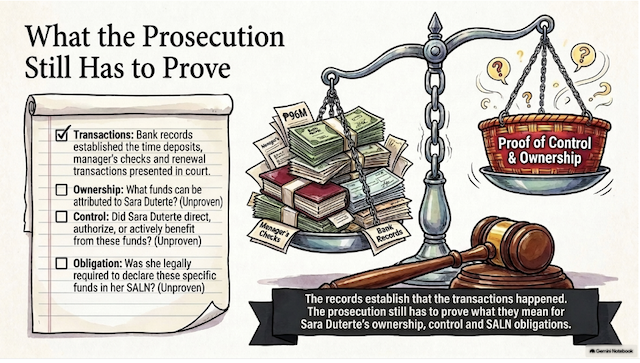
What Day 35 established
The prosecution produced bank testimony showing that substantial amounts moved through accounts carrying Sara Duterte’s name and explained how money converted into manager’s checks would no longer appear as a balance in the original deposit account at year-end.
The defense, in turn, showed that the BPI documents presented in court did not contain Sara Duterte’s signature on the transactions involving the ?41.7 million time deposit.
No one is disputing that the transactions happened. The issue is whether the prosecution can prove that Sara Duterte owned, controlled or was required to declare the funds.
The bank records alone do not answer whether the money was Sara Duterte’s, whether she controlled it, or whether it should have appeared in her SALN.
That is what the Senate impeachment court still has to determine from the evidence presented by both sides.
The Impeachment court granted the subpoenas the spliced Cayetano video framed as baseless

Fourteen out of twenty: What Day 29 changed in the Sara Duterte Impeachment trial

Day 26 Sara Duterte Impeachment trial : What her SALNs show, and what they don’t
About The Author

Noemi Lardizabal-Dado
Noemi Lardizabal-Dado is a content strategist with over 19 years of experience in blogging, content management, citizen advocacy, and media literacy, and over 30 years in web development. Otherwise known as @MomBlogger on social media, she believes in making a difference in the lives of her children by advocating for social change that benefits the greater good. She is a co-founder and a member of the editorial board of Blog Watch . She is a resource speaker on media literacy, social media, blogging, digital citizenship, good governance, transparency, parenting, women’s rights, wellness, and cyber safety. Her personal blogs such as aboutmyrecovery.com (parenting) , pinoyfoodblog.com (recipes), techiegadgets.com (gadgets) and benguetarabica.coffee keep her busy outside of Blog Watch. Disclosure: I am an advocate. I am NOT neutral. I will NOT give social media mileage to members of political clans, epal, a previous candidate for the same position and those I believe are a waste of taxpayers' money. I do not support or belong to any political party. I was part of accredited media covering the Office of the Vice President and Leni Robredo as she ran as a presidential aspirant in the 2022 National and local elections. On August 5, 2021, YouTube announced that I was selected as one of 50 Program participants of its Creator Program for Independent Journalists She was a Senior Consultant for ALL media engagements for the PCOO-led Committee on Media Affairs & Strategic Communications (CMASC) under the ASEAN 2017 National Organizing Council from January 4 -July 5, 2017. Having been an ASEAN advocate since 2011, she has written extensively about the benefits of the ASEAN community and as a region of opportunities on Blog Watch and aboutmyrecovery.com. Organization affiliation includes Consortium on Democracy and Disinformation Updated June 6, 2022