Day 34 Sara Duterte Impeachment trial: The P4.4-billion question moves from AMLC summaries to bank records
On Day 34 of Vice President Sara Duterte’s impeachment trial, the defense won an important clarification from the Anti-Money Laundering Council: billions of pesos in reported transactions do not automatically mean billions in unexplained wealth.
But that did not end the inquiry.
Instead, the Senate impeachment court moved closer to the records behind those numbers, as the prosecution began calling bank officials to authenticate Duterte’s accounts and transactions.
That distinction matters. The AMLC data can identify financial activity that banks were required or prompted to report. It cannot, by itself, prove that the money was illegally acquired. Day 34 showed that the next phase of Article II will depend on whether the prosecution can connect the transactions to actual bank records, declared assets and lawful sources of income.
The research provided for this article correctly identifies this shift, although several claims needed qualification after checking them against current news reports and official records. Sara Duterte Impeachment Day 34
Five things to know from Day 34
1. The defense established an important limit to the AMLC evidence
During cross-examination, AMLC Executive Director Ronel Buenaventura confirmed that simply reading a Covered Transaction Report or Suspicious Transaction Report does not allow the AMLC to conclude that the money came from an unlawful activity. He also said the AMLC had not independently verified whether all information contained in the reports was accurate.
That is an important distinction.
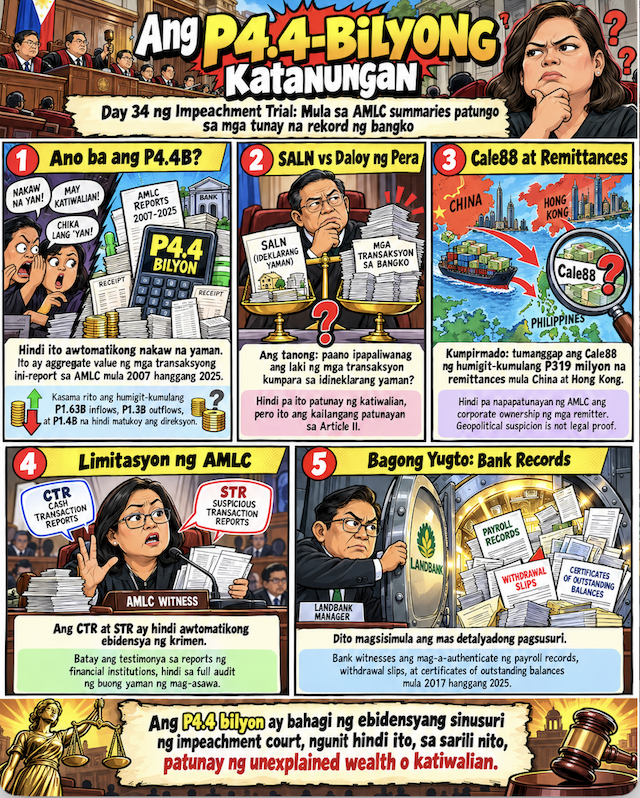
The P4.4 billion discussed in the trial represents the aggregate value of covered and suspicious transactions reported in connection with Duterte and her husband, Manases Carpio, from 2007 to 2025. It is not a finding that they possessed P4.4 billion in unexplained wealth, nor is an STR by itself proof of money laundering.
AMLC records showed about P1.63 billion in inflows, P1.3 billion in outflows and another P1.4 billion whose direction could not be determined.
This is where some social media shorthand becomes misleading. “P4.4 billion in transactions” and “P4.4 billion in stolen or unexplained money” are not interchangeable claims.
2. The P4.4-billion figure was corrected before the records reached the impeachment court
The research describes the reduction from an earlier P6.7-billion figure as resulting from a BPI “technical reporting glitch.” That wording goes farther than what I could independently verify.
Buenaventura testified that one of the covered institutions corrected 13 transaction reports and that the AMLC validated its data before submitting the records requested by the Senate. On Day 34, he stressed that the records submitted to the impeachment court were already the corrected set.
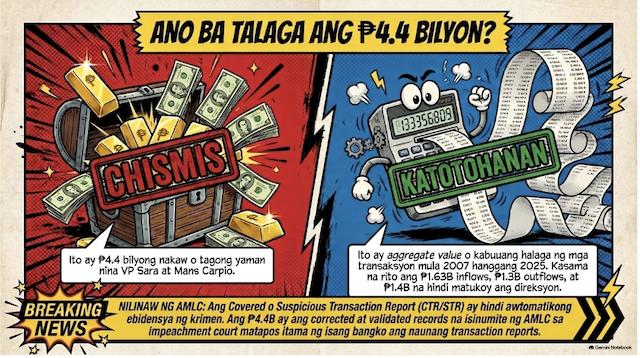
So the safer formulation is this: the earlier figure changed after corrections and AMLC validation.
The defense can use that history to question the reliability of the raw reporting process. But it does not follow that the P4.4-billion figure currently before the court is itself an acknowledged error.
3. Escudero pressed the gap between reported transactions and declared wealth
The significance of the AMLC figures became clearer when Presiding Officer Francis Escudero questioned how the financial activity compared with Duterte’s declarations of wealth.
The research records Escudero comparing the volume of transactions with the couple’s SALNs and asking Buenaventura to explain the difference. Buenaventura said he could not do so because the AMLC receives and organizes transaction reports rather than conducting a full audit of the couple’s finances. Sara Duterte Impeachment Day 34
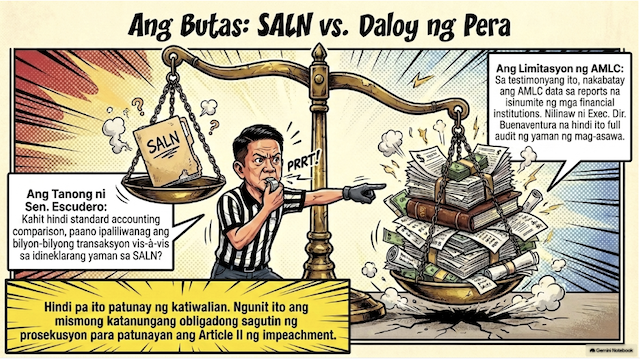
That exchange should not be read as proof of wrongdoing. It identifies the question that Article II now has to answer.
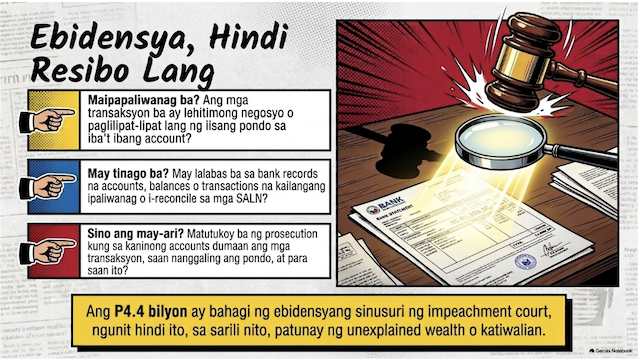
Were the transactions ordinary movements of legitimate money, business receipts, transfers between accounts or other explainable activity? Or do authenticated bank records reveal assets or financial flows that cannot be reconciled with the disclosures required of a public official?
The AMLC witness could not answer that. The prosecution will have to.
4. The P319 million received by Cale88 is confirmed, but the China issue needs careful wording
Buenaventura confirmed that Cale88 Foods Corporation, a company linked to Carpio, received about P319 million in remittances from China and Hong Kong.
During Day 34, Sen. Risa Hontiveros separately raised the claim that some companies sending money to Cale88 were Chinese state-owned enterprises. That assertion should be attributed to Hontiveros rather than presented as an AMLC finding.
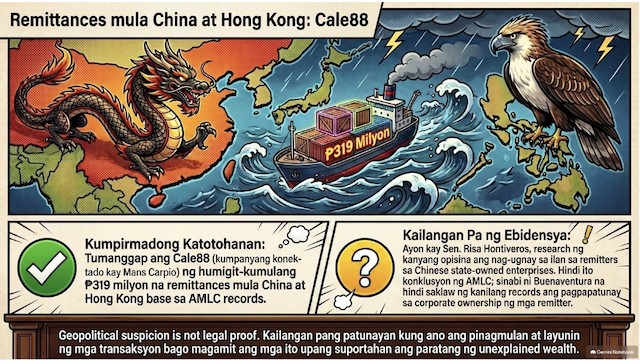 The research itself records another qualification: under questioning, Buenaventura said the AMLC records did not establish that the remitting companies were themselves direct organs of the Chinese government. Sara Duterte Impeachment Day 34
These are two different propositions.
The remittances are documented. Whether particular senders have state ownership, what commercial transactions the payments represented and whether any of the money has relevance to Article II still require evidence.
That is especially important because geopolitical suspicion cannot substitute for proof of unlawful enrichment.
5. The case began moving from AMLC summaries to actual bank documents
Perhaps the most consequential development came after Buenaventura’s testimony.
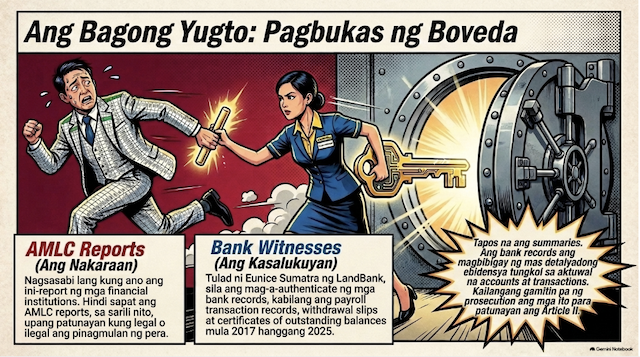
The prosecution called LandBank official Eunice Sumatra as its first bank witness. The research states that she was asked to authenticate records including payroll transactions, withdrawal slips and certificates of outstanding balances covering 2017 to 2025. Sara Duterte Impeachment Day 34
The House prosecution has said it intends to rely on financial evidence and bank and insurance representatives as the Article II presentation continues.
This changes the character of the inquiry.
AMLC reports tell the court what financial institutions reported. Bank witnesses can tell the court what the underlying accounts actually show.
That is where the unexplained-wealth allegation will face a more demanding test.
The defense apology mattered, too
Day 34 began with defense lawyer Mark Vinluan apologizing to the senator-judges over his remarks during the previous day’s cross-examination.
Vinluan had repeatedly raised possible criminal liability arising from the disclosure of confidential financial information. Senator-judges objected to what they regarded as threatening or intimidating language.
On Tuesday, Vinluan told the court that the defense intended only to test Buenaventura’s credibility and said he would be “more circumspect moving forward.” Escudero said the manifestation was well taken.
The episode matters beyond courtroom decorum. An impeachment proceeding must allow aggressive cross-examination while protecting witnesses, journalists and the court itself from intimidation.
The evidence should be contested through evidence.
What netizens were talking about
Online discussion remained heavily divided, but readers should be careful about treating comment sections as a public-opinion survey.
In a Day 34 Reddit discussion, much of the immediate chatter focused on the personalities and courtroom exchanges, including jokes about the defense lawyers and objections during the bank testimony. Other commenters turned their attention to the arrival of the LandBank witness and what authenticated bank records could add to the case.
The larger arguments visible around the trial followed two competing interpretations.
Duterte supporters pointed to the AMLC chief’s concessions: a covered or suspicious transaction is not itself proof of a crime, transactions can represent repeated movements of the same money, and the earlier aggregate had been corrected.
Critics focused instead on the scale of the transactions and asked whether Duterte and Carpio could document their sources and reconcile them with required financial disclosures.
Both sides now have something they can cite from the record. Neither side can fairly treat Day 34 as a verdict.
Follow the records, not the headline number
Day 34 narrowed the argument.
The defense showed why ?4.4 billion cannot simply be labeled unexplained wealth. The prosecution, meanwhile, has begun doing what it must do if Article II is to survive that objection: move past AMLC summaries and put the underlying bank records before the impeachment court.
For citizens following the trial, that is the record worth watching.
When the next bank witness takes the stand, the question is no longer whether billions of pesos appeared in an AMLC table. We already know they did.
The question is whether the prosecution can trace those transactions, identify who owned the money and show what, if anything, Sara Duterte was required to declare but did not.
Until those records are tested, ?4.4 billion is a lead. It is not yet a verdict.
Day 39: Three articles dropped, One unexplained-wealth case left

Day 33 Sara Duterte impeachment trial: AMLC puts ?4.4 billion in reported transactions before the Senate

Day 18 of Sara Duterte Impeachment Trial: The P250M request came before the plan
About The Author

Noemi Lardizabal-Dado
Noemi Lardizabal-Dado is a content strategist with over 19 years of experience in blogging, content management, citizen advocacy, and media literacy, and over 30 years in web development. Otherwise known as @MomBlogger on social media, she believes in making a difference in the lives of her children by advocating for social change that benefits the greater good. She is a co-founder and a member of the editorial board of Blog Watch . She is a resource speaker on media literacy, social media, blogging, digital citizenship, good governance, transparency, parenting, women’s rights, wellness, and cyber safety. Her personal blogs such as aboutmyrecovery.com (parenting) , pinoyfoodblog.com (recipes), techiegadgets.com (gadgets) and benguetarabica.coffee keep her busy outside of Blog Watch. Disclosure: I am an advocate. I am NOT neutral. I will NOT give social media mileage to members of political clans, epal, a previous candidate for the same position and those I believe are a waste of taxpayers' money. I do not support or belong to any political party. I was part of accredited media covering the Office of the Vice President and Leni Robredo as she ran as a presidential aspirant in the 2022 National and local elections. On August 5, 2021, YouTube announced that I was selected as one of 50 Program participants of its Creator Program for Independent Journalists She was a Senior Consultant for ALL media engagements for the PCOO-led Committee on Media Affairs & Strategic Communications (CMASC) under the ASEAN 2017 National Organizing Council from January 4 -July 5, 2017. Having been an ASEAN advocate since 2011, she has written extensively about the benefits of the ASEAN community and as a region of opportunities on Blog Watch and aboutmyrecovery.com. Organization affiliation includes Consortium on Democracy and Disinformation Updated June 6, 2022