
Day 24 of Sara Duterte Impeachment Trial: The trial paused, the financial records moved forward
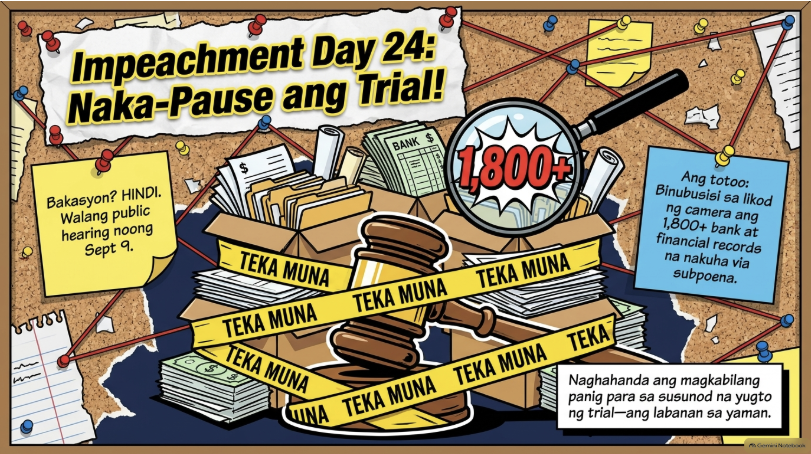
There was no public impeachment hearing on September 9.
Instead, the Senate impeachment court set aside September 9 and 10 for prosecutors and the defense to work through more than 1,800 bank, insurance and other financial records ahead of the next phase of Vice President Sara Duterte’s trial.

The documents were produced under subpoenas and are being marked in preparation for Article II, which deals with the allegation of unexplained wealth. The trial is scheduled to resume on September 14.
It may look like two quiet days after weeks of witness testimony. But what happens to these documents matters. The marking process identifies and organizes evidence for later presentation. Questions about authenticity, ownership and what the records actually prove are still to be fought over in court.
Five things to know from Day 24
- More than 1,800 financial records are being prepared for Article II
The records include bank and insurance documents obtained through subpoenas. Article II accuses Duterte of betrayal of public trust for allegedly accumulating wealth disproportionate to her lawful income and failing to fully and truthfully disclose assets and liabilities in her Statements of Assets, Liabilities and Net Worth (SALNs). The prosecution says it will begin presenting this case on September 14.
The volume alone does not prove the charge. That will depend on what the documents contain, whether they are authenticated and how the prosecution connects them to Duterte’s declared assets and lawful income.
- The prosecution stopped calling Article I witnesses, but Article I is not technically closed
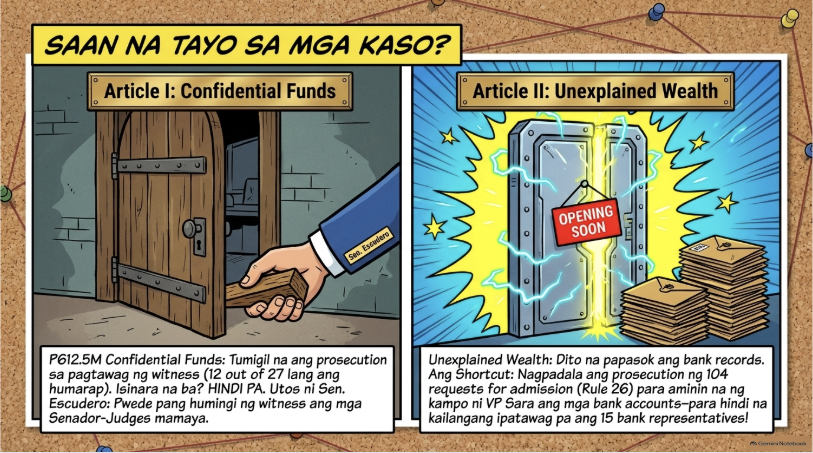
On September 8, private prosecutor Lorna Kapunan announced that the prosecution would no longer call its remaining 15 witnesses on Article I, which covers the alleged misuse and irregular liquidation of P612.5 million in confidential funds. Prosecutors had presented 10 witnesses and stipulated to the testimony of two others, or 12 of the 27 originally listed.
That does not mean the impeachment court has formally shut the door on Article I. Presiding Officer Francis “Chiz” Escudero directed the prosecution not to formally rest Article I yet. The court may later decide whether it needs additional witnesses after both sides finish presenting their evidence.
That distinction matters. The prosecution has stopped presenting its planned witnesses for now, but senator-judges have not given up their power to seek more testimony.
- The P6.77-billion figure needs context
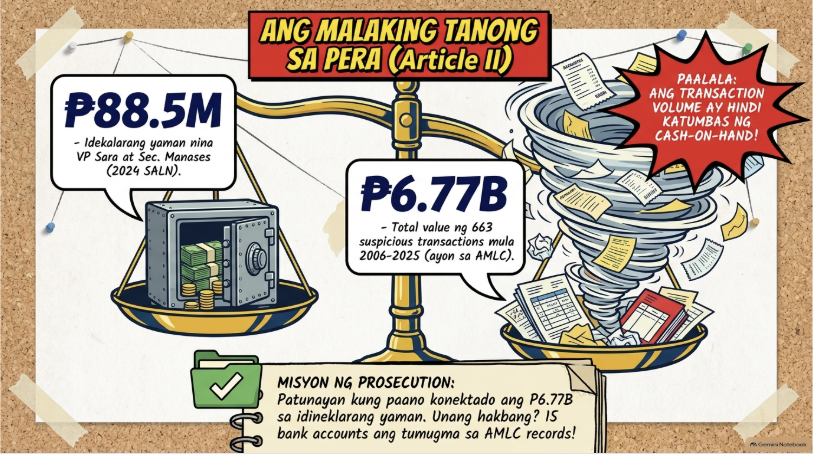
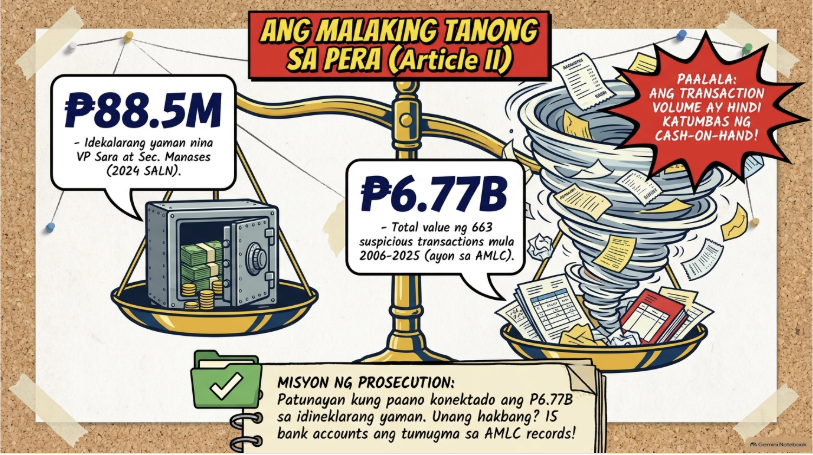
The House prosecution says an Anti-Money Laundering Council report covers 663 covered and suspicious transactions involving Duterte and her husband, lawyer Manases Carpio, with an aggregate value of about P6.77 billion from 2006 to 2025. About P3.77 billion was linked to Duterte and P2.99 billion to Carpio. AMLC Executive Director Ronel Buenaventura earlier confirmed the transaction data before the House justice committee.
But P6.77 billion in transactions is not the same as P6.77 billion in net worth or cash sitting in an account. It is the total value of reported transactions over many years. Even a transaction classified as suspicious does not by itself establish unlawful activity, a point Duterte’s defense has raised.
Duterte and Carpio reported a net worth of about P88.5 million in their 2024 SALN. Their SALNs from 2019 to 2024 did not separately list cash on hand or bank deposits, according to records submitted by the Ombudsman. Defense lawyer Michael Poa later said the cash was included under “others” in the personal-property section.
This is why Article II cannot be reduced to a comparison between P88.5 million and P6.77 billion. Prosecutors still have to establish what the transactions represent and how they relate to the allegations in the impeachment article.
There is one new development. House prosecutor Joel Chua said on September 9 that prosecutors had initially cross-checked 15 bank accounts and that all 15 matched details in AMLC records. That is the prosecution’s account of its review. The records have yet to be tested through the Article II presentation and defense questioning.
- The prosecution wants Duterte to admit or deny ownership of the bank accounts
Before the September 8 hearing, prosecutors served Duterte’s lawyers with 104 requests for admission. They want her to confirm whether subpoenaed bank records are genuine and whether the accounts identified in those records belong to her individually or jointly with other people.
Why does this matter? If the defense agrees that particular records and accounts are authentic, prosecutors would not have to spend as much court time calling bank officials simply to establish those facts. The House says as many as 15 bank representatives could otherwise be needed.
But there is still a legal question. Duterte’s lawyers questioned whether Rule 26 of the Rules of Court, which governs requests for admission in civil cases, applies to an impeachment trial. The impeachment court gave the defense 15 days to respond. It has not yet settled the broader question of how Rule 26 applies here.
- Two constitutional disputes remain unresolved
The first is whether Duterte herself can be compelled to testify.
Kapunan said prosecutors intend to present Duterte as a witness after they have presented evidence on all four impeachment articles. But the prosecution has not yet filed a formal motion asking the court to subpoena her. The defense argues that compelling Duterte to take the stand would violate the constitutional right against self-incrimination. Escudero has not ruled on the issue.
The second dispute may eventually affect the verdict itself.
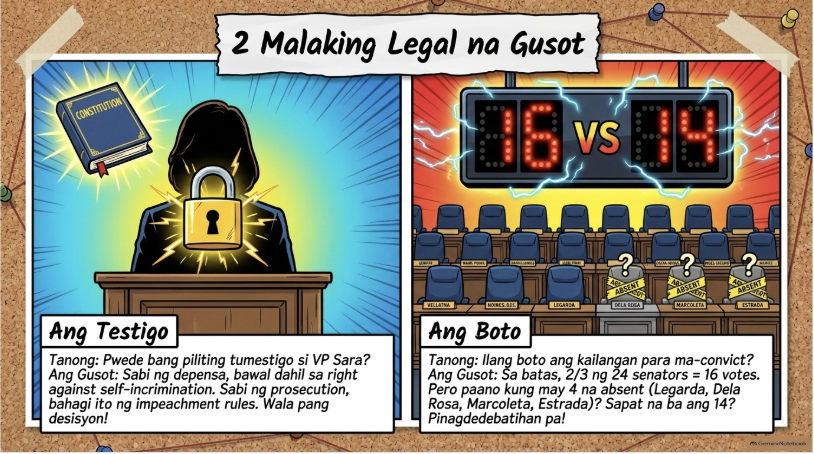
Article XI, Section 3(6) of the Constitution says: “No person shall be convicted without the concurrence of two-thirds of all the Members of the Senate.” With 24 Senate seats, the impeachment court had earlier set the conviction threshold at 16 votes.
Senator-judge Erwin Tulfo asked the court to reconsider who should count when four senators are currently unable to attend the trial. Senators Loren Legarda, Ronald dela Rosa, Rodante Marcoleta and Jinggoy Estrada have all been absent for different reasons. Tulfo questioned whether their inability to participate should effectively work against conviction. Senator-judge Pia Cayetano challenged his interpretation, while Robin Padilla argued that the constitutional wording should stand.
The court has not lowered the threshold to 14. Escudero scheduled September 16 for the views of invited amici curiae, or friends of the court. The prosecution and defense are scheduled to make oral arguments on September 23, after which the Senate is expected to vote on the threshold question.
What netizens are talking about
Since there was no hearing on September 9, much of the online discussion carried over from the previous day’s developments.
In the r/Philippines impeachment megathread, users were already arguing about the same question now before the senator-judges: should senators who have not been attending the proceedings count in deciding the final outcome? One commenter questioned giving voting power to senators who had not been listening to or participating in the trial. Another pushed back by pointing to the Constitution’s reference to all Senate members.
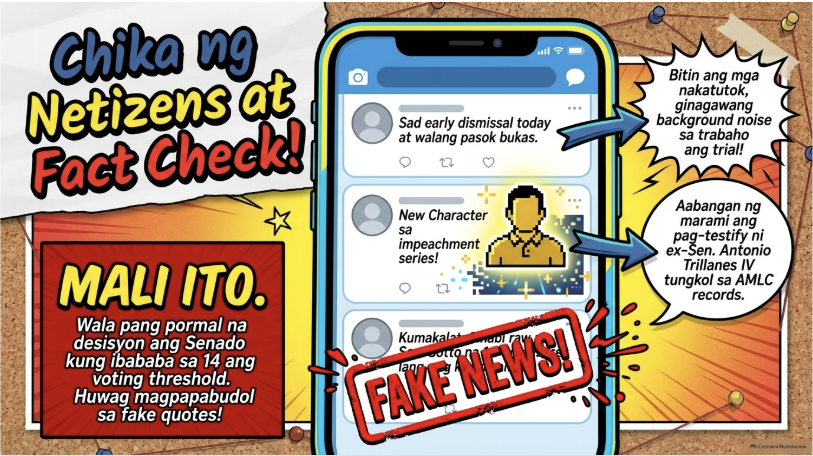
Other commenters were simply disappointed by the break. One wrote, “sad early dismissal today at walang pasok bukas.” Another described the impeachment coverage as background noise while working. These comments say something about how closely some Filipinos are following the hearings, but they are individual Reddit reactions, not a measure of national public opinion.
The announcement that former senator Antonio Trillanes IV is expected to testify under Article II also drew attention. A highly engaged r/newsPH thread had one commenter calling him a “New character sa impeachment series…” Other users anticipated how his testimony would play out before the senator-judges. The House prosecution says Trillanes is expected to testify about financial information that prosecutors say has previously been checked against AMLC records.
The voting-threshold debate also shows why claims circulating online need to be checked against the actual court record. VERA Files previously debunked a fake post claiming that Senator Tito Sotto had said 14 votes were enough to convict Duterte. He did not say that. The impeachment court has not adopted a 14-vote threshold.
Three dates to watch
September 14 is when Article II is scheduled to begin and the financial documents move from exhibit preparation into testimony and argument.
September 16 is when the impeachment court plans to hear constitutional experts on who should count when determining the votes required for conviction.
September 23 is when prosecution and defense are scheduled to argue the threshold question, followed by a Senate vote on the issue.

Those dates give citizens something more useful than speculation between hearings. We can check which financial records are actually presented, what the witnesses say about them, what the defense contests and what rule the Senate finally adopts.
The boxes of documents may be less dramatic than a witness on the stand. By September 23, however, we should know much more about both the money being questioned and the rules that will decide Duterte’s political fate. Watch the record, not the rumor cycle between hearings.

Day 10 of Sara Duterte’s impeachment trial: What “unusual but not suspicious” really means

Day 11 of Sara Duterte’s impeachment trial: When confidential funds met the receipts

Day 14 of the Sara Duterte impeachment trial: One officer, many provinces, and what the receipts actually prove
About The Author

Noemi Lardizabal-Dado
Noemi Lardizabal-Dado is a content strategist with over 19 years of experience in blogging, content management, citizen advocacy, and media literacy, and over 30 years in web development. Otherwise known as @MomBlogger on social media, she believes in making a difference in the lives of her children by advocating for social change that benefits the greater good. She is a co-founder and a member of the editorial board of Blog Watch . She is a resource speaker on media literacy, social media, blogging, digital citizenship, good governance, transparency, parenting, women’s rights, wellness, and cyber safety. Her personal blogs such as aboutmyrecovery.com (parenting) , pinoyfoodblog.com (recipes), techiegadgets.com (gadgets) and benguetarabica.coffee keep her busy outside of Blog Watch. Disclosure: I am an advocate. I am NOT neutral. I will NOT give social media mileage to members of political clans, epal, a previous candidate for the same position and those I believe are a waste of taxpayers' money. I do not support or belong to any political party. I was part of accredited media covering the Office of the Vice President and Leni Robredo as she ran as a presidential aspirant in the 2022 National and local elections. On August 5, 2021, YouTube announced that I was selected as one of 50 Program participants of its Creator Program for Independent Journalists She was a Senior Consultant for ALL media engagements for the PCOO-led Committee on Media Affairs & Strategic Communications (CMASC) under the ASEAN 2017 National Organizing Council from January 4 -July 5, 2017. Having been an ASEAN advocate since 2011, she has written extensively about the benefits of the ASEAN community and as a region of opportunities on Blog Watch and aboutmyrecovery.com. Organization affiliation includes Consortium on Democracy and Disinformation Updated June 6, 2022