
Day 14 of the Sara Duterte impeachment trial: One officer, many provinces, and what the receipts actually prove
“Clearly it’s physically impossible to be in all of these locations in one day.”
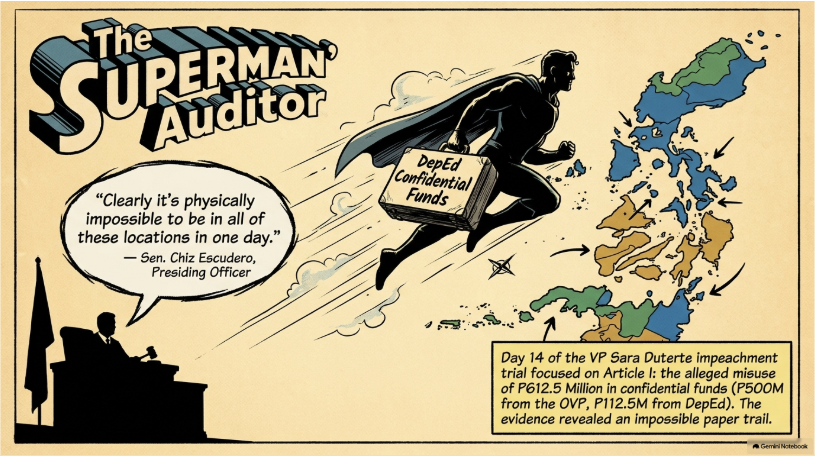
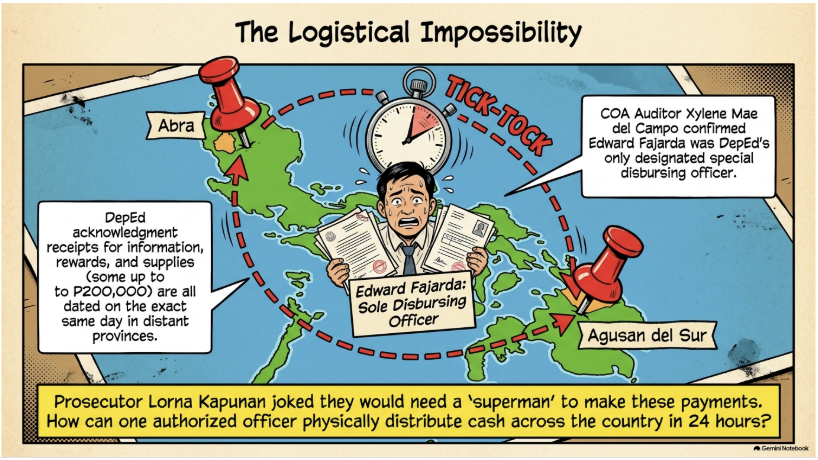
That was Senate impeachment court presiding officer Francis “Chiz” Escudero after Commission on Audit auditor Xylene Mae del Campo went through Department of Education acknowledgment receipts showing confidential-fund payments dated on the same day but recorded in provinces from Abra to Agusan del Sur. DepEd had only one designated special disbursing officer, Edward Fajarda.
That exchange captured the main issue on Day 14 of Vice President Sara Duterte’s impeachment trial on August 11. The hearing continued the prosecution’s presentation of evidence under Article I, which accuses Duterte of misusing P612.5 million in confidential funds: P500 million from the Office of the Vice President and P112.5 million from DepEd. Article I testimony actually began on July 29, or Day 10, so Day 14 was a continuation, not the start of this phase of the trial.
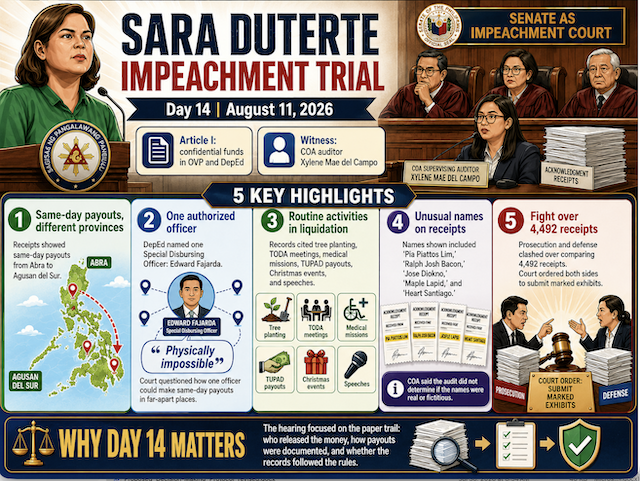
The attached research identified the same-day disbursements, OVP activities linked to confidential operations, unusual names on receipts and the dispute over documents as the main developments. I checked those claims against current reporting and the government rules on confidential funds before including them here.
Five things to know from Day 14
- One authorized officer, payments recorded across different provinces on the same day. Del Campo confirmed sets of DepEd acknowledgment receipts dated on the same day in different parts of the country. Some were for as much as P200,000 and were described as payments for information, rewards or supplies. She testified that Fajarda was DepEd’s only designated special disbursing officer and that COA had not been given documents showing authority for somebody else to perform his disbursing function. Escudero then raised the obvious logistical problem: how could one authorized officer make those payments in distant locations on the same day? Prosecutor Lorna Kapunan jokingly referred to “superman.” The rules being discussed come from Joint Circular No. 2015-01, the government guidelines covering the entitlement, release, use, reporting and audit of confidential and intelligence funds.
- Fajarda’s earlier account of handing the money to a security officer came back into the picture. Del Campo recalled Fajarda’s testimony at a House hearing that he turned over the funds to Col. Dennis Nolasco of the Vice Presidential Security and Protection Group. She told the impeachment court that such a transfer violated the joint circular because the disbursing responsibility assigned to the SDO could not simply be passed to another person. This matters because the same-day receipts do not, by themselves, establish that Fajarda personally traveled to every location. What they establish is a mismatch the court will have to examine between the records and the rule identifying who was authorized to disburse the money.

3. Tree planting, rice distribution and other activities appeared in documents submitted to support confidential-fund operations. Del Campo testified that OVP documents offered as proof of successful operations included rice distributions, medical missions, TUPAD payouts, tree-planting activities and Duterte’s speaking engagements. Certifications accompanying some activities said that “there were no untoward incidents.” Del Campo said that statement did not show the particular accomplishment needed to justify reward payments to informants. She also confirmed that some expenses occurred before the corresponding cash advance was released, effectively making them reimbursements, which the joint circular prohibits. Reporting by ABS-CBN separately identified Christmas activities, TODA meetings and tree planting among the activities examined during her testimony.
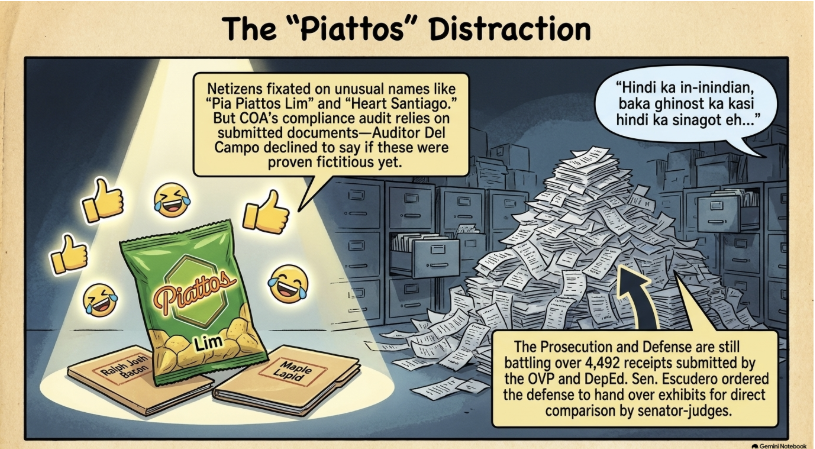
4. More unusual names appeared, but Day 14 did not prove that the people were fictitious. Receipts displayed by the prosecution included the names “Pia Piattos Lim,” “Ralph Josh Bacon,” “Jose Diokno,” “Maple Lapid” and “Heart Santiago.” The names naturally attracted attention because some resemble snack brands or well-known surnames. But there is an important limit to what Del Campo’s testimony established. She declined to say whether those were real people, explaining that COA’s compliance audit relied on the documents submitted to it. So it would be inaccurate at this stage to describe “Pia Piattos Lim” or “Ralph Josh Bacon” as proven fake beneficiaries.
5. The prosecution and defense were still fighting over 4,492 acknowledgment receipts. The Senate impeachment court had ordered the two sides to compare 4,492 receipts submitted by the OVP and DepEd. ( On Day 14, Kapunan complained that the defense had not agreed to meet within the earlier timetable. Defense lawyer Kristine Ferrer argued that comparing the documents was unnecessary because their authenticity would ultimately be decided by the court after the prosecution formally offered its evidence. Escudero ended the dispute by directing the defense to give the court its marked exhibits so the court or individual senator-judges could perform the comparison themselves.
The procedural argument also produced one of the day’s lighter moments. After Kapunan said the prosecution had been “na-Indian,” Escudero replied: “The chair would just like to correct. Hindi ka, Atty. Lorna, in-inindian, baka ghinost ka kasi hindi ka sinagot eh. Pero hindi ka in-inindian, wala namang pina-usapang date pa eh.”
What netizens were saying
Among the public posts that can be verified, the unusual names received much of the attention. On X, Jesus Falcis called attention to “Pia Piattos-Lim” as one of the newly disclosed names appearing in confidential-fund records. Another X account, Laitera, joked about a growing “Piattos” family after Mary Grace Piattos and other similar names had surfaced in previous hearings.
There was also a more cautious reaction. One X user argued that the real issue should not stop at whether an alias was used, but whether there was accountability for the money behind it. That distinction is worth keeping in mind because Del Campo herself did not testify that the Day 14 names were fictitious.
These individual posts should not be treated as a measure of national opinion. The better indicator available on August 11 is an OCTA Research survey conducted July 4 to 11. It found that 55 percent of respondents preferred to see the evidence presented at trial before deciding whether Duterte should be convicted or acquitted. Seventeen percent favored conviction, 21 percent favored acquittal and seven percent remained undecided.
What Day 14 actually leaves us with
“Pia Piattos Lim” and “Superman” make easy social media material. The more important record from Day 14 is less funny.
There was one officer formally authorized to disburse DepEd’s confidential funds. The records put payments on the same dates in far-apart provinces. There were OVP certifications meant to support millions in confidential-fund expenditures that a COA auditor said did not adequately establish the accomplishments behind the rewards. And there are thousands of receipts that still have to be admitted, examined and weighed by the impeachment court.
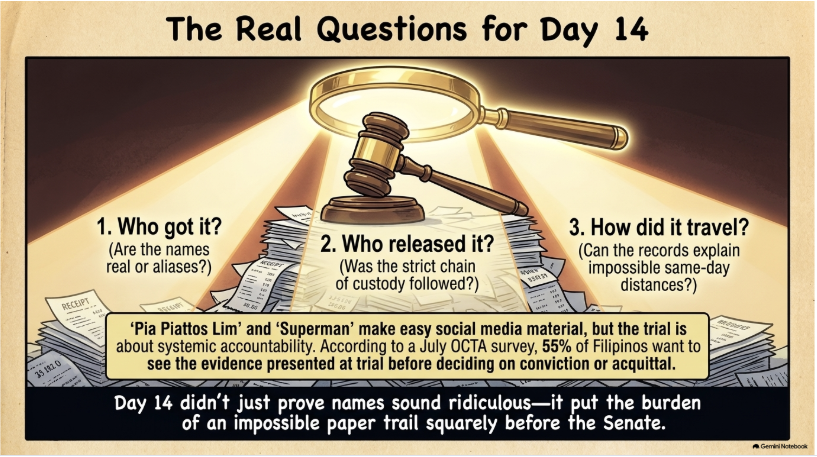
Day 14 did not establish that every strange name was fake, nor did Del Campo’s testimony alone establish Duterte’s personal responsibility for every questioned transaction. Those are distinctions worth preserving as the trial continues.
So when “Pia Piattos Lim” or “Superman” shows up on our feeds, the better question is not whether the names sound ridiculous. It is whether the evidence can show who actually received the money, who had authority to release it, and how the records can account for payments made across distant provinces on the same day. Day 14 put those questions squarely before the Senate.

Day 25 Sara Duterte Impeachment Trial : The law before the bank records

Day 7 impeachment trial of Sara Duterte: The subpoena finally came through

Day 39: Three articles dropped, One unexplained-wealth case left
About The Author

Noemi Lardizabal-Dado
Noemi Lardizabal-Dado is a content strategist with over 19 years of experience in blogging, content management, citizen advocacy, and media literacy, and over 30 years in web development. Otherwise known as @MomBlogger on social media, she believes in making a difference in the lives of her children by advocating for social change that benefits the greater good. She is a co-founder and a member of the editorial board of Blog Watch . She is a resource speaker on media literacy, social media, blogging, digital citizenship, good governance, transparency, parenting, women’s rights, wellness, and cyber safety. Her personal blogs such as aboutmyrecovery.com (parenting) , pinoyfoodblog.com (recipes), techiegadgets.com (gadgets) and benguetarabica.coffee keep her busy outside of Blog Watch. Disclosure: I am an advocate. I am NOT neutral. I will NOT give social media mileage to members of political clans, epal, a previous candidate for the same position and those I believe are a waste of taxpayers' money. I do not support or belong to any political party. I was part of accredited media covering the Office of the Vice President and Leni Robredo as she ran as a presidential aspirant in the 2022 National and local elections. On August 5, 2021, YouTube announced that I was selected as one of 50 Program participants of its Creator Program for Independent Journalists She was a Senior Consultant for ALL media engagements for the PCOO-led Committee on Media Affairs & Strategic Communications (CMASC) under the ASEAN 2017 National Organizing Council from January 4 -July 5, 2017. Having been an ASEAN advocate since 2011, she has written extensively about the benefits of the ASEAN community and as a region of opportunities on Blog Watch and aboutmyrecovery.com. Organization affiliation includes Consortium on Democracy and Disinformation Updated June 6, 2022