Day 21 Sara Duterte Impeachment Trial: Poa knew the COA reply, not the spending
Michael Poa was the Department of Education official who helped answer the Commission on Audit when it questioned the agency’s confidential fund spending. But on Day 21 of Vice President Sara Duterte’s impeachment trial, Poa repeatedly said he had no firsthand knowledge of how the money was actually used on the ground.
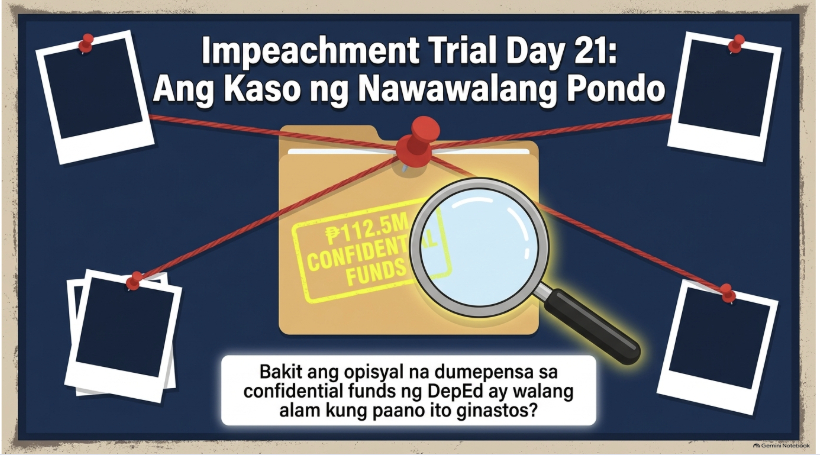
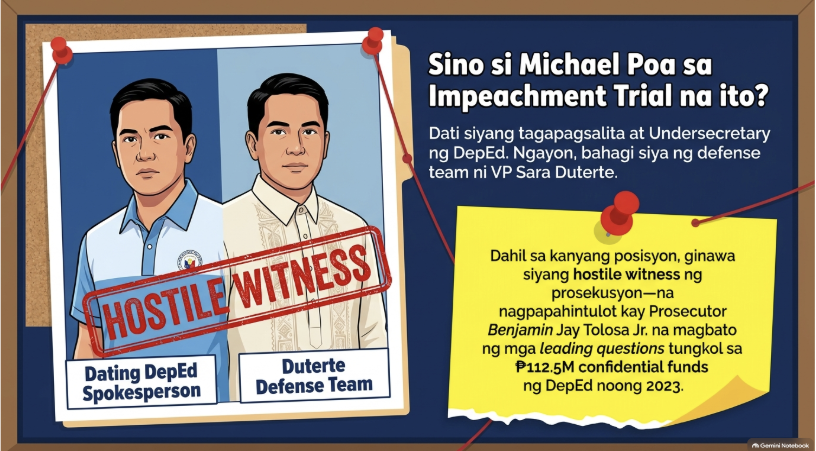
That made his testimony unusual. Poa is now part of Duterte’s defense team, but the House prosecution called him to testify about the ?112.5 million in confidential funds spent by DepEd in 2023, when Duterte was education secretary. The Senate impeachment court declared him a hostile witness, allowing private prosecutor Benjamin “Jay” Tolosa Jr. to ask leading questions.
Article I covers the alleged misuse, misappropriation and irregular liquidation of ?612.5 million in confidential funds: ?500 million at the Office of the Vice President and ?112.5 million at DepEd. The House prosecution says it plans to finish presenting evidence on Article I by September 9.
Here are five points from Day 21 worth watching.
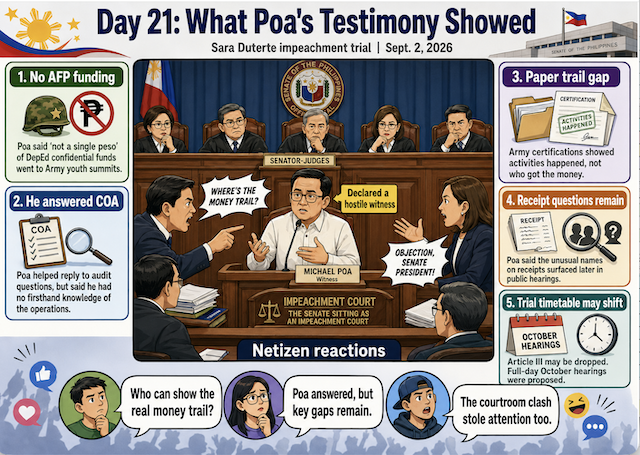
1. Poa confirmed no DepEd confidential funds went to the Army youth summits
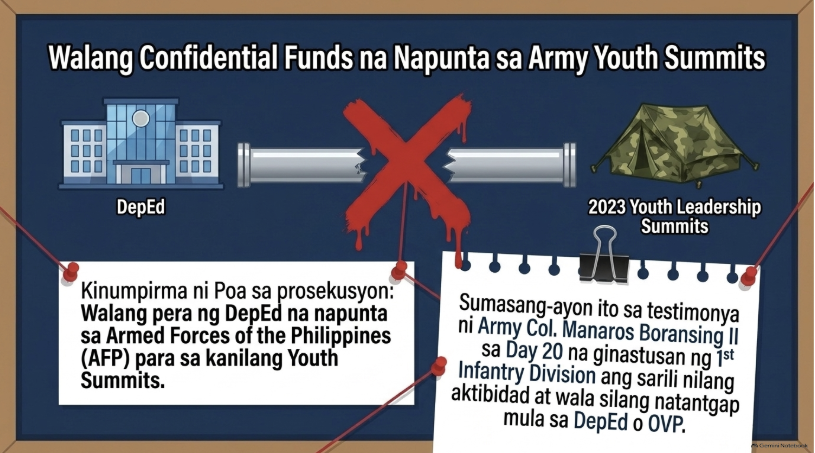
The clearest admission came when Tolosa asked whether DepEd confidential funds had been given to the Armed Forces of the Philippines for its 2023 Youth Leadership Summits.
“Yes sir, I confirm that,” Poa answered when the question was limited specifically to confidential funds.
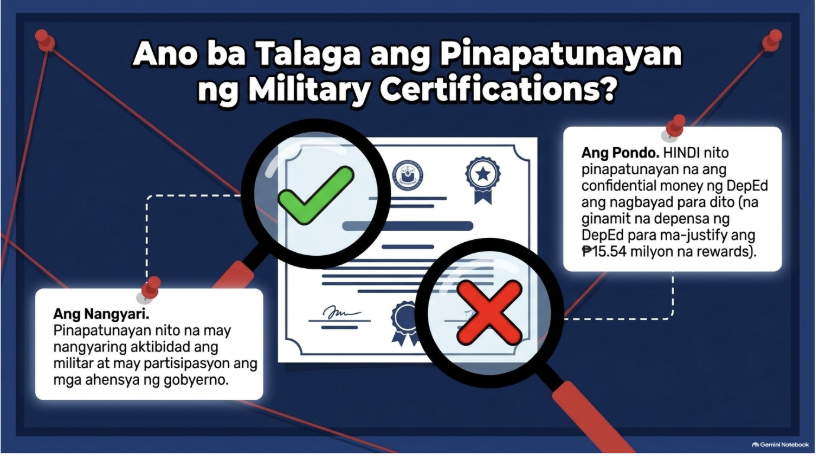
That matched the testimony of Army Col. Manaros Boransing II on Day 20. Boransing said his 1st Infantry Division financed its own youth activities and received no money from DepEd, the OVP or the Vice Presidential Security and Protection Group. He also said the certifications his unit issued merely confirmed that the activities took place and that government agencies participated. They did not certify confidential fund spending.
This matters because those military certifications became part of DepEd’s response to COA concerning ?15.54 million reported as rewards connected with confidential operations. Poa said he obtained the documents after asking then-Undersecretary Nolasco Mempin for reports that could support DepEd’s answer to the audit observation.
The certification proves that an Army activity happened. What remains disputed is whether it proves what DepEd said its confidential money paid for.
2. The official who answered COA did not know how the funds were spent
Poa’s lack of operational knowledge became the prosecution’s main line of questioning.
He served as DepEd undersecretary, chief of staff, spokesperson and officer-in-charge for finance. Yet he testified that his involvement with the confidential funds began only after COA issued an Audit Observation Memorandum, or AOM.
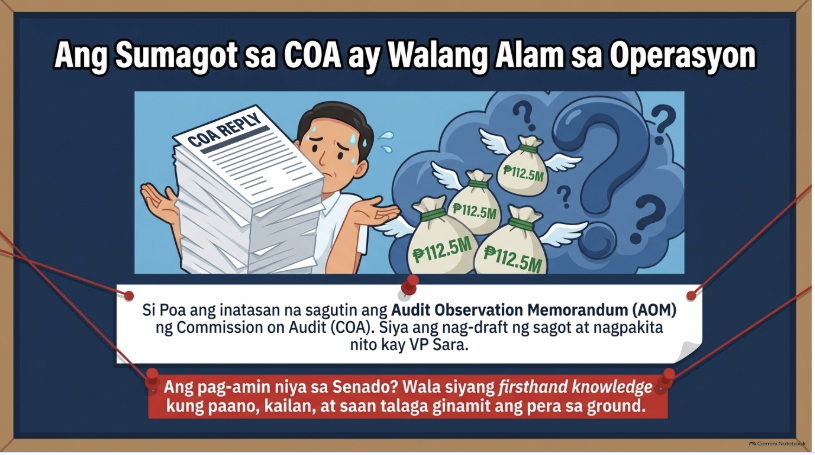
Poa said he informed Duterte about the AOM and asked permission to coordinate with then-special disbursing officer Edward Fajarda. He later briefed Duterte on his answers and gave her a soft copy before DepEd submitted its response to COA.
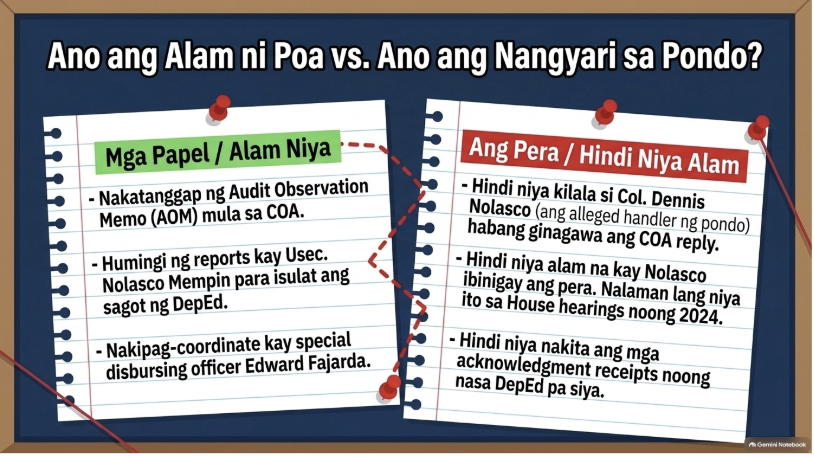
But Poa said he did not know at the time that DepEd security officer Col. Dennis Nolasco had allegedly been given the confidential funds for disbursement. He learned about Nolasco’s role only during the 2024 House hearings. Poa also said he never spoke with Nolasco while preparing the COA response.
Poa acknowledged that he remembered Fajarda’s earlier House testimony to the effect that Duterte had given authority for Nolasco to handle the money, although Poa cautioned that he could not recall Fajarda’s exact wording.
That leaves a fairly simple factual gap. DepEd had an official answering COA’s questions, but that official said he did not know one of the people who allegedly handled the money.
3. Poa could not connect the military papers to specific informant payments
Poa confirmed that the AFP certifications did not identify the confidential informants supposedly paid by DepEd. They also did not identify the specific information purchased from those informants.
He told the court that using the certifications as proof of a successful result was his interpretation. He did not claim personal knowledge that the information allegedly purchased with confidential funds actually produced the military activities mentioned in the certifications.
Poa also defended a broader reading of the confidential fund rules. He said not every piece of information purchased from an informant must immediately result in a successful operation, and acknowledged that this was his own understanding of the rules.
So there are two separate issues here. The defense disputes the idea that every informant payment needs an immediate operational result. The prosecution is asking a narrower evidentiary question: what document connects the ?15.54 million in claimed rewards to the activities cited in DepEd’s explanation?
Day 21 did not settle that question.
4. Poa said the unusual names surfaced only later
Senator-judge Erwin Tulfo also asked Poa about unusual names found in acknowledgment receipts, including “Mary Grace Piattos.”
Poa said he became aware of those names during the congressional investigation, when the receipts were displayed publicly. He told the court that he did not see the acknowledgment receipts while he was still at DepEd.
There is also an audit finding that should not be left out of the picture.
COA supervising auditor Xylene Mae del Campo previously testified that DepEd’s ?75 million in confidential fund spending for the first and second quarters of 2023 received a credit notice after auditors evaluated the liquidation documents. She said this meant the documents had been found in order at that stage of audit. She also explained that a settled account may still be reopened within three years in cases involving fraud, collusion or newly discovered material evidence.
That distinction matters. A credit notice is part of the defense’s answer to accusations that the spending was unsupported. But it does not prevent the impeachment court from examining new testimony about what the underlying documents actually proved.
5. The trial may get shorter, but the new calendar is not final
Away from Poa’s testimony, the prosecution disclosed that it is considering dropping Article III, the bribery charge involving alleged cash payments to DepEd officials.
Considering is the operative word.
Rep. Joel Chua said no final decision had been made. The prosecution is studying whether to move from Article I directly to Article II on alleged unexplained wealth.
The official House record confirms the four articles: Article I covers confidential funds, Article II unexplained wealth, Article III alleged bribery, and Article IV the alleged threats against President Ferdinand Marcos Jr., First Lady Liza Araneta-Marcos and former Speaker Martin Romualdez. The prosecution has already completed its presentation on Article IV.
Presiding officer Francis “Chiz” Escudero also proposed full-day trial sessions on October 1-2, October 5-9 and October 12-15, followed by a pause for budget work. Under the proposal, the court would meet again on November 9 and 16 before returning to a more regular trial schedule beginning November 23. Escudero stressed that the schedule was still subject to final agreement by the senator-judges.
And yes, the lawyers fought
Some of Day 21’s most shareable moments had little to do with accounting.
Tolosa described Poa during his offer of testimony as an “abogadong walang alam,” referring to Poa’s repeated statements that he had no knowledge of the actual confidential fund operations. Lead defense counsel Sheila Sison objected. Tolosa apologized, and Escudero ordered the phrase stricken from the record as discourteous.
As Tolosa, Sison and Poa repeatedly argued over questions and answers, Escudero appealed for patience: “Mahirap na nga po na may dalawang abogadong nagkakaroon ng tagisan ng talino, gawin pa nating tatlo.”
The exchanges made good video clips. The money trail remains the more important part of the record.
What netizens were saying
A small sample of Reddit comments showed that reactions were far from uniform. These posts are individual opinions, not a scientific measure of public sentiment.
One commenter gave Poa credit for engaging with the questions:
“Infairness to Poa todo sagot siya sa mga tanong ni Tolosa
Pero kapikon itong si Sison ha”
Another focused on the gap in Poa’s knowledge:
“Ang tanong dyan is Was Atty Poa was left in the dark when this whole shinenigans happened.”
Tolosa’s aggressive questioning divided viewers. One commenter felt Escudero appeared irritated by his manner. Another defended it:
“Tama lang ung approach ni Tolosa.. Poa is an atty and a hostile witness, alangan namang i-baby ng prosecution yan.”
The same discussion also included people simply trying to understand why a Duterte defense lawyer could be called by the prosecution and what a hostile witness means.
That may be one useful measure of Day 21. Beyond partisan reactions, viewers were trying to follow an unusual situation: a defense lawyer explaining government actions he helped defend administratively, while saying he did not know how those actions were carried out.
What Day 21 actually established
Poa did not testify that the ?112.5 million was stolen. Nor did his testimony by itself prove that the entire DepEd confidential fund was unlawfully spent.
What he did establish was narrower.
He prepared DepEd’s answer to COA despite having no firsthand knowledge of the operations. He did not know at the time that Nolasco allegedly handled the funds. He confirmed that no DepEd confidential money went to the AFP youth summits. And the military certifications used in DepEd’s explanation did not identify the informants, the information purchased or the payments made.
The defense, meanwhile, can point to COA’s earlier issuance of a credit notice covering ?75 million in DepEd spending. That evidence also belongs in the record.
Day 21 therefore narrowed the question rather than answering it.
Poa could explain how DepEd answered COA. He could not explain the actual movement of the confidential money.
The next witnesses and documents should matter more than the courtroom barbs. If the chief of staff who signed DepEd’s COA reply did not know Nolasco was handling the funds, who can now show the impeachment court the missing money trail?

Day 9 of Sara Duterte Impeachment trial: The prosecution rests its threat case on the NBI’s word

Day 11 of Sara Duterte’s impeachment trial: When confidential funds met the receipts

Day 23 Sara Duterte Impeachment Trial : The trial turns to Sara Duterte
About The Author

Noemi Lardizabal-Dado
Noemi Lardizabal-Dado is a content strategist with over 19 years of experience in blogging, content management, citizen advocacy, and media literacy, and over 30 years in web development. Otherwise known as @MomBlogger on social media, she believes in making a difference in the lives of her children by advocating for social change that benefits the greater good. She is a co-founder and a member of the editorial board of Blog Watch . She is a resource speaker on media literacy, social media, blogging, digital citizenship, good governance, transparency, parenting, women’s rights, wellness, and cyber safety. Her personal blogs such as aboutmyrecovery.com (parenting) , pinoyfoodblog.com (recipes), techiegadgets.com (gadgets) and benguetarabica.coffee keep her busy outside of Blog Watch. Disclosure: I am an advocate. I am NOT neutral. I will NOT give social media mileage to members of political clans, epal, a previous candidate for the same position and those I believe are a waste of taxpayers' money. I do not support or belong to any political party. I was part of accredited media covering the Office of the Vice President and Leni Robredo as she ran as a presidential aspirant in the 2022 National and local elections. On August 5, 2021, YouTube announced that I was selected as one of 50 Program participants of its Creator Program for Independent Journalists She was a Senior Consultant for ALL media engagements for the PCOO-led Committee on Media Affairs & Strategic Communications (CMASC) under the ASEAN 2017 National Organizing Council from January 4 -July 5, 2017. Having been an ASEAN advocate since 2011, she has written extensively about the benefits of the ASEAN community and as a region of opportunities on Blog Watch and aboutmyrecovery.com. Organization affiliation includes Consortium on Democracy and Disinformation Updated June 6, 2022