
Day 20 Sara Duterte Impeachment Trial: Certificates without a money trail
“Medyo nagulat po kami,” Army Col. Magtangol Panopio told the Senate impeachment court.
He was talking about a certification his unit had issued for Youth Leadership Summits in 2023. Panopio said the document certified that the activities took place. It did not certify anything about money or funds. He later learned that the Department of Education had used the certification as part of its documents for liquidating confidential funds.

That distinction became the center of Day 20 of Vice President Sara Duterte’s impeachment trial on September 1.
The Senate impeachment court remained on Article I, which covers allegations involving P612.5 million in confidential funds: P500 million released to the Office of the Vice President from the fourth quarter of 2022 through the third quarter of 2023, and P112.5 million released to DepEd during the first three quarters of 2023 when Duterte was education secretary.

Day 20 focused on P15.54 million of the DepEd funds. DepEd reported the money as rewards paid to informants. Military certifications covering youth leadership and information activities were among the documents submitted to support the agency’s accounting for those confidential operations. The two Army officers who testified said their certifications did not prove that those reward payments were made.
Here are five highlights.
1. The Army said it received no DepEd confidential funds
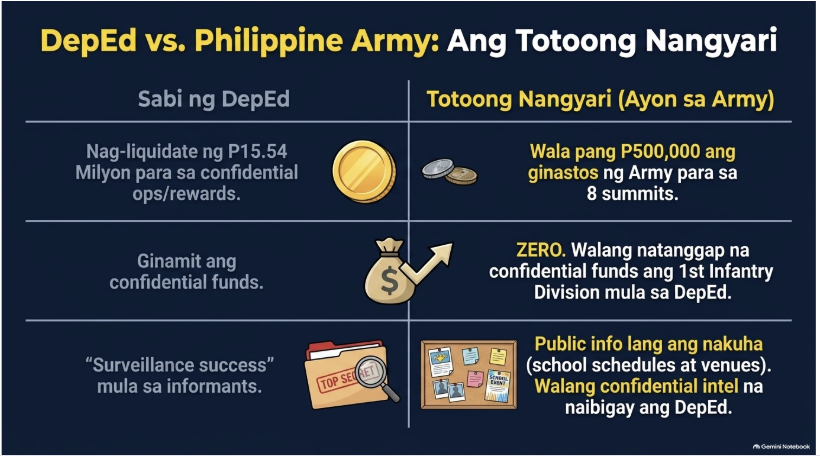
Retired Army Col. Manaros Boransing II testified that the 1st Infantry Division received no funds from DepEd or the OVP for the eight Youth Leadership Summits and 53 information, education and communication activities covered by his certification.

Boransing explained that different government agencies paid for their own participation. The Army used its own budget for its personnel and coordination, while local governments paid for students and out-of-school youth attending the programs. Other agencies covered their own participants.
His understanding of the certification was also straightforward. “We assumed that it will be used for their attendance, as we issued with the other agencies involved,” Boransing said.
Panopio gave a similar answer about the certification issued by his unit. He said they were surprised to learn it had been used in connection with DepEd’s confidential-fund liquidation.
This does not by itself prove that the P15.54 million was misused. What the testimony establishes is narrower: the certificates showed that Army activities happened. They did not show that the military received DepEd’s confidential funds or that particular informants received rewards.
2. The P15.54 million was not the cost of the summits
This point needs care because two different amounts came up during the hearing.
Under questioning from Sen. Bam Aquino, Boransing discussed what the Army normally spent on Youth Leadership Summits. Philstar reported that individual activities generally cost the military around P30,000 to P50,000, and a rough computation placed the Army’s spending for eight 2023 summits below P500,000, with local governments and participating agencies paying other costs.
The P15.54 million, however, was not presented by DepEd as the cost of staging those summits. According to the records discussed in court, it covered numerous alleged reward payments to informants, with amounts of around P100,000 to P200,000 per payment. DepEd used the Army certifications as evidence that the information-gathering or surveillance activities had succeeded.
That makes the comparison useful, but not because P15.54 million can simply be placed beside a P500,000 seminar budget.
The question is whether the certificates actually support the separate claim that P15.54 million was paid to informants. Boransing and Panopio could not verify that. Their documents did not name informants, state reward amounts or trace payments.
3. What confidential information did DepEd provide?
Another part of the hearing examined what DepEd actually contributed to the Army programs.
Boransing said DepEd provided what he described as open-source information. This included school schedules, possible student participants with leadership potential and possible venues. He told Senate President Sherwin Gatchalian that his division received no confidential or surveillance information from DepEd.
Panopio gave a somewhat different answer. He said teachers on the ground could provide information about problems in communities. When pressed for an example of information that might be confidential, he mentioned personal circumstances such as teenage pregnancy. But he explicitly presented this as speculation, not as confirmation that DepEd had actually supplied such information in the transactions being examined.
That distinction matters. Day 20 established what Boransing said his unit actually received. Panopio’s example should not be reported as proof that confidential student information was turned over to the military.

4. The defense skipped cross-examination, but the burden stayed with the prosecution
The defense chose not to cross-examine Boransing and Panopio.
Deputy defense spokesperson Justin Nicol Gular later explained that lawyers sometimes dispense with cross-examination when they do not see an issue in a witness’s testimony. The defense had agreed that the military officers issued the certifications and that their units did not receive the confidential funds in question.
Skipping cross-examination does not settle what the testimony means.
Later in the proceedings, Presiding Officer Francis “Chiz” Escudero made a separate point about who must prove the case. He said the “burden of evidence may shift,” but the burden of proof does not. It remains with the prosecution.
That means the prosecution still has to connect the documents and transactions it has presented to the impeachment charges against Duterte. The military witnesses could explain their own certifications. They could not testify about who received DepEd’s alleged informant payments or how DepEd handled the money internally.

5. Michael Poa is now the witness to watch
The next witness may be more directly connected to how those certifications ended up in DepEd’s audit documents.
Michael Poa, who was Duterte’s chief of staff and spokesperson at DepEd and later became spokesperson for her impeachment defense team, temporarily stepped aside from that role before his scheduled testimony. Gular said the defense had stopped communicating with Poa and that he was no longer staying in its holding room.
The House prosecution had earlier asked that Poa be called to testify about the DepEd confidential funds. Escudero said a subpoena was unnecessary because Poa was present and willing to testify. He is expected to take the witness stand on September 2.
That testimony could help answer a question the Army officers could not: why were certifications confirming ordinary military activities sought, and how were they connected to DepEd’s accounting for P15.54 million in informant rewards?
The AI earpiece image was fake
Day 20 also opened with a warning about misinformation surrounding the trial.
Escudero said viral images that appeared to show prosecution witness Lemuel Ortonio wearing an earpiece during his earlier testimony were AI-generated. What viewers were seeing was an ear piercing on the front-fold helix of Ortonio’s ear, not an electronic device.
The impeachment court then tightened enforcement of its rules against communication-capable devices for witnesses, including earpieces, cellphones, smartwatches and smart glasses.
The episode is also a reminder for those following the trial online: a viral image is not evidence simply because it looks convincing.
What netizens were saying
Online reaction was more interested in the gap between what the Army certifications said and what people assumed they proved.
In the Day 20 r/Philippines megathread, one commenter wrote: “So certificate of participation lang tapos yun ang ginamit to justify confidential fund disbursements lmao.” Another reacted to Aquino’s questioning: “Good question Sen. Bam.” A separate commenter saw a tactical reason for the defense’s decision not to cross-examine: “Wala naman sila mapapala sa cross, actually. Nagstipulate na sila dun sa mga certifications eh. Baka mas lumala lang if magtanong pa sila.”
Another thread focused on Boransing’s statement that his division received no confidential funds, with commenters asking where the money covered by DepEd’s liquidation documents went.
These Reddit comments are snapshots from one online community, not a scientific measure of public opinion. The thread itself leaned heavily critical of Duterte, so it should not be treated as representative of Filipino voters.
There was also criticism of the prosecution’s presentation. PhilSTAR Life columnist Gerry Lirio described parts of Day 20 as “lumalaylay” and questioned why Aquino, rather than the prosecution lawyers themselves, had to bring out the comparison between the Army’s modest program expenses and the much larger amount associated with DepEd’s informant rewards. That is commentary, not a factual finding of the court, but it reflects another strand of reaction to the day’s proceedings.
What Day 20 actually established

The Army officers did not tell the impeachment court where the P15.54 million went. They could not.
What they did establish was the limit of their own documents.
Their certifications confirmed that youth summits and information campaigns happened. Their units did not receive the DepEd confidential funds being examined. And the certificates themselves did not identify informants, show reward payments or certify how DepEd spent P15.54 million.
That leaves a specific gap in the record.
On Day 21, watch for one thing: can Michael Poa explain how a certificate saying an Army activity happened became part of DepEd’s accounting for P15.54 million in informant rewards?

Day 26 Sara Duterte Impeachment trial : What her SALNs show, and what they don’t

Day 5 of Duterte Impeachment Trial: The “threat” the defense pointed to came from the Dutertes’ own camp

Day 23 Sara Duterte Impeachment Trial : The trial turns to Sara Duterte
About The Author

Noemi Lardizabal-Dado
Noemi Lardizabal-Dado is a content strategist with over 19 years of experience in blogging, content management, citizen advocacy, and media literacy, and over 30 years in web development. Otherwise known as @MomBlogger on social media, she believes in making a difference in the lives of her children by advocating for social change that benefits the greater good. She is a co-founder and a member of the editorial board of Blog Watch . She is a resource speaker on media literacy, social media, blogging, digital citizenship, good governance, transparency, parenting, women’s rights, wellness, and cyber safety. Her personal blogs such as aboutmyrecovery.com (parenting) , pinoyfoodblog.com (recipes), techiegadgets.com (gadgets) and benguetarabica.coffee keep her busy outside of Blog Watch. Disclosure: I am an advocate. I am NOT neutral. I will NOT give social media mileage to members of political clans, epal, a previous candidate for the same position and those I believe are a waste of taxpayers' money. I do not support or belong to any political party. I was part of accredited media covering the Office of the Vice President and Leni Robredo as she ran as a presidential aspirant in the 2022 National and local elections. On August 5, 2021, YouTube announced that I was selected as one of 50 Program participants of its Creator Program for Independent Journalists She was a Senior Consultant for ALL media engagements for the PCOO-led Committee on Media Affairs & Strategic Communications (CMASC) under the ASEAN 2017 National Organizing Council from January 4 -July 5, 2017. Having been an ASEAN advocate since 2011, she has written extensively about the benefits of the ASEAN community and as a region of opportunities on Blog Watch and aboutmyrecovery.com. Organization affiliation includes Consortium on Democracy and Disinformation Updated June 6, 2022