Day 12 of the Sara Duterte impeachment trial: What the audit papers showed, and what they did not
August 4, 2026
By Day 12, the debate over Vice President Sara Duterte’s confidential funds had moved beyond the strange names on acknowledgment receipts. The bigger question now was this: What did the Office of the Vice President say the money was spent on, and were those expenses allowed under government audit rules?
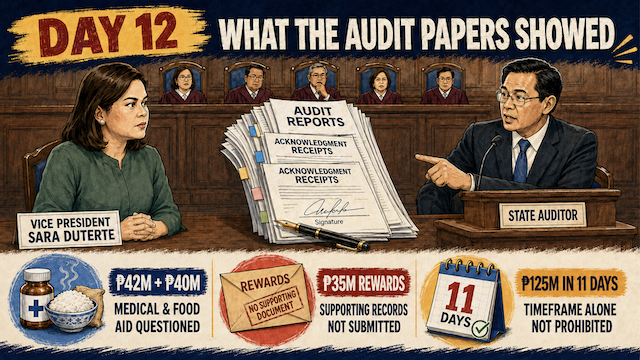
Former Commission on Audit state auditor Roderick Wamil returned to the witness stand. The prosecution used OVP and Department of Education documents to show expenses that Wamil said were outside the allowed uses of confidential funds or lacked the required support. The defense pushed back on the audit process, the rules cited by Wamil and the prosecution’s attempt to turn audit findings into proof of wrongdoing.

The result was a day that gave both sides useful points. The prosecution put Duterte’s signatures and questioned expense categories before the impeachment court. The defense obtained an important admission: spending P125 million in 11 days was unusual, but the speed alone did not violate Joint Circular No. 2015-01.
Here are five highlights from Day 12.
1. Medical and food assistance were charged to confidential funds
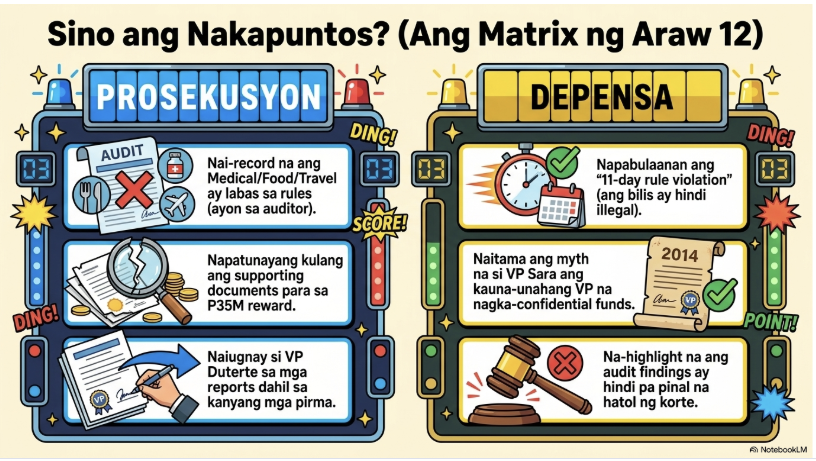
Wamil testified that an OVP accomplishment report for the first quarter of 2023 listed P42 million for medical and food assistance. A second-quarter report listed P40 million for the same purpose. He said these expenses were not among the exclusive uses allowed under Item 4.8 of Joint Circular No. 2015-01. The reports were signed by Duterte, according to documents presented in court.

The circular limits confidential expenses to specified activities, including the purchase of information, rent and maintenance of safehouses, rental of vehicles for confidential operations, operational equipment that cannot go through regular procurement, rewards to informers under stated conditions, and activities meant to protect an agency’s people or property. Medical and food aid do not appear on that list.
This does not by itself prove that money was stolen. It does mean the prosecution has identified expenses that the audit witness considered non-allowable under the rule governing confidential funds. The defense can still challenge that interpretation, the status of the audit findings and the conclusion the court should draw from the documents.
2. Travel and rewards were also questioned
The OVP reports included P10 million for incentives or travel related to confidential operations in the first quarter of 2023 and another P10 million in the second quarter. Wamil said this expense was not on the circular’s exclusive list.
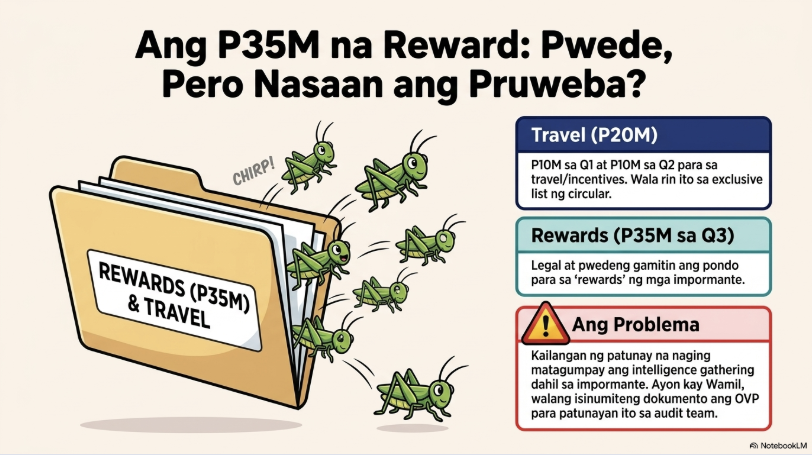
For the third quarter, the OVP reported P35 million in rewards. Rewards to informers can be paid from confidential funds, but the circular requires approval and documents showing that the information led to successful intelligence gathering or surveillance. Wamil said the supporting records required for that purpose were not submitted to the audit team.
That distinction matters. A reward is not automatically prohibited. The audit issue is whether the OVP provided the documents needed to show that the payment met the circular’s conditions.
3. Duterte's signatures tied her to the reports, but the legal effect is still for the court to decide
Prosecution counsel Lorna Kapunan showed Wamil financial plans, accomplishment reports and other OVP and DepEd documents. Wamil identified Duterte’s signatures on several of them. The prosecution’s purpose was clear: to connect the vice president to the approval and certification of the questioned spending instead of treating the paperwork as the work of unnamed staff.
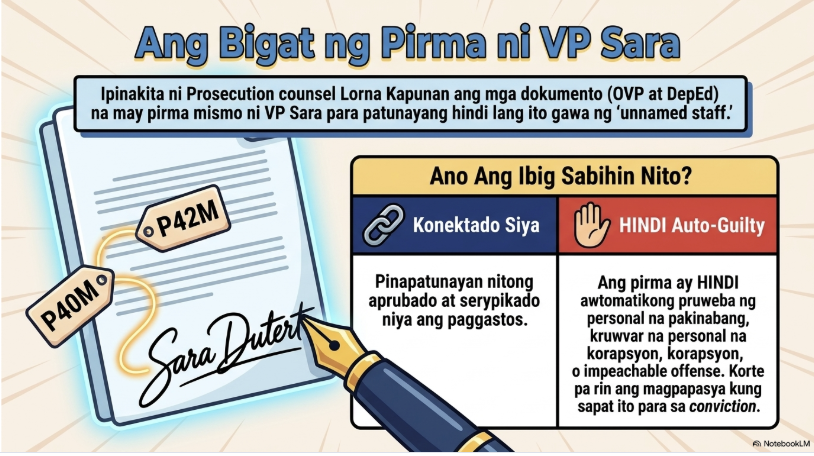
But a signature is not an automatic finding of personal benefit, corruption or an impeachable offense. It establishes participation in approving or certifying a document. The Senate impeachment court must still decide what Duterte knew, whether the expenses violated the applicable rules and whether the evidence meets the constitutional standard for conviction.
4. The defense scored a point on the 11-day spending period
Under cross-examination by defense counsel Michael Poa, Wamil acknowledged that Joint Circular No. 2015-01 does not expressly prohibit an agency from spending a quarterly confidential-fund cash advance in 11 days. COA recorded the timeframe in an Audit Observation Memorandum, but Wamil agreed that the number of days alone was not a violation of the circular.
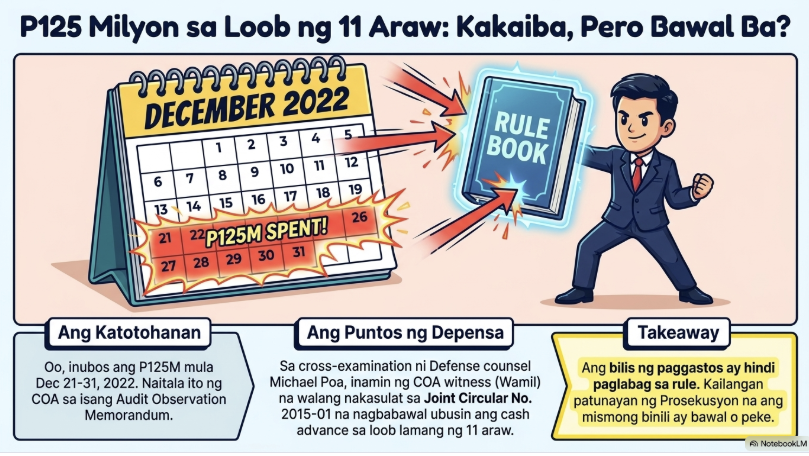
This corrects an easy but misleading shorthand. The issue is not simply that P125 million was spent from December 21 to 31, 2022. The prosecution still has to show that the reported uses were prohibited, unsupported, fabricated or otherwise tied to an impeachable offense. The defense, for its part, has to answer the documents and audit findings rather than rely only on the absence of a minimum spending period.
5. The claim that Duterte was the first vice president to receive confidential funds was corrected
The defense presented a 2014 Special Allotment Release Order showing that the OVP received confidential funds during the term of then Vice President Jejomar Binay. Wamil had earlier said Duterte was the only vice president whose office received such funds. The 2014 document showed that statement was wrong.
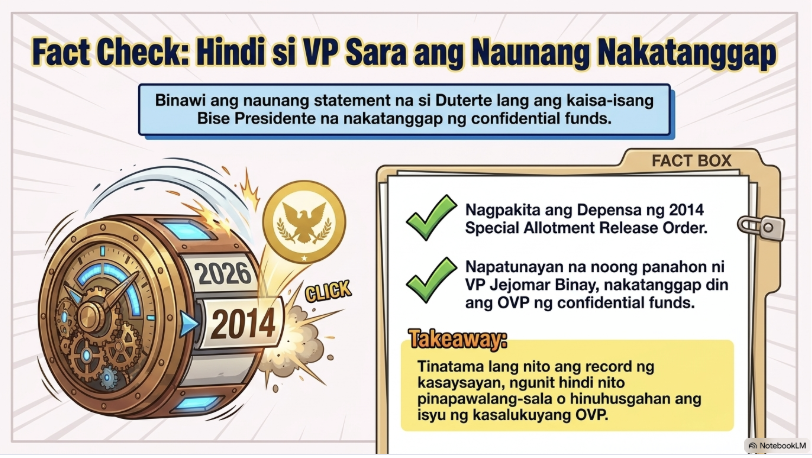
The correction does not settle whether Duterte’s OVP used its funds properly. It does remove one inaccurate claim from the record. The mere existence of an earlier OVP confidential-fund allocation neither validates nor invalidates the expenses now under trial.
The “scam” remark was struck from the record
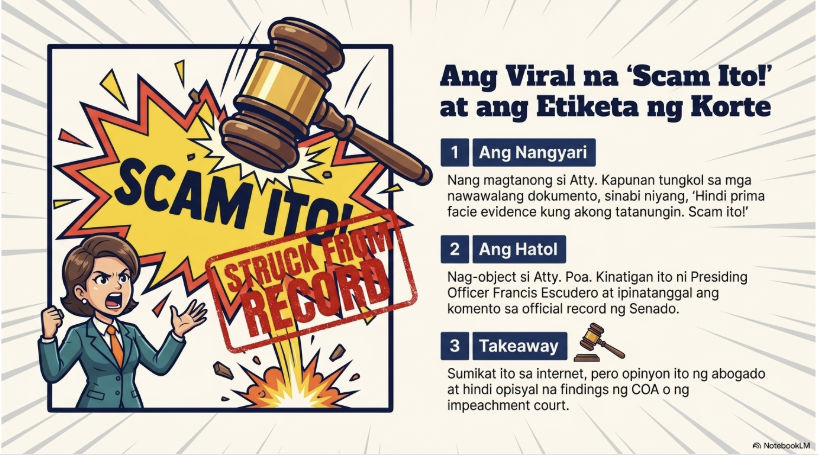
During redirect examination, Kapunan asked Wamil about the consequences when an accountable officer fails to produce supporting documents. After the witness answered, Kapunan said, “Hindi prima facie evidence kung akong tatanungin. Scam ito!”
Poa objected. Presiding Officer Francis Escudero sustained the objection and ordered the comment struck from the record. The moment spread online, but it was counsel’s characterization, not a finding by COA or a ruling by the impeachment court.
What netizens were reacting to
The most visible reactions remained focused on “Mary Grace Piattos,” the name on an OVP acknowledgment receipt for P70,000 described as a reward, with medicines written in parentheses. News posts about the receipt drew jokes about the name sounding like a combination of a restaurant and a snack brand. Others were less amused and asked whether a person tied to public spending could be identified and produced. The House prosecution later said a subpoena for Mary Grace Piattos was still under discussion, not yet a settled action.
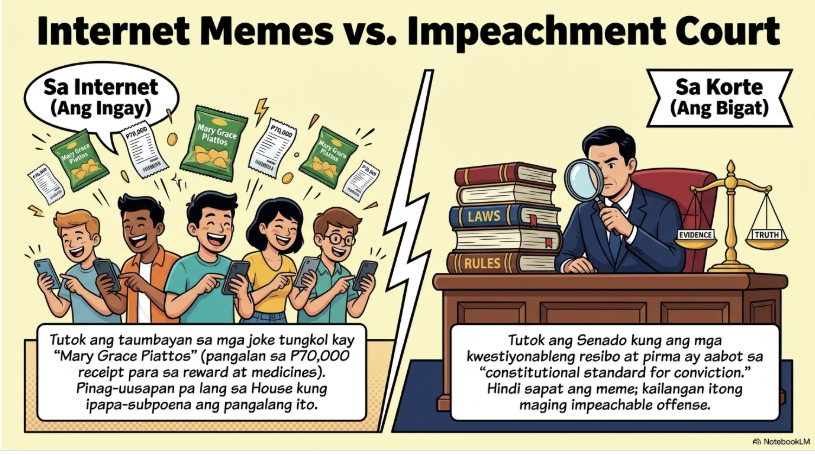
Reactions to the hearing itself followed two broad lines. Critics of Duterte circulated Kapunan’s “Scam ito!” remark and the documents carrying Duterte’s signatures. Duterte supporters shared the defense’s point that no rule prohibited spending the P125 million within 11 days and argued that confidential operations cannot be audited like ordinary purchases. Both claims need the same caution: the struck remark was not a court finding, while the 11-day admission did not resolve the separate questions about allowable uses and supporting documents.
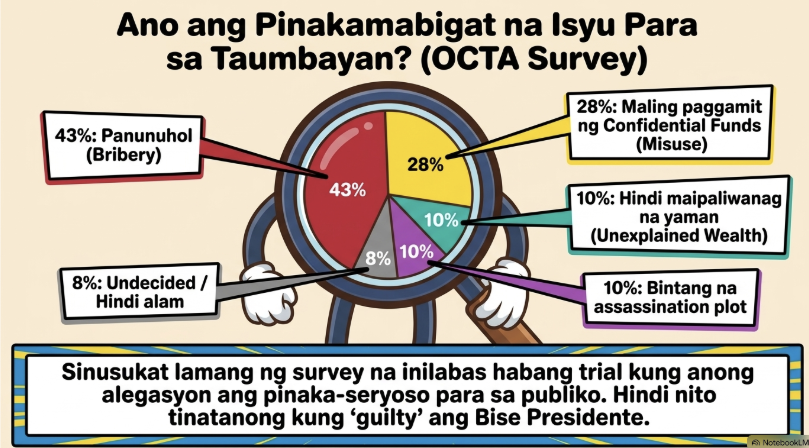
An OCTA Research survey released during the trial found that 43 percent of adult Filipinos considered bribery the most serious allegation against Duterte, while 28 percent chose misuse of confidential funds. Ten percent each chose unexplained wealth and the alleged assassination plot, while 8 percent said they did not know enough to choose. The survey measured which allegation respondents considered most serious. It did not ask whether Duterte was guilty.
What Day 12 proved, and what remains open
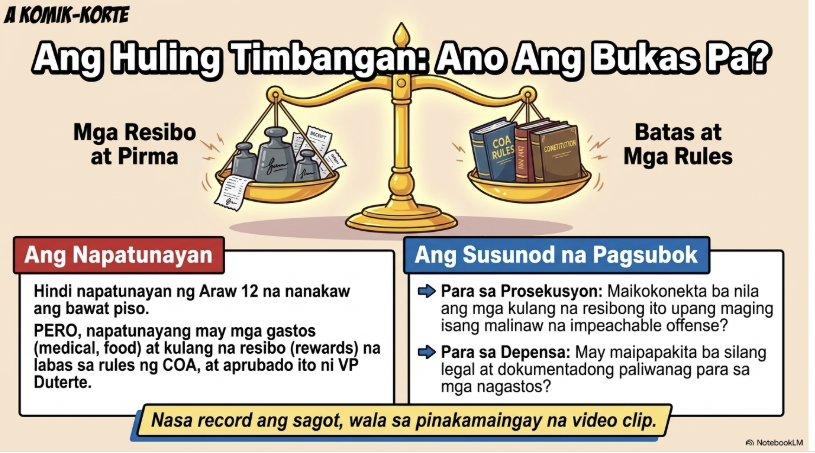
Day 12 did not prove that every questioned peso was stolen. It did show that OVP reports signed by Duterte included expense categories that the prosecution’s audit witness said were not allowed under the confidential-fund circular. It also showed that some reward payments lacked the supporting records the auditor expected.
The defense exposed two limits in the prosecution’s presentation. Spending P125 million in 11 days was not prohibited by the circular, and Sara Duterte was not the first vice president whose office received confidential funds. Those corrections should stay in any fair account of the hearing.
The next test is more specific than the names that became memes. Can the prosecution connect the questioned reports, missing support and Duterte’s signatures to an impeachable offense? And can the defense produce a lawful, documented explanation for the medical aid, travel and reward entries? The court record, not the loudest clip from either side, has to answer both.
Day 16 of Sara Duterte’s impeachment trial: Who handled the 500 million?

Day 25 Sara Duterte Impeachment Trial : The law before the bank records
Day 4 of the Duterte Impeachment Trial: The Paperwork Cracks, the Assassin Still Missing
About The Author

Noemi Lardizabal-Dado
Noemi Lardizabal-Dado is a content strategist with over 19 years of experience in blogging, content management, citizen advocacy, and media literacy, and over 30 years in web development. Otherwise known as @MomBlogger on social media, she believes in making a difference in the lives of her children by advocating for social change that benefits the greater good. She is a co-founder and a member of the editorial board of Blog Watch . She is a resource speaker on media literacy, social media, blogging, digital citizenship, good governance, transparency, parenting, women’s rights, wellness, and cyber safety. Her personal blogs such as aboutmyrecovery.com (parenting) , pinoyfoodblog.com (recipes), techiegadgets.com (gadgets) and benguetarabica.coffee keep her busy outside of Blog Watch. Disclosure: I am an advocate. I am NOT neutral. I will NOT give social media mileage to members of political clans, epal, a previous candidate for the same position and those I believe are a waste of taxpayers' money. I do not support or belong to any political party. I was part of accredited media covering the Office of the Vice President and Leni Robredo as she ran as a presidential aspirant in the 2022 National and local elections. On August 5, 2021, YouTube announced that I was selected as one of 50 Program participants of its Creator Program for Independent Journalists She was a Senior Consultant for ALL media engagements for the PCOO-led Committee on Media Affairs & Strategic Communications (CMASC) under the ASEAN 2017 National Organizing Council from January 4 -July 5, 2017. Having been an ASEAN advocate since 2011, she has written extensively about the benefits of the ASEAN community and as a region of opportunities on Blog Watch and aboutmyrecovery.com. Organization affiliation includes Consortium on Democracy and Disinformation Updated June 6, 2022