Sara Duterte’s impeachment trial: what citizens need to watch
“There is a right way to do the right thing at the right time.”
That line from the Supreme Court’s 2025 ruling on Vice President Sara Duterte’s first impeachment attempt should stay with us as the Senate trial opens. It was not a defense of Duterte. The Court was clear that it was not absolving her of the charges. It was a warning to Congress: even impeachment has rules. Even politics must answer to fairness. (Supreme Court of the Philippines)
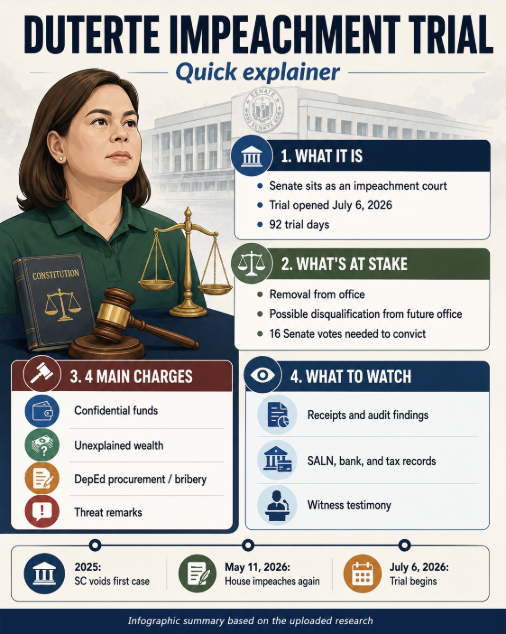
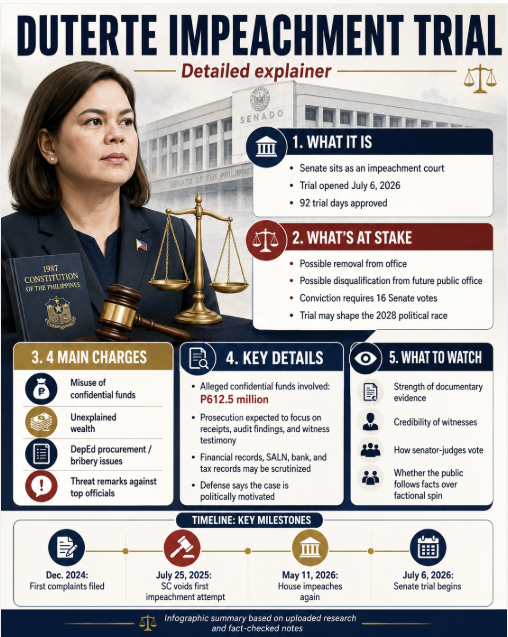
On July 6, 2026, the Senate sits as an impeachment court for the first Philippine vice president to face such a trial. The case is set for 92 trial days. If convicted, Duterte can be removed from office and permanently barred from holding public office, a result that would also end her announced 2028 presidential bid.
That is why this trial is not only about Sara Duterte. It is about whether our institutions can still handle power, family rivalry, public money, and public anger without breaking their own rules.
How we got here
This is the second attempt to impeach Duterte.
The first attempt collapsed after the Supreme Court ruled in July 2025 that the House complaint transmitted to the Senate on February 5, 2025 violated the one-year bar rule and failed the standards of fairness required even in impeachment. In January 2026, the Court denied the House motion for reconsideration with finality. It also clarified that an impeachment complaint may be deemed initiated not only when referred to the Committee on Justice, but also when the House fails to place a properly filed complaint in the Order of Business within the required period.
That ruling shaped the second impeachment effort.
This time, the House moved more carefully. On May 11, 2026, it voted 257-25-9 to impeach Duterte for a second time and send the case to the Senate.
The lesson is plain. A strong case can still fail if the process is careless. A weak defense can still gain ground if the process looks rushed. The Senate trial will test both evidence and procedure.
What are the charges?
The consolidated Articles of Impeachment have four main grounds.
First, Duterte is accused of culpable violation of the Constitution, graft and corruption, and betrayal of public trust over the alleged misuse of P612.5 million in confidential funds. The amount is broken down into P500 million under the Office of the Vice President and P112.5 million under the Department of Education during her time as education secretary.
Second, she is accused of unexplained wealth, based on alleged financial discrepancies and bank transactions that prosecutors say were not properly reflected in her statements of assets, liabilities and net worth.
Third, she is accused of bribery, graft and corruption over alleged cash payments to DepEd officials connected to procurement and other official actions.
Fourth, she is accused of high crimes and betrayal of public trust over her November 2024 statements about contracting someone to kill President Ferdinand Marcos Jr., First Lady Liza Araneta-Marcos, and then Speaker Martin Romualdez if she herself were killed. Duterte has denied wrongdoing and has said the impeachment is politically motivated.
These are allegations. They still have to be proven in the impeachment court.
Why confidential funds matter
The most publicly understood part of the case is the confidential funds issue.
The P125 million in OVP confidential funds reportedly spent in 11 days in December 2022 became the symbol of a larger question: how does government track money that is hidden from ordinary public view by design?
The prosecution is expected to focus on liquidation records, acknowledgment receipts, audit findings, and witnesses. One controversial name is “Mary Grace Piattos,” listed in connection with alleged confidential fund receipts. GMA News reported that “Mary Grace Piattos” appears in the prosecution witness list for Article I, which covers the alleged misuse of P612.5 million in confidential funds.
Then there is Ramil Madriaga, the alleged bagman. Philstar reported that Madriaga claimed in an affidavit that the P125 million was not merely spent in 11 days, but disposed of in less than 24 hours. That claim is explosive, but it is still a claim. The defense has challenged his credibility. The Senate trial is where that story should be tested.
This is why the trial should not be reduced to slogans. Receipts, bank records, tax records, audit findings, and witness credibility will matter more than speeches.
The Senate math
Under the Constitution, conviction requires a two-thirds vote of all members of the Senate. AP and Reuters both report that this means 16 votes out of 24.
That number matters because the Senate itself is divided. Reuters reports that the trial opens after weeks of Senate turmoil, including the removal of Alan Peter Cayetano as Senate president and the election of Sherwin Gatchalian. Reuters also reported that Senator Ronald “Bato” dela Rosa, a Duterte ally, resurfaced in May to help install Cayetano, then later disappeared again, with his whereabouts unknown.
AP also reports that three Duterte-aligned senators face separate legal or political complications: Jinggoy Estrada has been detained on a plunder charge, Rodante Marcoleta faces possible arrest over a plunder charge, and Dela Rosa has gone into hiding after an ICC warrant.
Still, unless the impeachment court rules otherwise, the working number is 16. Anything else is argument, not settled law.
Why this trial feels bigger than one office
The Marcos-Duterte alliance won in 2022. It did not last.
The trial now sits inside a wider family and factional fight. Marcos has moved the Philippines closer to the United States and taken a more assertive position on the West Philippine Sea. Rodrigo Duterte built warmer ties with China and Russia, and AP notes that Sara Duterte has been criticized for not condemning Chinese actions against Filipino forces and fishermen.
But we should be careful here. The Senate is not holding a foreign policy referendum. It is trying an impeachment case. The foreign policy split explains the political heat around the trial, but it does not prove or disprove the articles.
The danger is that both camps will ask the public to see only politics. One side will say the case is pure accountability. The other side will say it is pure persecution. The record will likely be messier than both narratives.
What citizens should watch
We do not vote in the impeachment court. But we can still watch the process with discipline.
Watch the evidence, not just the personalities.
Ask whether the prosecution proves each article with documents and credible testimony.
Ask whether the defense answers the substance or hides only behind procedure.
Watch how senator-judges treat both sides. A fair trial is not a favor to Duterte. It is protection for the public record.
Track the receipts, SALNs, bank records, audit findings, tax records, and witness statements as they are presented.
Be careful with viral clips. A short video may show a dramatic moment, but it may not show the evidence that matters.

Defending DILG’s Php 14 Billion DAP
Sen Pacquiao’s use of the Bible to justify his arguments is dangerous
Where is the President in times of trouble?
About The Author

Noemi Lardizabal-Dado
Noemi Lardizabal-Dado is a content strategist with over 19 years of experience in blogging, content management, citizen advocacy, and media literacy, and over 30 years in web development. Otherwise known as @MomBlogger on social media, she believes in making a difference in the lives of her children by advocating for social change that benefits the greater good. She is a co-founder and a member of the editorial board of Blog Watch . She is a resource speaker on media literacy, social media, blogging, digital citizenship, good governance, transparency, parenting, women’s rights, wellness, and cyber safety. Her personal blogs such as aboutmyrecovery.com (parenting) , pinoyfoodblog.com (recipes), techiegadgets.com (gadgets) and benguetarabica.coffee keep her busy outside of Blog Watch. Disclosure: I am an advocate. I am NOT neutral. I will NOT give social media mileage to members of political clans, epal, a previous candidate for the same position and those I believe are a waste of taxpayers' money. I do not support or belong to any political party. I was part of accredited media covering the Office of the Vice President and Leni Robredo as she ran as a presidential aspirant in the 2022 National and local elections. On August 5, 2021, YouTube announced that I was selected as one of 50 Program participants of its Creator Program for Independent Journalists She was a Senior Consultant for ALL media engagements for the PCOO-led Committee on Media Affairs & Strategic Communications (CMASC) under the ASEAN 2017 National Organizing Council from January 4 -July 5, 2017. Having been an ASEAN advocate since 2011, she has written extensively about the benefits of the ASEAN community and as a region of opportunities on Blog Watch and aboutmyrecovery.com. Organization affiliation includes Consortium on Democracy and Disinformation Updated June 6, 2022