
Day 4: What “Superman” ordered: Five things the ICC hearing proved about Duterte’s war
Watch the video explainer in English:
Watch the video explainer in Tagalog:
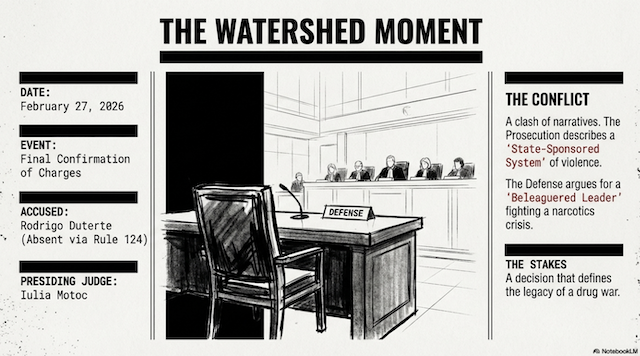
The chair reserved for Rodrigo Duterte at Pre-Trial Chamber I sat empty on February 27. His lead counsel, Nicholas Kaufman, stood in his place, citing age, citing health, citing a jurisdiction Duterte refuses to acknowledge. The Court did not pause. It proceeded.
Read Day 1: The drug war goes to The Hague: Inside Duterte’s confirmation of charges hearing
Read Day 2: “Nanlaban” was a lie. The ICC just spent a full day proving it.
Read Day 3: What the Duterte Defense Is actually arguing
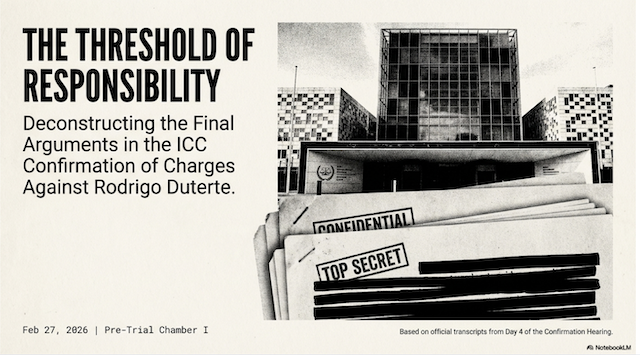
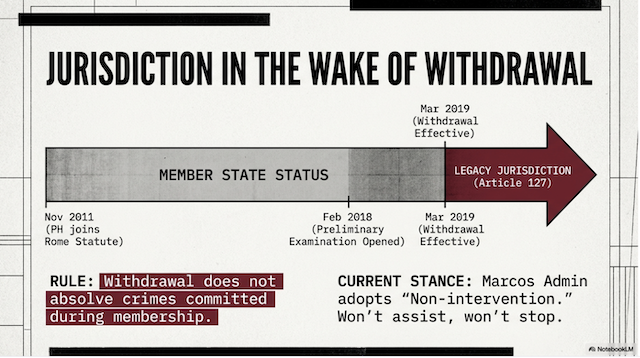
I have been waiting for this moment of accountability for nearly a decade. Official police records alone acknowledge more than 6,000 deaths during the 2016 to 2022 War on Drugs, a figure that does not capture what human rights monitors documented independently. The question before Pre-Trial Chamber I is no longer whether people died. It is whether the man who ordered it can be held accountable under the Rome Statute, the treaty the Philippines signed and later fled.
- THE NAME BEHIND THE ORDER
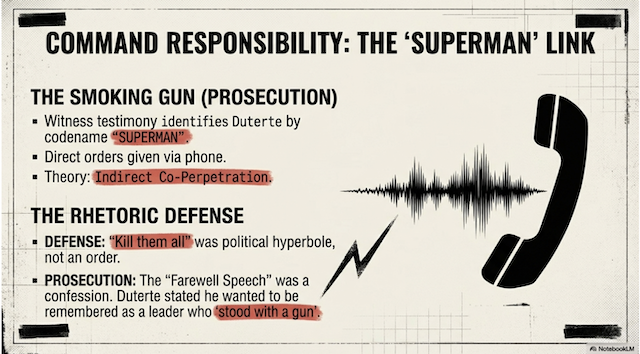
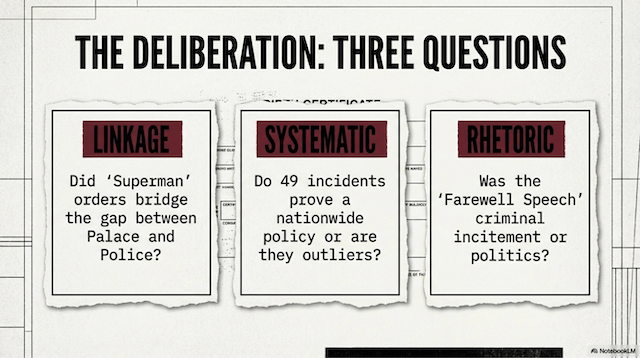
“Superman” was how witnesses knew him. It was the codename long associated with Duterte and the Davao Death Squad. At the February 27 hearing, the prosecution introduced testimony linking that name to a direct telephone order authorizing killings. In international criminal law, this is what lawyers call “functional control”: the evidentiary standard required to hold a head of state responsible for crimes carried out by thousands of officers across hundreds of operations.
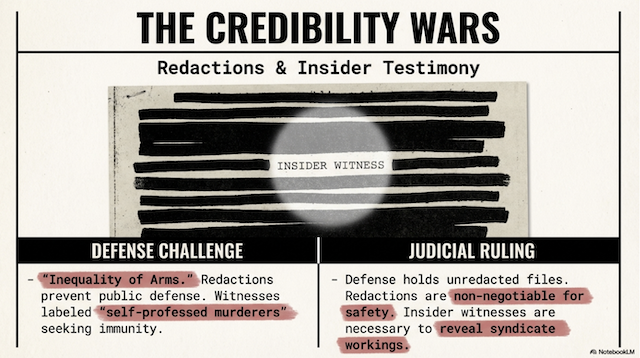
When Kaufman attacked the prosecution’s redacted filings as leaving “virtually nothing intelligible” for the public, Presiding Judge Iulia Motoc corrected him on the record. The defense held the full, unredacted documents. The redactions protected witnesses, not the prosecution’s case. That correction, delivered from the bench, set the tone for what followed.
- WHAT “NEUTRALIZE” ACTUALLY MEANT
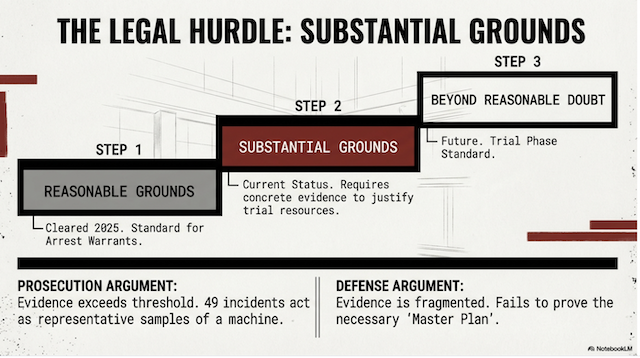
The hearing placed official PNP language under a forensic microscope. Police Chief Senator Ronald “Bato” dela Rosa’s operational circulars used terms like “neutralize,” “Oplan Tokhang,” and “narco-list.” The defense argued these were standard law enforcement vocabulary. The prosecution argued they were a system of plausible deniability: bureaucratic language engineered to authorize killings while keeping the word “kill” off the page.
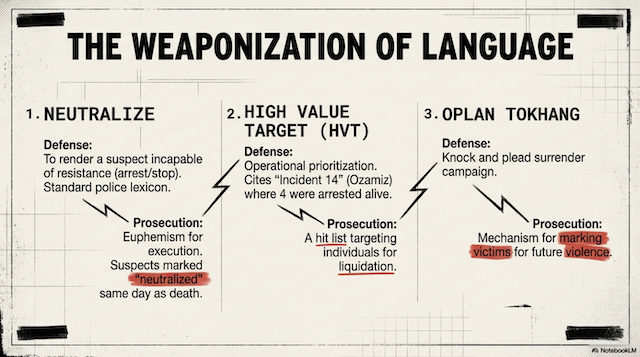
The prosecution’s summary was hard to argue against. When a suspect appears on the narco-list on Monday and turns up dead in a gutter on Tuesday, marked “neutralized” in the after-action report, the dictionary definition of the word stops mattering.
- THE 10% RULE AND WHAT IT ACTUALLY PROVES
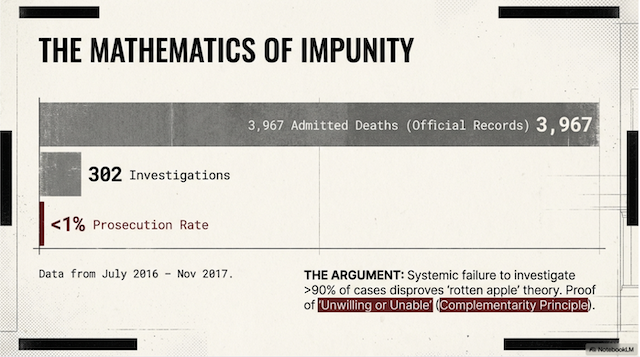
Victims’ representative Gilbert Andres presented a single figure to the Court that does more damage to the Philippine government’s position than almost any single testimony. Between July 2016 and November 2017, official records acknowledged 3,967 deaths in police operations. The government investigated at most 302 of those cases, roughly 10 percent. Convictions were virtually non-existent.
This is not a caseload problem. A justice system overwhelmed by volume makes mistakes, closes cases late, and acquits for lack of evidence. It does not investigate 10 percent and stop. The ICC’s “unwilling or unable” standard for complementarity, the legal test that determines whether the Philippines can handle this case itself, was answered by the Philippine government’s own numbers.
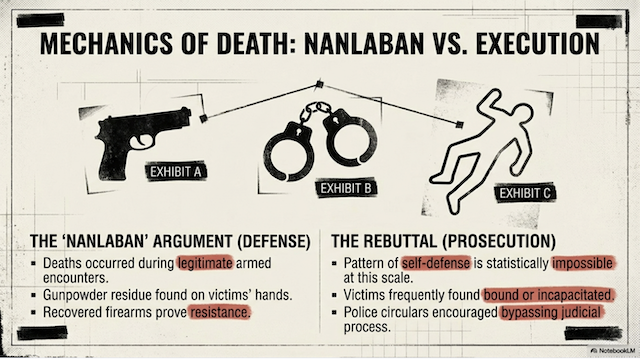
- THE SURVIVAL PARADOX DID NOT HOLD
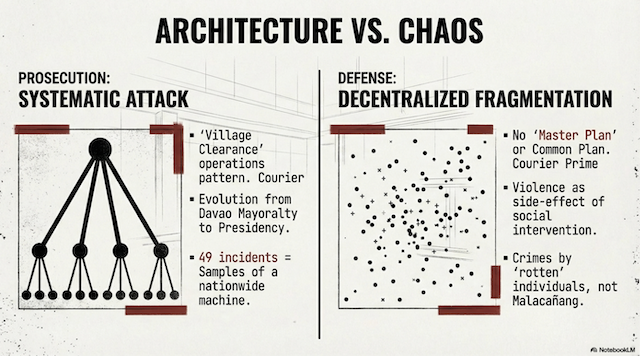
Kaufman pointed to “Incident 14,” the raid on the Parojinog family where the mayor was killed but four suspects survived, as proof there was no systematic intent to murder. His logic: if the policy was to kill everyone, why did anyone live?
The prosecution dismantled this quickly. Selective use of force does not cancel a systematic policy. The 49 charged incidents and 78 named victims are not presented as a complete count. They are representative samples of a broader, state-orchestrated attack on a civilian population. A few survivors do not exonerate a state for the thousands who did not.
- THE HONG KONG SPEECH WAS NOT POLITICAL HYPERBOLE
Days before the hearing, Duterte addressed an audience in Hong Kong. He described the drug war killings as a “necessary evil” and told the crowd he wished to be remembered as a leader who stood with a gun rather than a book.
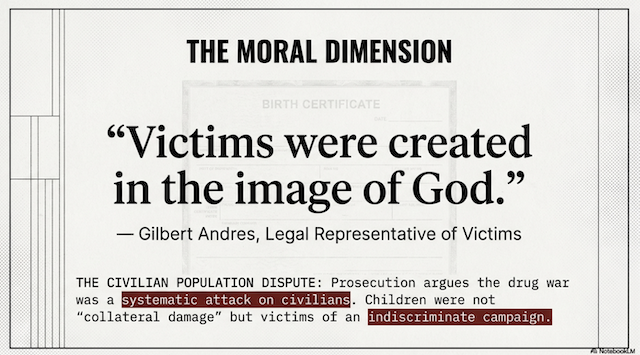
Prosecutors used this as their closing argument for criminal intent. In international law, demonstrating that a leader knew, approved, and publicly embraced a policy of lethal force matters to the question of guilt. Duterte did not make this statement under cross-examination. He offered it voluntarily, in public, days before judges would weigh whether he possessed the intent required for crimes against humanity.
WHAT THE COURT WILL DECIDE IN 60 DAYS
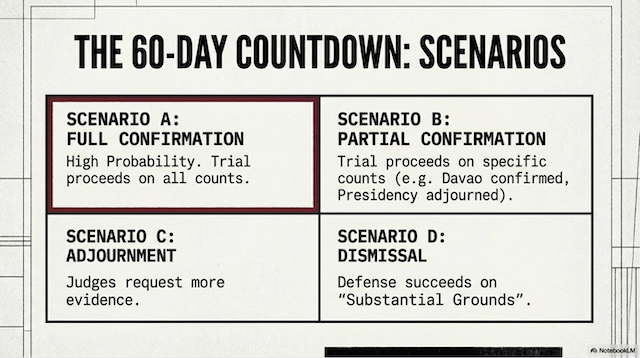
Pre-Trial Chamber I has four options before late April 2026:
- Confirm all charges. The case proceeds to full trial on all 49 incidents.
- Confirm partial charges. The trial is limited to specific timeframes, such as Davao-era crimes versus the Presidential-era war on drugs.
- Request additional evidence. The prosecution is given time to close specific evidentiary gaps.
- Decline to confirm. The case is dismissed, a move legal observers describe as unlikely given the record already established.
THE 60-DAY COUNTDOWN BELONGS TO ALL OF US
For each of those 60 days, the Marcos administration will maintain its calculated ambiguity. It will publicly question ICC jurisdiction while not physically blocking the proceedings. But the Senate has already moved beyond ambiguity.
The Senate’s answer is on record. In the same week the confirmation hearing opened, the pro-Duterte minority bloc filed Senate Resolution 307 to protect Filipinos from surrender to international courts. The timing was not coincidental. Dela Rosa and Go are sitting senators named as co-perpetrators in the same case being heard in The Hague.
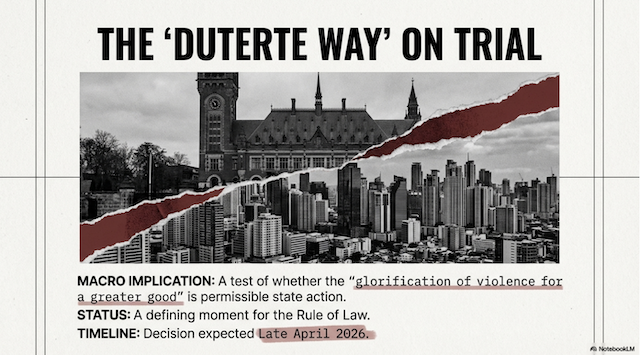
The 10 percent rule is not an abstraction. For 90 percent of the families whose loved ones were killed in police operations and never saw an investigation opened, the ICC is the only court that chose to show up. Before the April decision lands, ask your senator whether Senate Resolutions 307 is the position they want attached to their name when the judges issue their ruling.
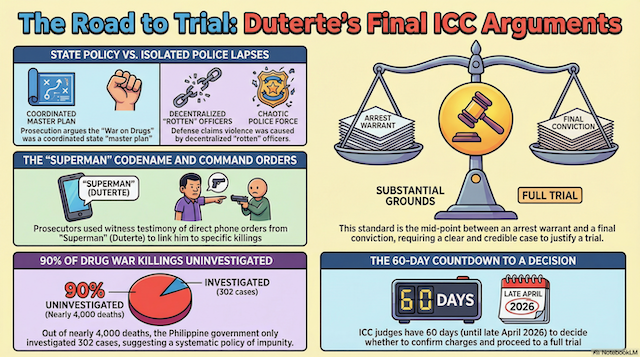
Videos and infographics generated in NotebookLM from sources of this blog post.
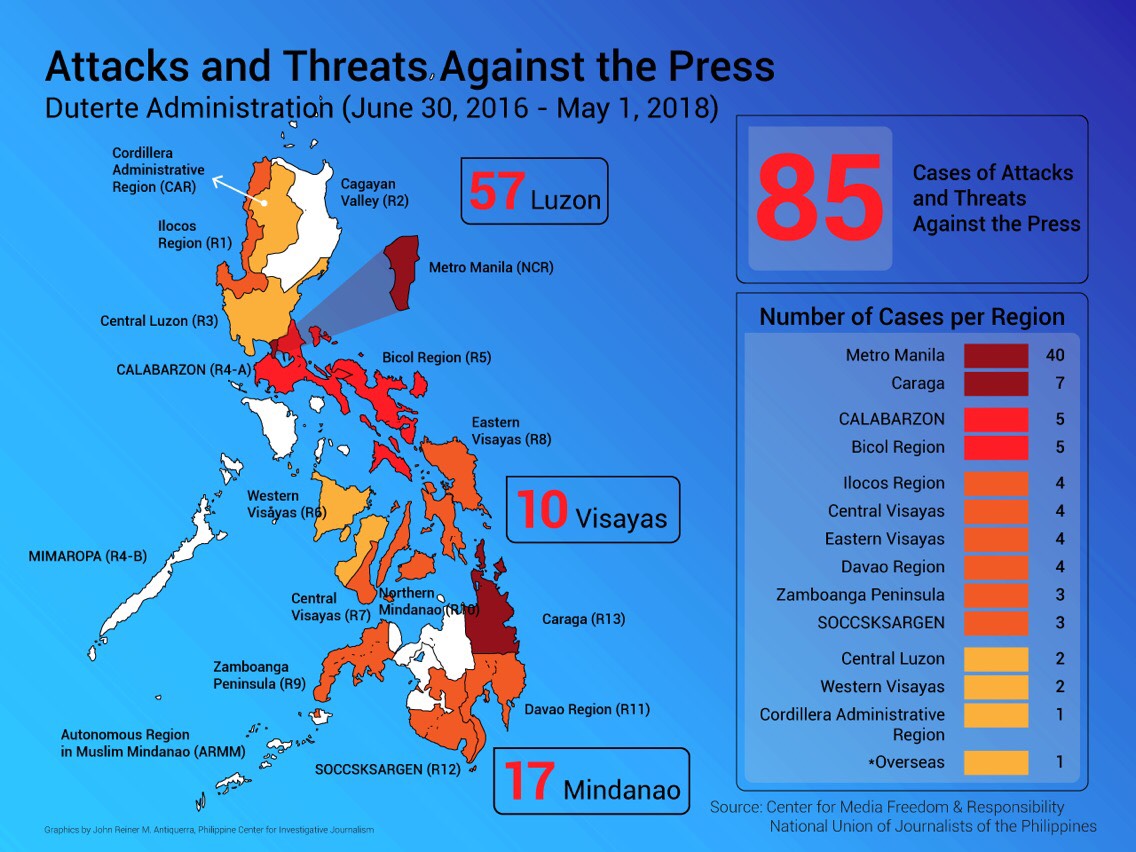
State of Philippine Media Report, World Press Freedom Day
State of World Population 2016 report: The future depends on today’s 10 year old girl
Day 3: What the Duterte Defense Is actually arguing
About The Author

Noemi Lardizabal-Dado
Noemi Lardizabal-Dado is a content strategist with over 19 years of experience in blogging, content management, citizen advocacy, and media literacy, and over 30 years in web development. Otherwise known as @MomBlogger on social media, she believes in making a difference in the lives of her children by advocating for social change that benefits the greater good. She is a co-founder and a member of the editorial board of Blog Watch . She is a resource speaker on media literacy, social media, blogging, digital citizenship, good governance, transparency, parenting, women’s rights, wellness, and cyber safety. Her personal blogs such as aboutmyrecovery.com (parenting) , pinoyfoodblog.com (recipes), techiegadgets.com (gadgets) and benguetarabica.coffee keep her busy outside of Blog Watch. Disclosure: I am an advocate. I am NOT neutral. I will NOT give social media mileage to members of political clans, epal, a previous candidate for the same position and those I believe are a waste of taxpayers' money. I do not support or belong to any political party. I was part of accredited media covering the Office of the Vice President and Leni Robredo as she ran as a presidential aspirant in the 2022 National and local elections. On August 5, 2021, YouTube announced that I was selected as one of 50 Program participants of its Creator Program for Independent Journalists She was a Senior Consultant for ALL media engagements for the PCOO-led Committee on Media Affairs & Strategic Communications (CMASC) under the ASEAN 2017 National Organizing Council from January 4 -July 5, 2017. Having been an ASEAN advocate since 2011, she has written extensively about the benefits of the ASEAN community and as a region of opportunities on Blog Watch and aboutmyrecovery.com. Organization affiliation includes Consortium on Democracy and Disinformation Updated June 6, 2022