
The architecture of organized forgetting: Inside Epstein’s digital cleanup
“The Google page is not good.”
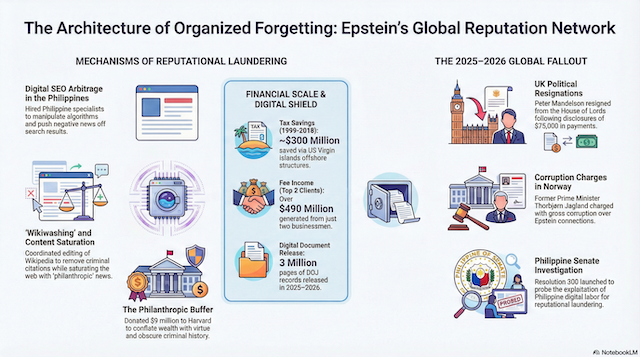
That line, lifted from emails released in the Epstein document batches, is not small talk. It is a strategy memo in plain language. Epstein and his circle treated the public record like a search problem, and treated search like something you can bend with enough money and enough labor.
By late 2025 and into early 2026, the scale of what came out made that strategy harder to deny. The U.S. Department of Justice release alone was described as three million files, and it immediately raised questions about who was named, what was redacted, and who had been protected by silence or complexity.
Epstein’s crimes were not “new.” What looked newly visible was the machinery that helped him keep operating in elite circles, even after his 2008 Florida plea made him a registered sex offender.
The 2008 problem he needed to solve
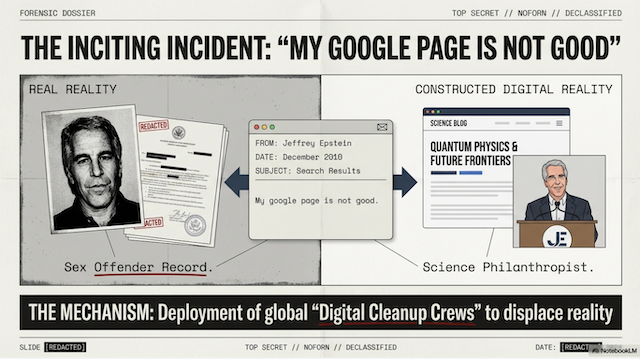
After the Florida guilty plea, Epstein had a reputational break that money alone could not fix. The old persona, the connected financier, could not survive first-contact scrutiny. The question became: how do you keep access to institutions and people who care about appearances when the internet has receipts?
That is where organized forgetting enters. Not forgetting as time passing, but forgetting as work. Someone has to push things down, pull other things up, and keep doing it long enough that the public learns to stop looking.
Philanthropy as cover, and the internet as the battlefield
The familiar part is philanthropy. Donations can buy association, photo ops, and institutional glow. They can also buy hesitation. People soften their language around donors, even when the facts are ugly.
The modern part is what comes next. In a search-first world, social proof is built on what ranks, what appears in a snippet, what autocomplete suggests, and what Wikipedia leads with. That is why the released emails and reporting focus so heavily on Google presence and the practical mechanics of search manipulation.
This is not about clever persuasion. It is about friction. Make the truth harder to reach and most people will not reach it.
Google as gatekeeper, SEO as weapon
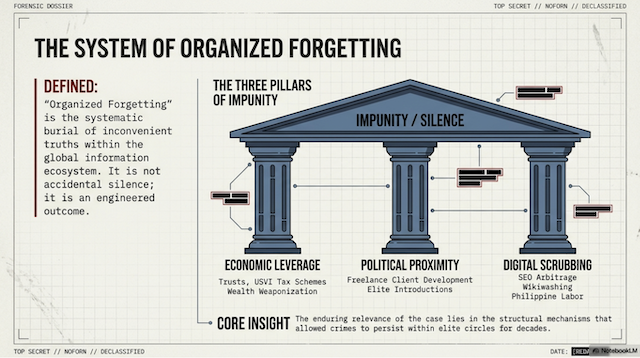
The Verge reporting on the released emails details how Epstein’s orbit pursued search manipulation tactics to bury coverage of his crimes.
The logic is simple. If negative reporting is on page one, move it off page one. If people search his name and see crimes, flood the web with content that pushes a softer identity. If autocomplete hints at the worst truths, try to drown those hints with alternative terms and competing pages.
One method described is namesake confusion. It does not require the public to believe a lie. It only requires the public to click the wrong Jeffrey Epstein, lose the thread, and move on.
That is not a side story. That is the point. If attention is the scarce resource, then misdirection becomes protection.
Wikipedia and the fight over default truth
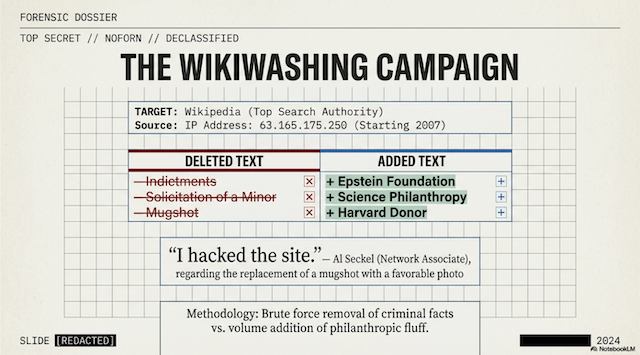
Wikipedia is not just another website. It is the reference layer people lean on when they want a quick background check. It is also a search amplifier. It can shape what other outlets repeat and what search results summarize.
The same reporting describes attempts to reshape Epstein’s Wikipedia presence by downplaying criminality and boosting philanthropic framing.
If you can shift the default summary, you do not need to erase the facts. You only need to ensure the facts stop being the first thing people see.
The Philippine connection, and why it matters here
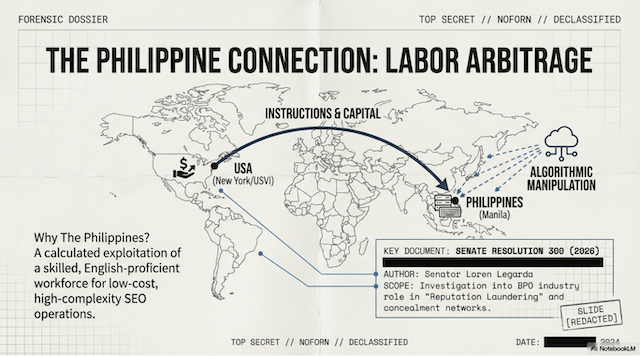
The Philippines appears in this story because reputation work can be outsourced. SEO and content operations are often remote, modular, and cheap to scale. Camille Diola reported on How a Philippines-based ops tried to bury Jeffrey Epstein’s bad press. That creates a predictable pipeline: wealthy clients in the West and digital labor in countries with strong English proficiency and a mature outsourcing industry.
What makes it a Philippine public interest issue is not the existence of outsourcing. It is the allegation that this ecosystem can be used as a service layer for concealing exploitation.
In February 2026, Senator Loren Legarda filed Senate Resolution No. 300 seeking a Senate investigation into the Epstein files and warning about protecting Filipino children from exploitation and guarding against the Philippines being used in this kind of network.
That is the right framing. This is not a reputational scandal. This is a governance problem that touches labor, digital accountability, and child protection.
The key question is not whether Filipinos have the skills. We do. The question is what guardrails exist when those skills are hired to bury criminal truth, and who is responsible for spotting it, stopping it, and prosecuting it when it crosses into harm.
When the buried record resurfaces
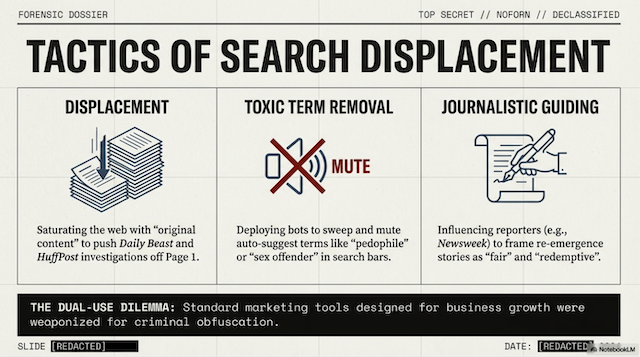
Organized forgetting can buy time. It can delay consequences. It can keep powerful people comfortable.
It cannot hold forever.
The UK offers a live example. The Guardian reported that Peter Mandelson resigned from the House of Lords in early February 2026 after Epstein-linked emails and allegations of leaked confidential government communications surfaced.
In the US, today’s reporting shows the same pattern of institutional fallout after the DOJ releases, including a high-profile resignation at Goldman Sachs amid scrutiny tied to names appearing in the files.
When the archive reappears, what collapses is not only reputations. It is the story powerful people told themselves about being untouchable.
What this case really exposes
Epstein’s impunity was not charisma. It was infrastructure. Elite access, institutional prestige, and the architecture of online visibility can be rented. The emails and reporting make that uncomfortably clear.
If you want to talk about democracy, start with mechanics. Who can pay to add friction to truth. Who benefits when citizens have to work harder just to find basic facts. Who gets protected when the first page of results becomes a curated stage.
What to demand now
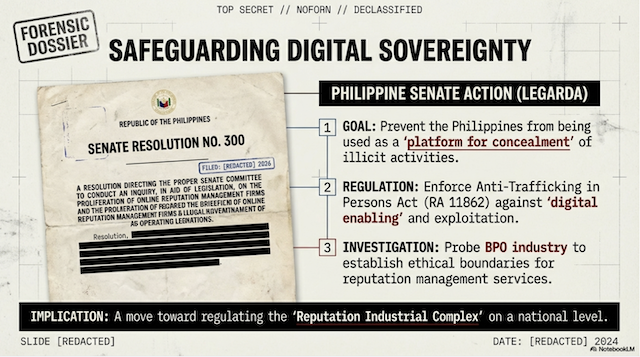
Start with transparency. The Senate inquiry should not stop at naming. It should map the pipeline. Who contracted the work. Who executed it. What platforms were involved. What local entities were paid. What laws were breached, if any, and what enforcement path exists.
Next, treat reputation laundering tied to exploitation as a public safety issue, not a marketing trick. It is not normal SEO work when the goal is to bury criminal history and obstruct scrutiny.
Finally, make digital labor safer without scapegoating workers. The responsibility sits with clients, brokers, and systems that accept money to bury harm. The Philippines should not be a place where global predators come to buy silence by proxy.
Because the real danger is not only the lie. The real danger is what happens when the truth becomes exhausting to reach, until people stop trying.
Live tweets of @ReallyVirtual on Osama Bin Laden Raid
Tsunami alert includes Philippines after Japan earthquake
The Rise of Tough Leaders and Their Populist Agenda
About The Author

Noemi Lardizabal-Dado
Noemi Lardizabal-Dado is a content strategist with over 19 years of experience in blogging, content management, citizen advocacy, and media literacy, and over 30 years in web development. Otherwise known as @MomBlogger on social media, she believes in making a difference in the lives of her children by advocating for social change that benefits the greater good. She is a co-founder and a member of the editorial board of Blog Watch . She is a resource speaker on media literacy, social media, blogging, digital citizenship, good governance, transparency, parenting, women’s rights, wellness, and cyber safety. Her personal blogs such as aboutmyrecovery.com (parenting) , pinoyfoodblog.com (recipes), techiegadgets.com (gadgets) and benguetarabica.coffee keep her busy outside of Blog Watch. Disclosure: I am an advocate. I am NOT neutral. I will NOT give social media mileage to members of political clans, epal, a previous candidate for the same position and those I believe are a waste of taxpayers' money. I do not support or belong to any political party. I was part of accredited media covering the Office of the Vice President and Leni Robredo as she ran as a presidential aspirant in the 2022 National and local elections. On August 5, 2021, YouTube announced that I was selected as one of 50 Program participants of its Creator Program for Independent Journalists She was a Senior Consultant for ALL media engagements for the PCOO-led Committee on Media Affairs & Strategic Communications (CMASC) under the ASEAN 2017 National Organizing Council from January 4 -July 5, 2017. Having been an ASEAN advocate since 2011, she has written extensively about the benefits of the ASEAN community and as a region of opportunities on Blog Watch and aboutmyrecovery.com. Organization affiliation includes Consortium on Democracy and Disinformation Updated June 6, 2022