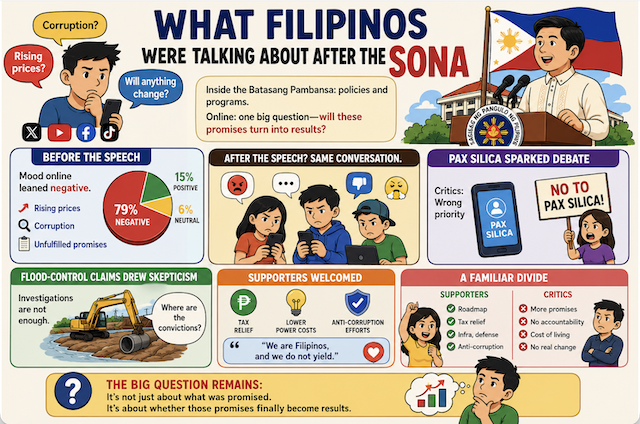
What Filipinos were talking about after the SONA
Inside the Batasang Pambansa, the focus was on policies and government programs. Online, it was something else entirely. The biggest question wasn’t really what President Marcos would say. It was whether Filipinos still believed anything would come of it.

That sentiment was already apparent before President Marcos delivered his fifth State of the Nation Address. Long before the speech began, many Filipinos had already shifted the conversation elsewhere. Instead of speculating about what the President might announce, they were talking about corruption, the economy, and the administration’s record. Social listening cited by the Philippine Daily Inquirer found that the discussion leaned largely negative, driven by concerns over rising prices, corruption, and promises people felt had gone nowhere. The newspaper’s review of reader comments reflected much the same mood: roughly 79% expressed negative views, compared with 15% positive and 6% neutral.
Once the speech ended, the conversation barely changed. The same issues continued to dominate discussions on X, YouTube, and other social media platforms.
“Puro salita”
One of the most common criticisms was that many of the promises sounded familiar.

Several users questioned whether this year’s commitments would finally translate into concrete action.
“May mga magagandang promises nga sana pero ang tanong kung matutupad ba yung mga yon? Puro salita lang ba ulit at walang aksyon?” — @islesbiyana
Others dismissed the speech outright.
“Longest SONA? Of no achievements! Puro salita!” — @lazykid2020
Flood-control claims drew skepticism
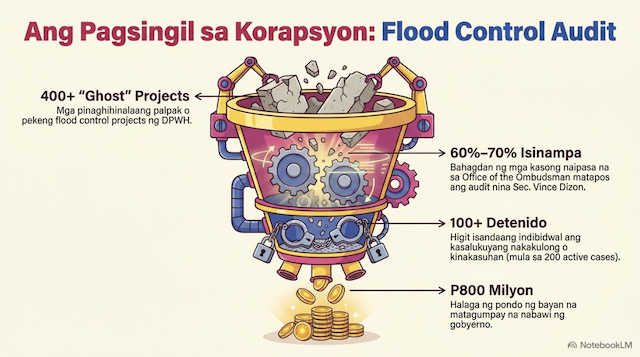
Marcos devoted a significant portion of the address to ongoing investigations into allegedly anomalous flood-control projects, saying hundreds of projects had been audited and public funds recovered.
For many online, however, investigations alone were not enough.
“Kakatawa tong si BBM, binida pa talaga yung flood control issues na akala mo naman napakulong nya lahat.” — @f4ggotism
Many commenters said they wanted to see convictions, not just audits and announcements.
Pax Silica sparked another debate
The administration’s push for the Pax Silica digital identity initiative also generated strong reactions.
Critics questioned whether the government was focusing on the right priorities while many Filipinos continued to struggle with food prices and household expenses.
Posts carrying slogans such as “NO TO PAX SILICA! IBASURA!” circulated widely, while others criticized what they saw as an emphasis on technology over immediate economic concerns.
Supporters welcomed tax relief and the West Philippine Sea message
The reaction was not entirely negative.
Many supporters welcomed the administration’s plans for tax relief, lower electricity costs, and the continuation of anti-corruption investigations. One widely shared post argued that measures aimed at the middle class could leave families with more money for tuition, housing, or small businesses, rather than depending on additional cash assistance.
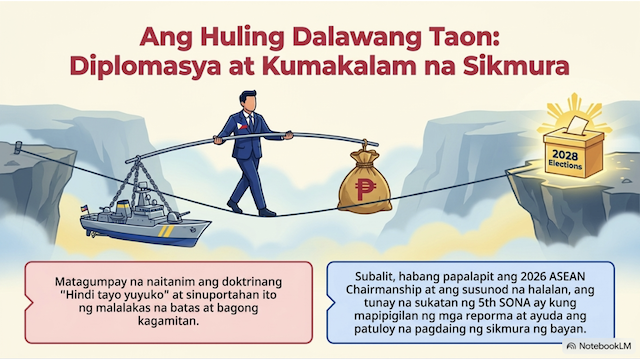
Supporters also praised the overall tone of the speech and backed the President’s continued stand on the West Philippine Sea. One line, in particular, resonated with them:
“We are Filipinos, and we do not yield.”
It quickly became one of the most widely shared excerpts from the address.
A familiar divide

The reactions that followed reflected a political divide Filipinos have seen many times before.
Supporters viewed the speech as a roadmap for the administration’s remaining years, highlighting its plans on tax relief, infrastructure, national defense, and anti-corruption efforts.
Critics heard something different. They saw another address filled with commitments but lacking accountability. Many questioned whether the flood-control investigations would lead to convictions, whether the cost of living would ease, and whether ordinary Filipinos would notice any real difference in their daily lives.
The question that remains
That, perhaps, became the biggest question after the fifth State of the Nation Address. It wasn’t simply about what the President promised. It was whether those promises would finally turn into results.
Forwarded radiation text message is false
5 useful stats about Marawi City and Lanao del Sur of the ARMM
Twitter reactions: And on the 10th Day, Senator Lito Lapid spoke
About The Author

Noemi Lardizabal-Dado
Noemi Lardizabal-Dado is a content strategist with over 19 years of experience in blogging, content management, citizen advocacy, and media literacy, and over 30 years in web development. Otherwise known as @MomBlogger on social media, she believes in making a difference in the lives of her children by advocating for social change that benefits the greater good. She is a co-founder and a member of the editorial board of Blog Watch . She is a resource speaker on media literacy, social media, blogging, digital citizenship, good governance, transparency, parenting, women’s rights, wellness, and cyber safety. Her personal blogs such as aboutmyrecovery.com (parenting) , pinoyfoodblog.com (recipes), techiegadgets.com (gadgets) and benguetarabica.coffee keep her busy outside of Blog Watch. Disclosure: I am an advocate. I am NOT neutral. I will NOT give social media mileage to members of political clans, epal, a previous candidate for the same position and those I believe are a waste of taxpayers' money. I do not support or belong to any political party. I was part of accredited media covering the Office of the Vice President and Leni Robredo as she ran as a presidential aspirant in the 2022 National and local elections. On August 5, 2021, YouTube announced that I was selected as one of 50 Program participants of its Creator Program for Independent Journalists She was a Senior Consultant for ALL media engagements for the PCOO-led Committee on Media Affairs & Strategic Communications (CMASC) under the ASEAN 2017 National Organizing Council from January 4 -July 5, 2017. Having been an ASEAN advocate since 2011, she has written extensively about the benefits of the ASEAN community and as a region of opportunities on Blog Watch and aboutmyrecovery.com. Organization affiliation includes Consortium on Democracy and Disinformation Updated June 6, 2022