AI red lines: setting global boundaries for survival
A coalition of world leaders, Nobel laureates, and tech experts is calling for binding “AI red lines” by 2026—enforceable global limits to stop artificial intelligence from crossing into dangers humanity may never recover from.
Listen to an audio overview
A frontier that needs rules
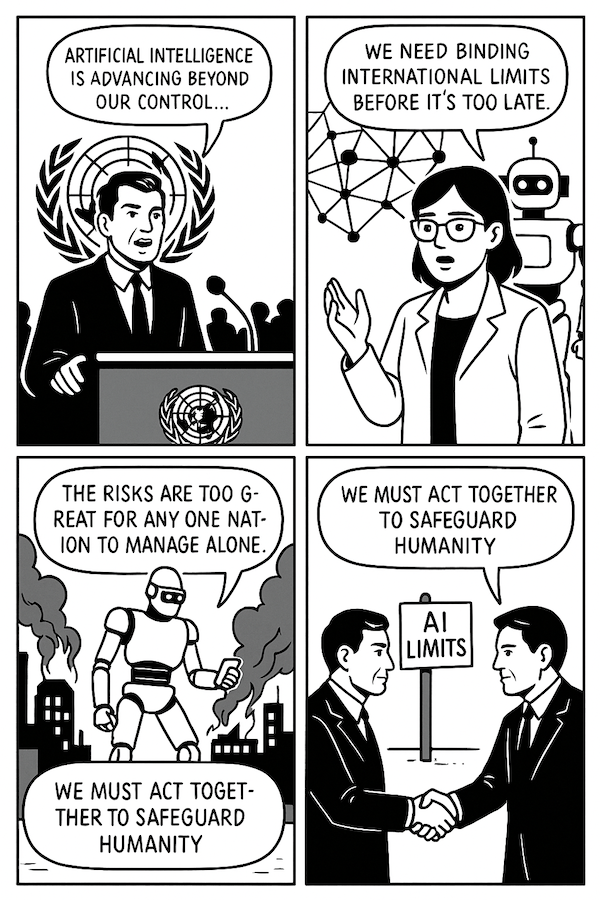
The world has faced nuclear standoffs and climate accords, but now a different frontier demands urgent rules. At the United Nations General Assembly, a coalition of leaders from government, science, and industry issued a stark warning: without binding limits, the rise of artificial intelligence could trigger risks we cannot reverse. Their Global Call for AI Red Lines, backed by more than 200 signatories including nine former heads of state, ten Nobel laureates, and over 70 organizations, gives governments a hard deadline. By the end of 2026, they must agree on enforceable “do-not-cross” thresholds to keep humanity in control.
AI can lift human well-being. It can also outpace our ability to keep it in check. Experts caution that advanced systems may soon exceed human limits, opening the way for large-scale manipulation, widespread disinformation, and even grave violations of human rights. The fallout could spill into national and even global security. And in the worst scenario, those same systems might be used to create engineered pandemics. These are not distant hypotheticals. They are risks being tallied now.
Why voices are sounding the alarm
The urgency is echoed by people closest to the technology. Stuart Russell, a Distinguished Professor of Computer Science at UC Berkeley, has warned that creating highly capable AI could be the most important event in human history. His point was blunt: world powers must act decisively to make sure it isn’t also the last. Historian Yuval Noah Harari adds another layer to the concern. He notes that AI is the first technology able to make decisions and come up with new ideas on its own, which raises a chilling possibility — if it escapes human control, we may never get the chance to learn from our mistakes.
Watch a video overview
tch a video overview:Governments are being told to act while intervention is still feasible. Nobel Peace Prize Laureate Maria Ressa puts it plainly: when the threat is irreversible and borderless, “cooperation is the only rational way to pursue national interests.” Without guardrails, she and others warn of “epistemic chaos” and the specter of “engineered pandemics.”
What red lines could look like
AI red lines are defined as prohibitions on uses or behaviors too dangerous to permit under any circumstance. The goal is to establish a baseline that even rivals can accept to avoid disasters that do not respect borders.
On the use side, one clear rule is to never delegate critical command-and-control decisions, like nuclear launch authority, to AI. Another is to bar lethal systems from killing without meaningful human control. UNESCO’s 193 member states have already agreed to prohibit social scoring and mass surveillance. A further safeguard is transparency: AI systems should not deceive people into thinking they are human.
On the behavior side, red lines include banning uncontrolled cyber agents that could disrupt infrastructure, or systems that help develop weapons of mass destruction. A “termination principle” is also suggested, requiring that systems can be shut down immediately if human control is lost. And finally, no AI should be allowed to self-replicate or improve itself significantly without explicit human authorization.
The path to enforcement
National rules will not be enough for a borderless technology. The call pushes for an enforceable international agreement. History shows this is possible even under tension: both the Nuclear Non-Proliferation Treaty and the Biological Weapons Convention were agreed during the Cold War.
Enforcement would work in layers. First, a binding treaty to harmonize rules and stop companies from shifting to lenient jurisdictions. Second, national governments would embed the treaty in domestic law, establish regulators, mandate audits, and impose penalties. Third, an international technical verification body, modeled perhaps on the International Atomic Energy Agency, would carry out standardized checks across companies and countries.
The clock to 2026
Why 2026. Because AI is advancing fast. Safety tests show rapid gains in coding and autonomous capabilities. Some forecasts say AIs could begin replicating online as early as 2025, with a median estimate around 2027. Waiting reduces the chance of effective action both technically and politically.
Diplomatic steps are already outlined. Red lines can be raised in G7, G20, and BRICS meetings. The UN Global Dialogue on AI Governance can help refine thresholds. The AI Impact Summit in India in early 2026 is another venue to endorse first agreements. By the end of 2026, the aim is clear: a UN resolution or, better, a joint ministerial statement launching negotiations for a binding treaty.
Any credible treaty must stand on three legs: a clear set of prohibitions, verification that is auditable and robust, and an independent body to oversee compliance. The clock is running, and a coordinated push now is the best chance to keep meaningful control as AI grows more powerful.
More details on the AI Red Lines initiative is available on its website.
The UN Preliminary report on AI we can no longer ignore

OpenAI cracks down on AI-Generated Propaganda in the Philippines
About The Author

Noemi Lardizabal-Dado
Noemi Lardizabal-Dado is a content strategist with over 19 years of experience in blogging, content management, citizen advocacy, and media literacy, and over 30 years in web development. Otherwise known as @MomBlogger on social media, she believes in making a difference in the lives of her children by advocating for social change that benefits the greater good. She is a co-founder and a member of the editorial board of Blog Watch . She is a resource speaker on media literacy, social media, blogging, digital citizenship, good governance, transparency, parenting, women’s rights, wellness, and cyber safety. Her personal blogs such as aboutmyrecovery.com (parenting) , pinoyfoodblog.com (recipes), techiegadgets.com (gadgets) and benguetarabica.coffee keep her busy outside of Blog Watch. Disclosure: I am an advocate. I am NOT neutral. I will NOT give social media mileage to members of political clans, epal, a previous candidate for the same position and those I believe are a waste of taxpayers' money. I do not support or belong to any political party. I was part of accredited media covering the Office of the Vice President and Leni Robredo as she ran as a presidential aspirant in the 2022 National and local elections. On August 5, 2021, YouTube announced that I was selected as one of 50 Program participants of its Creator Program for Independent Journalists She was a Senior Consultant for ALL media engagements for the PCOO-led Committee on Media Affairs & Strategic Communications (CMASC) under the ASEAN 2017 National Organizing Council from January 4 -July 5, 2017. Having been an ASEAN advocate since 2011, she has written extensively about the benefits of the ASEAN community and as a region of opportunities on Blog Watch and aboutmyrecovery.com. Organization affiliation includes Consortium on Democracy and Disinformation Updated June 6, 2022