
?817.87 Million, Missing Records and a 73-Minute Cash Withdrawal: Five Revelations from Day 38 of Sara Duterte’s Impeachment Trial
“I’m not scared naman po.”
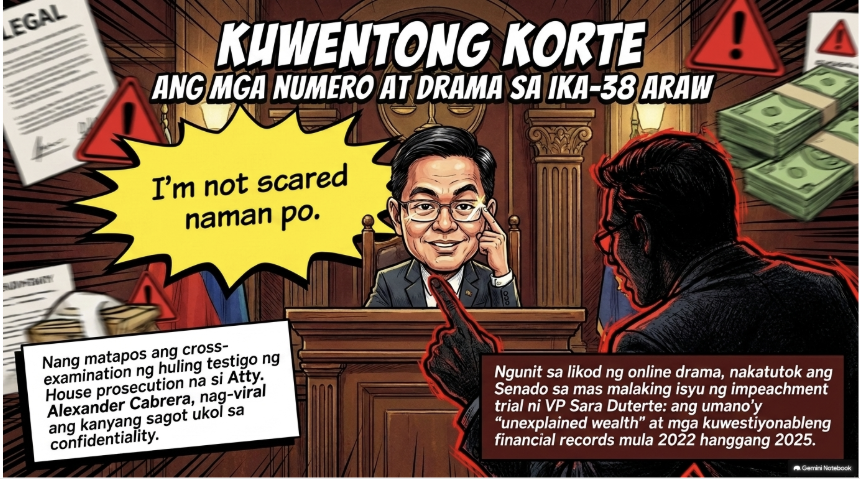
Financial forensic analyst Alexander Cabrera gave that reply when defense lawyer Kristine Ferrer questioned him about confidentiality provisions under the Anti-Money Laundering Act during Day 38 of Vice President Sara Duterte’s impeachment trial.
The exchange drew reactions online, but the bigger story was in the financial records.
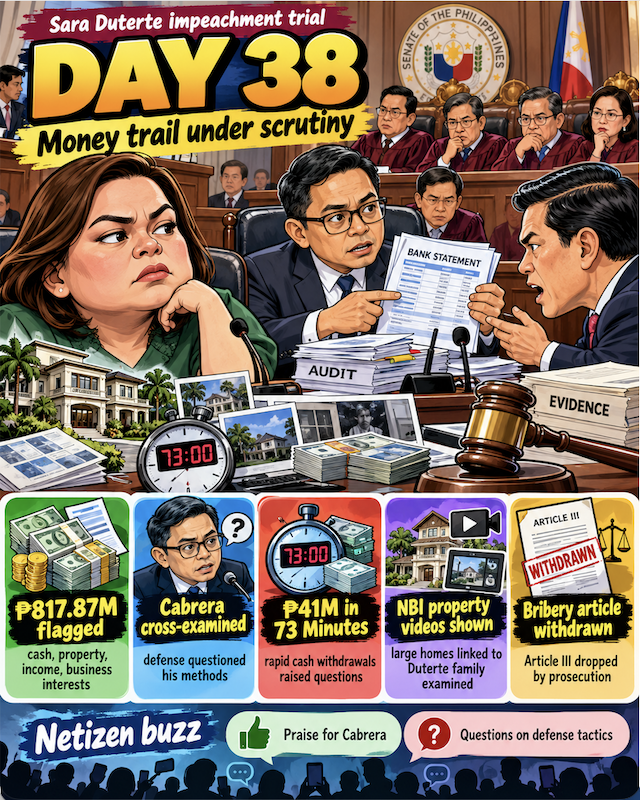
An alleged ?817.87 million in undeclared assets and income. ?41 million withdrawn in just 73 minutes. Business interests and properties that may not have been fully disclosed in Duterte’s Statements of Assets, Liabilities, and Net Worth (SALNs).
These were among the matters examined by the Senate impeachment court on October 12, 2026.
Cabrera, a lawyer and certified public accountant, was the House prosecution’s final witness. His financial report covers the records of Duterte and her husband, lawyer Manases Carpio, from 2022 to 2025.
The defense questioned the reliability of his findings, the documents he examined and his qualifications as a forensic accounting expert.
Here are five highlights from Day 38.
1. The ?817.87-million discrepancy: What the financial records show
Cabrera’s report identified approximately ?817.87 million in allegedly undeclared assets and income associated with Duterte and Carpio between 2022 and 2025.
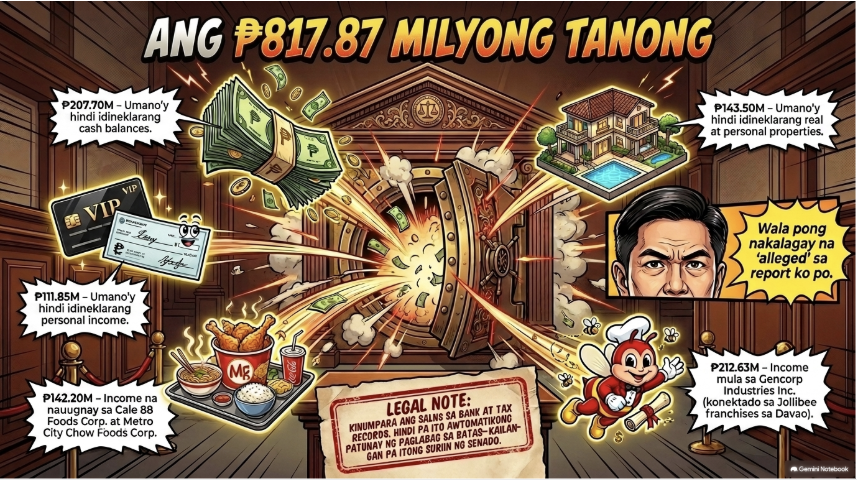
The findings covered several categories:
- ?207.70 million in allegedly undeclared cash balances.
- ?143.50 million in allegedly undeclared real and personal properties.
- ?111.85 million in allegedly undeclared personal income.
- ?142.20 million in income associated with Cale 88 Foods Corp. and Metro Chow King Food Corp.
- ?212.63 million in income associated with Gencorp Industries Inc., a company linked to Jollibee franchises in Davao City.
The financial analysis compared SALNs with banking records, tax filings and corporate disclosures.
Cabrera maintained that the calculations represented the results of his examination rather than unsupported accusations.
During cross-examination, Ferrer repeatedly referred to alleged business interests. Cabrera objected to that characterization.
“Wala pong nakalagay na ‘alleged’ sa report ko po.”
But Cabrera’s confidence in his calculations does not make the alleged discrepancies established violations of the law.
The Senate must still determine whether the financial records support the prosecution’s conclusions and consider any evidence offered by the defense.
There is also a distinction between undeclared assets, unreported income and unexplained wealth. They are related issues, but the legal findings depend on the evidence supporting each allegation.
2. The defense questions Cabrera’s financial investigation
One of the most substantive parts of the cross-examination concerned the documents Cabrera did not examine.
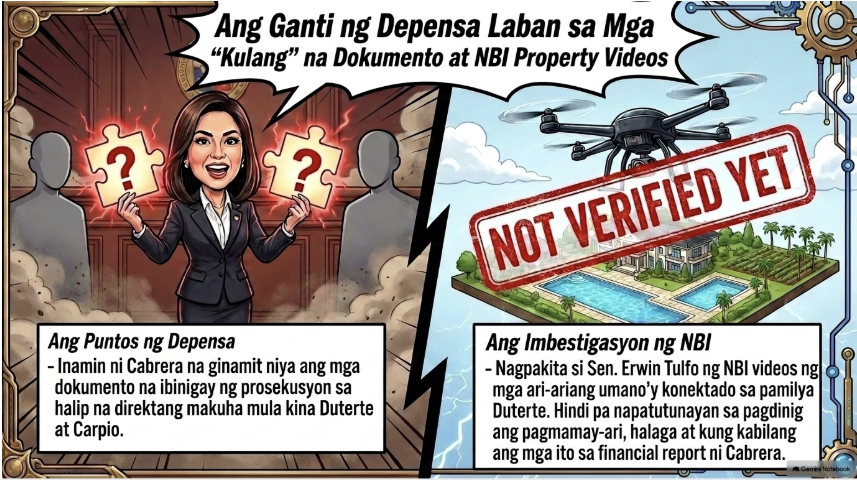
Ferrer established that Cabrera had not obtained financial documents directly from Duterte and Carpio or interviewed their personal accountants and corporate auditors.
Cabrera explained that his team relied on documents provided through the prosecution, including banking, tax and corporate records.
“Kung ano po ‘yong naibigay lamang sa’min, ‘yon lamang ang aming puwedeng pagbasehan,” he said.
He also acknowledged that his team had approximately three weeks to examine subpoenaed banking records received in September, although the broader financial analysis began months earlier.
The defense questioned whether that period was sufficient for an examination involving numerous accounts and corporate transactions.
Ferrer also challenged the basis for Cabrera’s conclusions about Duterte’s reported 20 percent interest in Gencorp Industries.
Cabrera acknowledged that his team had not examined the company’s stock certificates, stock and transfer book or franchise agreements. He maintained that his calculations were based on the available documents.
These admissions give the defense grounds to challenge the completeness of the investigation. They do not automatically invalidate the banking and corporate records already submitted.
The prosecution argues that the documents establish discrepancies requiring explanation. The defense maintains that an examination without complete source records can lead to inaccurate conclusions.
If additional financial records exist that could explain the discrepancies, they may affect how the Senate evaluates Cabrera’s findings.
3. ?41 million withdrawn in 73 minutes: Why the transactions raised questions
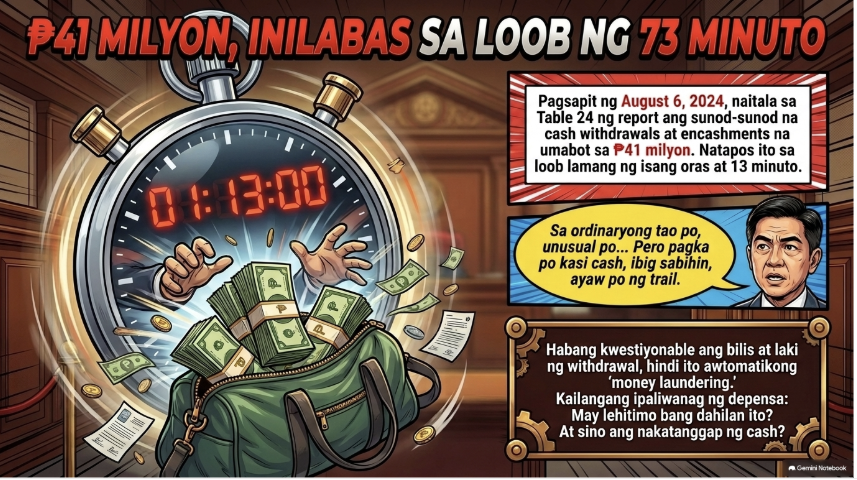
One of the day’s most striking financial details involved ?41 million in cash withdrawals and encashments completed within one hour and 13 minutes.
The transactions occurred on August 6, 2024, and were identified in Table 24 of Cabrera’s report.
During questioning by Senator Risa Hontiveros, Cabrera described the speed and volume of the transactions as unusual.
“Sa ordinaryong tao po, unusual po. PHP41 million in cash, kailangan nyo po siyempre ng bag po doon,” he said.
Cabrera also explained why large cash withdrawals receive particular attention during financial investigations.
“Pero pagka po kasi cash, ibig sabihin, ayaw po ng trail.”
His statement reflected his interpretation of the transactions. It did not establish that the individuals involved intended to conceal money.
The issue for investigators is whether the withdrawals had legitimate purposes, who ultimately received the cash and whether supporting documents can account for the transactions.
The size of the withdrawals warrants examination. But cash withdrawals, even unusually large ones, are not automatically evidence of money laundering or unlawful enrichment.
The Senate will need to evaluate the transaction records and any explanations submitted by the defense.
4. NBI videos put Duterte-linked properties under scrutiny
Senator-judge Erwin Tulfo introduced another issue during the hearing when he played National Bureau of Investigation (NBI) videos showing two large properties allegedly connected to Duterte and her family.
One property had two swimming pools.
The videos came from a separate NBI investigation into possible property acquisitions linked to allegations involving cash deliveries.
Tulfo questioned whether the properties shown in the footage appeared in Duterte’s SALNs.
He also referred to a parcel of agricultural land in Barangay Santo Niño, Island Garden City of Samal, with a reported acquisition cost of ?200,000.
Cabrera declined to make an immediate assessment of the videos without examining the relevant documents.
That was an important limitation. Aerial footage may show buildings and other improvements, but it cannot establish legal ownership, acquisition costs or the source of funds.
Those questions require land titles, tax declarations, transaction documents and verified financial records.
The NBI investigation and the Senate impeachment proceedings are separate processes. Evidence presented in one does not automatically prove the allegations being examined in the other.
For now, the properties remain part of an investigation, not an established finding of undeclared wealth.
5. Prosecutors abandon the bribery article as the defense prepares its case
The House prosecution has decided to withdraw Article III of the impeachment complaint, which involved allegations that Duterte bribed Department of Education officials to influence procurement decisions.
The panel informed the Senate impeachment court of its decision through a manifestation filed on October 6.
House prosecutor Jonathan Keith Flores explained that the prosecution wanted to shorten the proceedings and concentrate on the remaining articles.
Article II, involving alleged unexplained wealth, inaccurate SALNs and continued business interests, was the last article for which prosecutors presented evidence.
Article I concerns the alleged misuse of ?500 million in confidential funds under the Office of the Vice President and ?112.5 million under the Department of Education.
Questions also remained about whether additional military witnesses would be summoned in connection with Article I.
The withdrawal of Article III is significant because the prosecution will no longer seek a Senate conviction on that particular charge.
However, the decision does not amount to a finding that the bribery allegations were false. Prosecutors have said those allegations could still be referred to appropriate government agencies for separate investigation.
After Cabrera’s cross-examination ended, the prosecution opted not to conduct a redirect examination.
With its final witness finished, the prosecution was preparing to formally offer its evidence and address outstanding procedural matters before the defense presents its case.
Netizen reactions: Praise for Cabrera, criticism of courtroom tactics
The exchanges between Ferrer and Cabrera attracted considerable attention in online discussions, especially on Reddit.
Many commenters focused on the defense’s attempts to question Cabrera’s qualifications and impartiality.
One commenter in the r/Philippines impeachment trial megathread wrote:
“Gusto ata iparating na biased si Atty Cabrera at gusto nyang ma-convict si Sara. They can’t attack his credentials, kaya they’ll say he’s biased.”
Cabrera’s reply about confidentiality provisions also drew attention:
“I’m not scared naman po” Boom HAHAHAHAHAHA
Other commenters questioned the way Ferrer pressed the witness for yes-or-no answers.
A commenter in r/newsPH observed:
“Also, some questions can’t be answered with a yes or no. It is necessary to explain.”
In r/AccountingPH, a commenter who identified as an auditor praised Cabrera’s responses:
“Grabe, I’m so amazed by how Atty. Cabrera handles and answers questions sa impeachment court. As an auditor myself, nakaka proud lang and I can’t help but root for him. Tho I’m kinda curious, how he works kaya in an engagement? Strict ba siya or medyo kenkoy din?”
The online conversation also showed how the trial’s technical evidence can be overshadowed by courtroom exchanges.
Some viewers focused on the witness’s composure. Others questioned the defense’s approach.
These comments reflect reactions from particular online communities. They cannot be treated as a scientific measure of public opinion.
The defense’s questions about missing records, incomplete corporate documents and the methodology behind the financial report deserve examination regardless of how the lawyers or witness performed before the cameras.

Duterte rejects the allegations
Vice President Duterte has denied wrongdoing and described the impeachment proceedings as politically motivated.
She has accused the prosecution of relying on questionable evidence and challenged the credibility of witnesses who testified against her.
Her husband, Manases Carpio, has also disputed attempts to connect his personal credit card transactions to Duterte’s official functions.
Carpio said that questioned expenses during overseas trips were personal transactions paid with his own funds, including expenses shared with traveling companions.
The defense maintains that personal spending and legitimate business transactions should not automatically be characterized as unlawful wealth.
The prosecution, meanwhile, argues that the financial records show discrepancies that Duterte must answer.
The Senate must assess the documents and testimony presented by both sides before reaching a verdict.
What citizens should watch next
With the prosecution’s final witness finished, attention will turn to the documentary evidence and the defense’s response.
Three matters deserve particular attention:
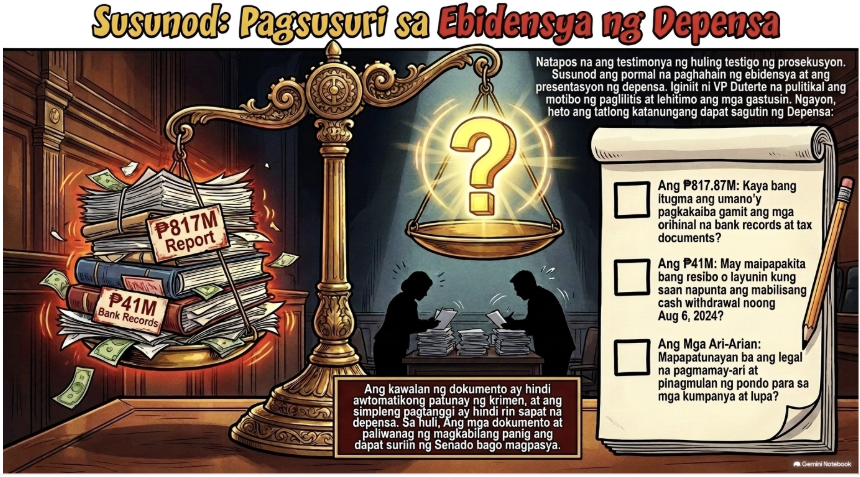
- The financial report: Can the defense reconcile the alleged ?817.87-million discrepancy using bank records, tax documents and other verifiable evidence?
- The ?41-million withdrawals: Are there supporting documents explaining the purpose and ultimate recipients of the cash withdrawn on August 6, 2024?
- The corporate and property records: Can the ownership interests, income and asset valuations questioned during the hearings be established through official documents?
The public should also follow the Senate’s rulings on the formal offer of evidence and the unresolved procedural matters involving the remaining impeachment articles.
The records must speak for themselves
The defense has exposed gaps in Cabrera’s examination, particularly the absence of documents obtained directly from Duterte and Carpio. At the same time, the prosecution has presented banking and corporate records that it says support substantial discrepancies in the couple’s declared finances.
The ?41-million withdrawal is one example of why the explanations matter. The transactions are documented in the financial report, but their purpose and ultimate destination remain contested.
As the defense prepares its case, citizens can compare the explanations with the documents placed on record. A missing document should not be treated as proof of wrongdoing, just as an unsupported explanation should not be accepted simply because it comes from a public official.
The next test is whether the defense can account for the disputed assets, income and transactions with evidence the Senate can examine.
?817.87 million is the prosecution witness’s calculation. The records presented by both sides will determine how much of it stands.
Suit filed at the Presidential Electoral Tribunal : Jail Brillantes & his 5 Commissioners for contempt
English Translation : The 2015 State of the Nation Address #SONA2015
VP Robredo to Mayors: Request Aid from Foreign Agencies Directly
About The Author

Noemi Lardizabal-Dado
Noemi Lardizabal-Dado is a content strategist with over 19 years of experience in blogging, content management, citizen advocacy, and media literacy, and over 30 years in web development. Otherwise known as @MomBlogger on social media, she believes in making a difference in the lives of her children by advocating for social change that benefits the greater good. She is a co-founder and a member of the editorial board of Blog Watch . She is a resource speaker on media literacy, social media, blogging, digital citizenship, good governance, transparency, parenting, women’s rights, wellness, and cyber safety. Her personal blogs such as aboutmyrecovery.com (parenting) , pinoyfoodblog.com (recipes), techiegadgets.com (gadgets) and benguetarabica.coffee keep her busy outside of Blog Watch. Disclosure: I am an advocate. I am NOT neutral. I will NOT give social media mileage to members of political clans, epal, a previous candidate for the same position and those I believe are a waste of taxpayers' money. I do not support or belong to any political party. I was part of accredited media covering the Office of the Vice President and Leni Robredo as she ran as a presidential aspirant in the 2022 National and local elections. On August 5, 2021, YouTube announced that I was selected as one of 50 Program participants of its Creator Program for Independent Journalists She was a Senior Consultant for ALL media engagements for the PCOO-led Committee on Media Affairs & Strategic Communications (CMASC) under the ASEAN 2017 National Organizing Council from January 4 -July 5, 2017. Having been an ASEAN advocate since 2011, she has written extensively about the benefits of the ASEAN community and as a region of opportunities on Blog Watch and aboutmyrecovery.com. Organization affiliation includes Consortium on Democracy and Disinformation Updated June 6, 2022