Day 33 Sara Duterte impeachment trial: AMLC puts ?4.4 billion in reported transactions before the Senate
“Section 8A protects AMLC information against leaks, indiscriminate publication, and other unauthorized disclosure.”
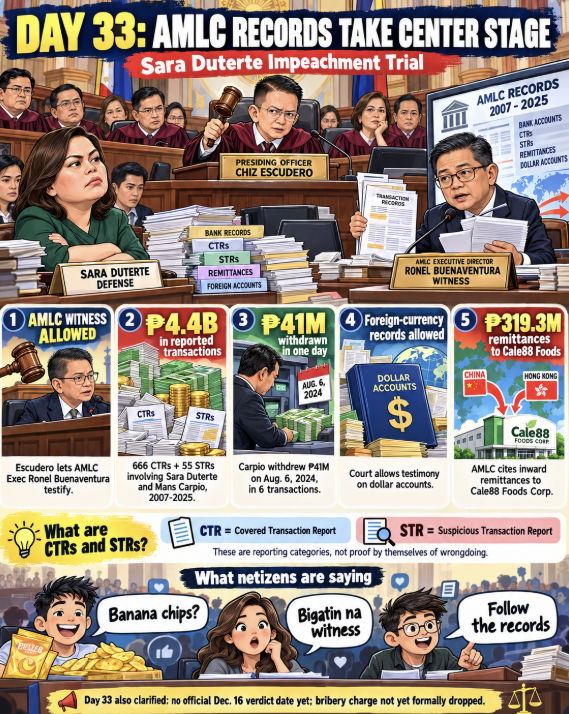
Senate impeachment court Presiding Officer Francis Escudero said this as he rejected an attempt by Vice President Sara Duterte’s defense to stop Anti-Money Laundering Council (AMLC) Executive Director Ronel Buenaventura from testifying on financial transactions involving Duterte and her husband, lawyer Manases “Mans” Carpio.
The ruling cleared the way for one of Day 33’s main events: Buenaventura’s presentation of AMLC records as part of the prosecution’s case under Article II, which covers allegations of unexplained wealth and inaccurate disclosure of assets in Duterte’s Statements of Assets, Liabilities and Net Worth (SALNs).
Buenaventura presented summaries of Covered Transaction Reports (CTRs) and Suspicious Transaction Reports (STRs) involving Duterte and Carpio.
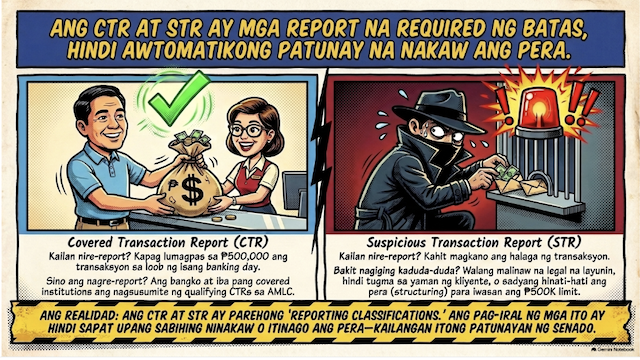
A Covered Transaction Report (CTR) is the report a covered institution sends to AMLC when a transaction meets the threshold set by law. For bank transactions, Republic Act No. 11521 defines a covered transaction as cash or an equivalent monetary instrument exceeding ?500,000 within one banking day.
A Suspicious Transaction Report (STR) may be submitted regardless of the amount. The law lists circumstances that can make a transaction suspicious, including the absence of an apparent legal or economic purpose, an amount inconsistent with the client’s financial capacity, transaction structuring intended to avoid reporting rules, or activity that departs from the client’s usual transaction profile. Lawphil
That distinction matters. A CTR or STR is a reporting classification, not a verdict. The existence of one does not by itself establish that money was stolen, illegally obtained, or hidden from the government. The Senate still has to examine what the transactions represent and whether they support the allegations in the articles of impeachment.
Five highlights from Day 33
- The defense failed to keep the AMLC witness off the stand. Defense lawyer Mark Vinluan invoked Section 8-A of the Anti-Money Laundering Act, which requires the AMLC and its Secretariat to protect information received or processed and bars officials from revealing information they know because of their office. Escudero ruled that the provision protects AMLC information against unauthorized disclosure but does not prevent the agency from complying with a lawful and particularized subpoena from the impeachment court. Republic Act No. 1405, the Bank Secrecy Law, also expressly lists impeachment as an exception to the general confidentiality of bank deposits.
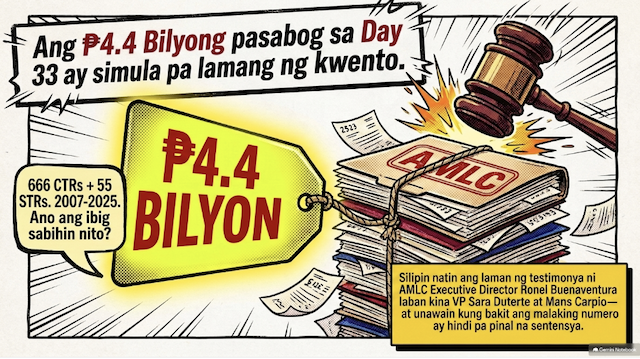
- AMLC revised the Duterte-Carpio transaction total from ?6.7 billion to about ?4.4 billion. Buenaventura testified that AMLC records covering 2007 to 2025 contained 666 CTRs and 55 STRs involving Duterte and Carpio. He said the ?4.4-billion aggregate was lower than the ?6.7 billion previously presented during House proceedings after BPI corrected its data. Of the revised total, about ?1.63 billion was classified as inflows, ?1.3 billion as outflows, while roughly ?1.4 billion could not be classified as either.
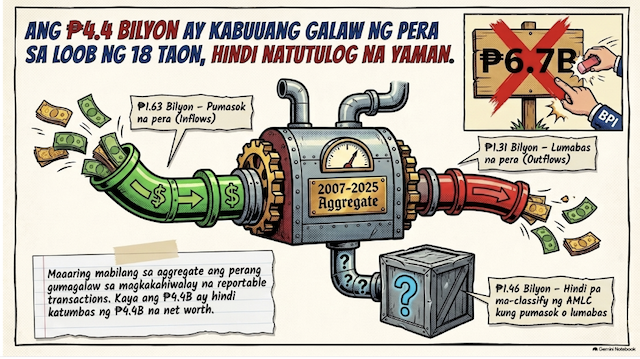
The correction is important. The ?4.4 billion should not be described as Duterte and Carpio’s “?4.4 billion in unexplained wealth.” It is an aggregate of transactions reported to AMLC over an 18-year period. The prosecution still has to show how particular transactions relate to its allegations and to the couple’s declared assets and income.
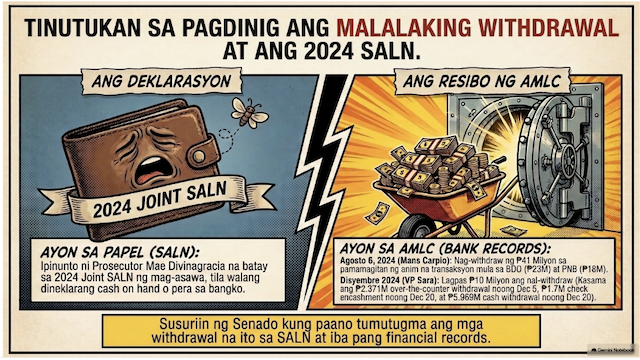
- The prosecution focused on large withdrawals in 2024. Buenaventura testified that Carpio withdrew ?41 million on August 6, 2024, through six transactions at two banks. Of the total, ?23 million was withdrawn from BDO and ?18 million from Philippine National Bank. Prosecutor Mae Divinagracia said the withdrawals were inconsistent with the couple’s 2024 joint SALN, which she said declared no cash on hand or in bank. That is the prosecution’s position and remains subject to the defense’s response and the court’s assessment. Buenaventura also identified more than ?10 million in transactions involving Duterte in December 2024: a ?2.371-million over-the-counter withdrawal on December 5, a ?1.7-million check encashment on December 20, and a ?5.969-million withdrawal later that day.
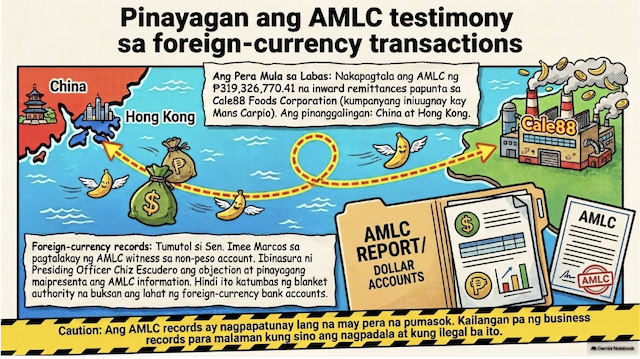
- The court allowed testimony involving foreign-currency accounts. Senator-Judge Imee Marcos objected when Buenaventura began discussing a non-peso account. Escudero overruled the objection and allowed the presentation to continue. The dispute matters because foreign-currency deposits have separate confidentiality protections, and the defense questioned whether information about them could be presented during the impeachment trial.
- Cale88 Foods received ?319.3 million in remittances from China and Hong Kong, according to AMLC records. Buenaventura testified that the AMLC tabular summary showed ?319,326,770.41 in inward remittances to Cale88 Foods Corporation, a company linked to Carpio.
That figure also needs careful wording. AMLC records establish that the reported remittances originated from China and Hong Kong. That does not by itself establish who ultimately provided the funds, why they were transferred, or whether the transfers were illegal. Those questions require the underlying banking and business records.
?4.4 billion is a big number. It is not the verdict.
The easiest mistake after Day 33 is to treat the ?4.4-billion figure as if AMLC had discovered ?4.4 billion sitting in Duterte and Carpio’s bank accounts.
That is not what Buenaventura testified.
The amount represents the aggregate value of covered and suspicious transactions reported to AMLC over many years. Some were inflows, some were outflows, and others could not be classified by AMLC as either.
Money can also move more than once. A withdrawal, transfer, reinvestment or movement between accounts can generate another transaction without creating new wealth.
The better question is therefore not simply: Why ?4.4 billion?
The Senate has to determine what the transactions represented, where the money came from, where it went, and whether the financial records are consistent with Duterte’s legally required disclosures.
This is where SALNs, bank records, corporate records and testimony from the financial institutions become important.
What Day 33 did not settle
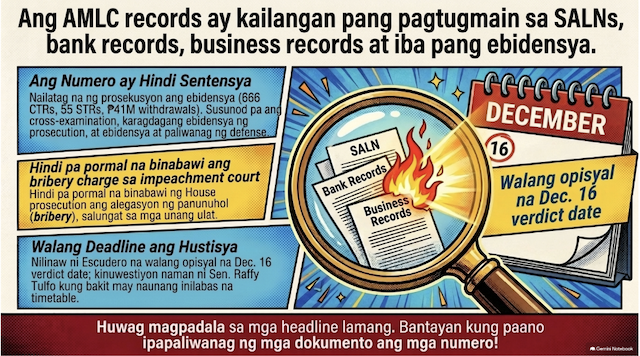
The prosecution has not yet formally dropped the bribery allegation.
House prosecution spokesperson Rep. Zia Alonto Adiong said the panel appeared to be moving in that direction, but he also said discussions were still ongoing and that the decision had not been finalized. Saying that the bribery charge has already been withdrawn would therefore be premature.
There is also no official December 16 deadline for a verdict.
Escudero said reports that a verdict would be issued before December 16 were “not entirely accurate.” Senator-Judge Raffy Tulfo also questioned why an impeachment court spokesperson had publicly given such a timetable.
The pace still depends on the evidence presented, objections, cross-examinations and the remaining witnesses.
What netizens were talking about
On Reddit’s Day 33 impeachment megathread, Cale88 quickly became material for political humor. One commenter posted: “Classmates, kain tayo ng banana chips. ?”
Other users focused less on the amounts and more on whether Buenaventura’s testimony could change political opinions. In another discussion, one commenter called him a “Bigatin na witness” but immediately questioned whether his testimony would persuade committed Duterte supporters.
There was also criticism of the defense’s attempt to prevent Buenaventura from testifying, while other commenters followed the technical arguments over the AMLC records and the meaning of the transaction reports.
These Reddit threads are useful for seeing one part of the online conversation, but they are not a public-opinion survey. The communities are self-selecting, and the Day 33 discussions I could independently verify leaned heavily critical of Duterte. It would be misleading to present them as representative of Filipino sentiment as a whole.
Follow the records, not just the headline number
Day 33 changed the discussion because the Senate now has specific records to examine: 666 Covered Transaction Reports, 55 Suspicious Transaction Reports, the ?41-million withdrawals, Duterte’s December 2024 transactions, and ?319.3 million in remittances to Cale88 Foods.
But none of those numbers can explain themselves.
For citizens following the trial, the useful comparison from here is between the AMLC summaries, the relevant SALNs, and the bank or business documents offered to explain each transaction. If a prosecution figure changes, as the ?6.7-billion figure already did, the correction should be reported. If a transaction has a documented lawful source, that explanation should also be reported.
Day 33 put the numbers before the court. The next test is whether the documents can explain them.

Day 27: What SEC records revealed about Sara Duterte’s business roles

Day 9 of Sara Duterte Impeachment trial: The prosecution rests its threat case on the NBI’s word
Day 16 of Sara Duterte’s impeachment trial: Who handled the 500 million?
About The Author

Noemi Lardizabal-Dado
Noemi Lardizabal-Dado is a content strategist with over 19 years of experience in blogging, content management, citizen advocacy, and media literacy, and over 30 years in web development. Otherwise known as @MomBlogger on social media, she believes in making a difference in the lives of her children by advocating for social change that benefits the greater good. She is a co-founder and a member of the editorial board of Blog Watch . She is a resource speaker on media literacy, social media, blogging, digital citizenship, good governance, transparency, parenting, women’s rights, wellness, and cyber safety. Her personal blogs such as aboutmyrecovery.com (parenting) , pinoyfoodblog.com (recipes), techiegadgets.com (gadgets) and benguetarabica.coffee keep her busy outside of Blog Watch. Disclosure: I am an advocate. I am NOT neutral. I will NOT give social media mileage to members of political clans, epal, a previous candidate for the same position and those I believe are a waste of taxpayers' money. I do not support or belong to any political party. I was part of accredited media covering the Office of the Vice President and Leni Robredo as she ran as a presidential aspirant in the 2022 National and local elections. On August 5, 2021, YouTube announced that I was selected as one of 50 Program participants of its Creator Program for Independent Journalists She was a Senior Consultant for ALL media engagements for the PCOO-led Committee on Media Affairs & Strategic Communications (CMASC) under the ASEAN 2017 National Organizing Council from January 4 -July 5, 2017. Having been an ASEAN advocate since 2011, she has written extensively about the benefits of the ASEAN community and as a region of opportunities on Blog Watch and aboutmyrecovery.com. Organization affiliation includes Consortium on Democracy and Disinformation Updated June 6, 2022