
Day 30 Sara Duterte Impeachment trial: GenCorp contracts, 51 firearms and the bank records fight
“Sabi nga ni Senator Lacson, ‘yung malaking paputok naging kwitis.”

Senator Migz Zubiri used that line as senator-judges questioned why the prosecution was spending court time on Vice President Sara Duterte’s firearms. The comment captured one of the tensions on Day 30 of the impeachment trial: which evidence actually helps establish the allegations under Article II, and which evidence merely attracts attention?
The September 28 proceedings returned to Duterte’s alleged unexplained wealth, business interests and Statements of Assets, Liabilities and Net Worth (SALNs). The prosecution presented records involving GenCorp Industries Inc., a company Duterte declared as a business interest in her 2024 and 2025 SALNs, and firearms registered to Duterte and her husband, Manases Carpio. A separate dispute over subpoenaed bank records could determine how the court handles some of the financial evidence still to come.

Here are five developments worth following.
1. Eleven Davao City contracts with GenCorp did not go through public bidding
Philippine Government Electronic Procurement System (PhilGEPS) official Rendell Sopeña testified that GenCorp received 15 contracts from the Davao City government worth about P34 million.
Eleven of those contracts, worth a combined P7 million to P8 million, used negotiated Small Value Procurement rather than public bidding. Sopeña said none of the 11 individually exceeded the P2-million threshold, and all involved food and catering services awarded on different dates.
That distinction matters. The absence of public bidding does not by itself establish that the contracts were illegal. Small Value Procurement is an alternative procurement method allowed for qualifying purchases. The prosecution’s argument is different: it is trying to connect the contracts to the constitutional prohibition on the President and Vice President having a direct or indirect financial interest in government contracts.
Article VII, Section 13 of the 1987 Constitution states that the President and Vice President “shall not, directly or indirectly, practice any other profession, participate in any business, or be financially interested in any contract with, or in any franchise, or special privilege granted by the Government or any subdivision, agency, or instrumentality thereof.”
Lead prosecutor Gerville Luistro argued that Duterte’s declared interest in GenCorp, combined with its government contracts, presented a conflict of interest. The defense has not conceded that conclusion.
There is also an unresolved discrepancy. Duterte listed GenCorp as a business interest in her SALNs, while Securities and Exchange Commission records previously presented in court did not list her as an incorporator, director or stockholder. Presiding Officer Francis Escudero said that difference still has to be reconciled.
Luistro tried to summarize the prosecution’s theory with a “tong-its” analogy. The defense objected, and Escudero ordered the remark stricken from the record. The prosecution’s characterization therefore should not be treated as a finding by the court. The research provided for this explainer also distinguishes the prosecution’s argument from the court’s disposition.
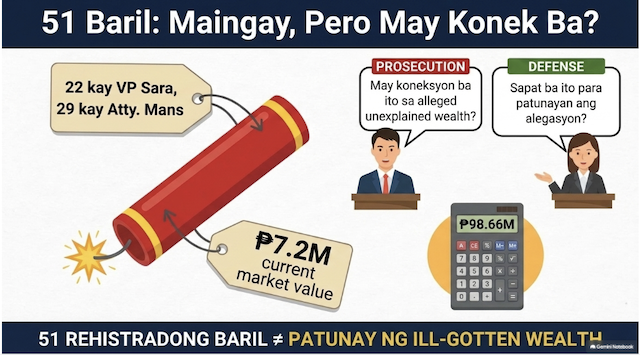
2. Duterte and Carpio have 51 registered firearms, but senator-judges questioned their relevance
Police Major Joericson Sangalang of the PNP Firearms and Explosives Office testified that Duterte and Carpio have 51 registered firearms between them.
Twenty-two are registered to Duterte: 14 pistols, two revolvers, five rifles and one shotgun. Their estimated current market value is P2,184,550. Three of Duterte’s rifles are classified as Class A light weapons with fully automatic functions. Carpio has another 29 registered firearms. The combined estimated market value of the couple’s firearms is more than P7.2 million.
Sangalang also testified that individuals who legally possessed Class A light weapons before the current firearms law took effect may continue to have them registered. In other words, the classification of the three rifles does not by itself establish illegal possession.
The bigger problem for the prosecution was relevance.
Zubiri, Erwin Tulfo, Tito Sotto and Alan Cayetano questioned how the firearms helped establish unexplained wealth. Escudero noted that even the roughly P7-million combined current value was within Duterte’s declared P88-million net worth. He eventually allowed the testimony to continue but said the witness was less convincing on the question of ill-gotten wealth than other possible evidence.
The defense waived cross-examination.
The distinction is important: the PNP testimony established the existence and registration of the firearms. It did not establish that they were bought with unlawful funds.

3. The prosecution changed course on Duterte’s bank records
The more consequential fight may be over records that were barely discussed in detail on Monday.
Prosecutor Chel Diokno withdrew the prosecution’s earlier request asking Duterte to admit ownership of bank accounts identified in records submitted to the impeachment court.
Instead, Diokno proposed that the defense agree to narrower stipulations: that the accounts exist, that the banks produced the records pursuant to Senate subpoenas, and that the documents are authentic copies of records maintained by those banks. The distinction matters because authentication and ownership are not the same thing. A stipulation that a document is a genuine bank record does not necessarily concede what that record proves about Duterte.
The court had already ruled in July that subpoenaed peso-denominated bank, tax and Anti-Money Laundering Council records met the requirements of relevance and materiality under Article II.
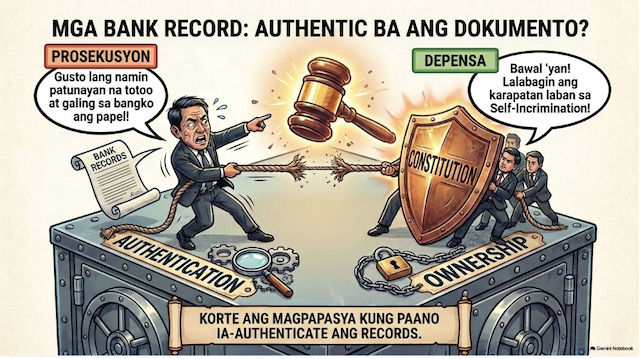
The defense has raised constitutional and procedural objections to the prosecution’s use of requests for admission. The Day 30 research records the defense’s argument that compelling such admissions could implicate Duterte’s right against self-incrimination, while Diokno argued that authenticating records created by third-party institutions is different from compelling incriminating testimony. Sara Duterte Impeachment Day 30
Escudero asked that the proposed stipulation be submitted in writing rather than resolving the issue immediately.
This procedural fight could determine whether prosecutors need to bring individual bank representatives to court to authenticate records or whether some foundational facts can simply be agreed upon.
4. Baste Duterte’s testimony moves to September 29 and 30
Davao City Mayor Sebastian “Baste” Duterte was supposed to be available under a subpoena covering September 28 to 30, but he asked the court for additional time to gather, organize, authenticate and reproduce the requested city records.
Escudero granted the request. The mayor is expected to appear on September 29 and 30.
His testimony could help fill a gap in the GenCorp evidence.
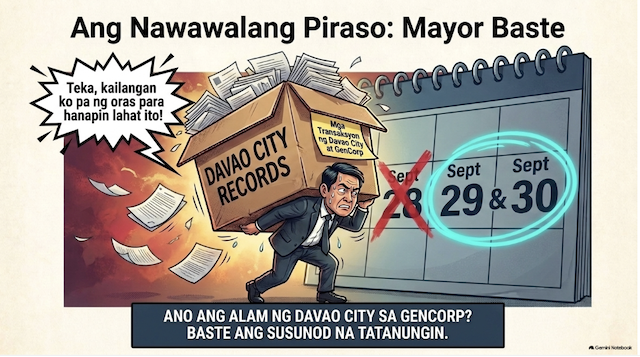
The court has asked for Davao City records involving GenCorp and related transactions. Because Duterte’s SALN identifies GenCorp as one of her business interests while the company received Davao City government contracts, the prosecution is seeking evidence about the nature of those transactions and Duterte’s connection, if any, to the company when the contracts were awarded.
The evidence presented so far establishes that the contracts existed. It does not, on its own, establish that Baste Duterte improperly awarded them or that Sara Duterte personally participated in them.
Those are questions the prosecution still has to prove.
5. The court warned Terry Ridon over public comments
The Senate impeachment court also dealt with what participants may say outside the courtroom.
It issued House prosecutor Terry Ridon a “stern warning” over comments concerning the ongoing case. The court accepted Ridon’s explanation that he had acted in good faith and acknowledged that the senator-judges, not prosecutors speaking publicly, ultimately determine what the evidence proves.
The dispute quickly widened.
The prosecution asked for equal application of the sub judice rule after Duterte herself referred to the proceedings as a “sarsuela” when reporters asked whether she would attend the trial. Duterte said, “Anong ibig sabihin? Manood ako doon sa kanilang sarsuela?”
That leaves the court with a question of consistency: how far can either side publicly characterize an ongoing impeachment case without crossing the court’s restrictions?
What netizens were talking about
Online discussion during Day 30 often followed the same fault lines visible inside the Senate chamber.
The firearms testimony drew questions about relevance. A Day 30 Reddit thread also turned quickly toward the bank records, with commenters debating why the defense should or should not agree to authenticate documents submitted by banks. Other comments focused on whether Baste Duterte would appear after receiving the subpoena. These are individual reactions, not a scientific measure of public opinion.
The lighter courtroom moments also drew attention. When Manila Rep. Bienvenido Abante appeared to doze off behind the witness, Escudero asked that someone nudge him and suggested that he might want to rest somewhere other than directly behind the witness. Luistro joked that Abante was “praying for the prosecution.” Escudero replied: “I doubt that.”
Those moments made easy social media clips. But the evidence that matters to Article II remains less meme-friendly: procurement documents, SALNs, corporate records, bank transactions and AMLC records.

What to watch next
Day 30 showed why impeachment trials cannot be reduced to the day’s most viral testimony.
The 51 firearms generated attention, but senator-judges openly questioned whether they moved Article II forward. The GenCorp documents raise a more direct constitutional issue, but the prosecution still has to establish Duterte’s actual financial relationship with the company and connect that relationship to the government contracts.
The next hearings may provide more direct evidence. Baste Duterte is scheduled to appear on September 29 and 30, while the court has cleared the use of AMLC records and is expected to require an AMLC official to authenticate and explain them.
For citizens following the trial, the useful test is simple: separate what a witness established from what either side says the evidence means. Watch the documents. Check whether the testimony connects them to the allegations. And pay attention to what survives objections and becomes part of the court’s record.
Day 30 gave us 51 firearms and a “tong-its” line. The coming bank, AMLC and procurement evidence will tell us whether Article II has something more substantial behind it.

Day 22 Sara Duterte impeachment trial: When the confidential-fund names met the PSA

Day 10 of Sara Duterte’s impeachment trial: What “unusual but not suspicious” really means

Duterte Impeachment Day 6: Whose secrets outrank the truth?
About The Author

Noemi Lardizabal-Dado
Noemi Lardizabal-Dado is a content strategist with over 19 years of experience in blogging, content management, citizen advocacy, and media literacy, and over 30 years in web development. Otherwise known as @MomBlogger on social media, she believes in making a difference in the lives of her children by advocating for social change that benefits the greater good. She is a co-founder and a member of the editorial board of Blog Watch . She is a resource speaker on media literacy, social media, blogging, digital citizenship, good governance, transparency, parenting, women’s rights, wellness, and cyber safety. Her personal blogs such as aboutmyrecovery.com (parenting) , pinoyfoodblog.com (recipes), techiegadgets.com (gadgets) and benguetarabica.coffee keep her busy outside of Blog Watch. Disclosure: I am an advocate. I am NOT neutral. I will NOT give social media mileage to members of political clans, epal, a previous candidate for the same position and those I believe are a waste of taxpayers' money. I do not support or belong to any political party. I was part of accredited media covering the Office of the Vice President and Leni Robredo as she ran as a presidential aspirant in the 2022 National and local elections. On August 5, 2021, YouTube announced that I was selected as one of 50 Program participants of its Creator Program for Independent Journalists She was a Senior Consultant for ALL media engagements for the PCOO-led Committee on Media Affairs & Strategic Communications (CMASC) under the ASEAN 2017 National Organizing Council from January 4 -July 5, 2017. Having been an ASEAN advocate since 2011, she has written extensively about the benefits of the ASEAN community and as a region of opportunities on Blog Watch and aboutmyrecovery.com. Organization affiliation includes Consortium on Democracy and Disinformation Updated June 6, 2022