
Day 25 Sara Duterte Impeachment trial : What her SALNs show, and what they don’t
For most of Day 25 of Vice President Sara Duterte’s impeachment trial, the Senate was looking at numbers she herself had declared under oath.
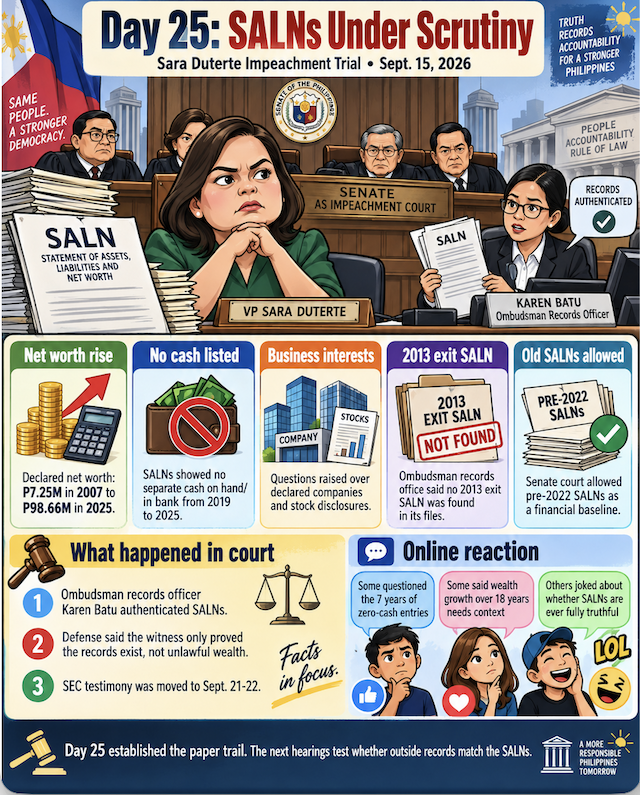
Her Statements of Assets, Liabilities, and Net Worth, or SALNs, stretched back to 2007, when she was Davao City vice mayor. By 2025, her declared net worth had reached P98.66 million.
But that number, by itself, does not answer the charge in Article II.
The question is whether Duterte’s sworn declarations match her lawful income, financial records and business interests during the years covered by the impeachment case. That is what prosecutors are now trying to establish, while the defense is challenging what can legally be inferred from the documents.

Here are five points from the September 15 hearing.
1. Duterte’s declared net worth went from P7.25 million to P98.66 million
Office of the Ombudsman records officer Karen Batu authenticated Duterte’s SALNs and read the figures into the record.
Duterte declared a net worth of P7,250,497 in 2007. It stood at P65.31 million in 2021, before she assumed the vice presidency, P71.66 million in 2022, and P98.66 million in 2025.
That is an increase of about P91.4 million over 18 years.

The percentage increase made headlines, but the hearing also put an important limit on what that figure proves. Asked whether rising net worth is prohibited, Batu said increases in SALNs do occur. The records officer was there to authenticate the documents, not to determine whether Duterte’s wealth had been illegally acquired.
This distinction matters. The prosecution still has to connect the figures to other evidence. Prosecutor Terry Ridon said Duterte’s SALNs would be checked against records from tax authorities, banks, the Anti-Money Laundering Council and other agencies.
2. From 2019 to 2025, no cash was separately declared
Batu testified that Duterte’s SALNs contained no declaration of cash on hand or cash in bank from 2019 through 2025. Before that, her SALNs had carried cash entries, including about P6.37 million in 2017.
Prosecutors argue that this needs an explanation because Republic Act No. 6713 requires officials to disclose assets including “cash on hand or in banks.” The law also covers stocks and other investments.
But Day 25 also exposed a dispute about how those declarations are supposed to appear on the form.

During cross-examination, Batu acknowledged that the prescribed SALN forms did not have a separate line specifically labeled for cash, and that the rules did not expressly prohibit some personal properties from being grouped together. Duterte’s defense has said her cash was included under “others.”
Current Civil Service Commission guidance is clearer. Its 2026 SALN FAQs say income still held by the declarant at the reporting date should appear as cash on hand or cash in bank.
So “zero cash” is a fact about how the SALNs were presented. Whether that amounted to concealment is a separate claim that still has to be proved.
3. Business interests were listed, but many stock holdings were not separately valued
Another line of questioning dealt with companies connected to Duterte and her husband, lawyer Manases Carpio.
Batu testified that Duterte declared business and financial interests in several companies but did not separately declare shares of stock in 2007, 2009 to 2012, and 2016 to 2025. Her 2008 SALN was different: Batu said it contained an entry for “stocks equity paid in.”
The prosecution says the shares should have appeared under personal property with their acquisition cost.
Current CSC guidance supports the basic disclosure requirement. It states that shares of stock are personal property and that the amount paid to acquire them should be declared as their acquisition cost.

Still, Presiding Officer Francis Escudero pointed out a problem with the prescribed form itself. The section for business interests has no separate space asking for the acquisition cost of those interests. Batu confirmed that gap during questioning.
That left the court with two related questions: what the law requires an official to disclose, and whether the government form made that requirement clear enough.
4. No 2013 exit SALN was found in Ombudsman records
Senator-judge Sherwin Gatchalian also asked about a break in Duterte’s SALN record after her first stint as Davao City mayor.
Batu said the Ombudsman’s records did not contain an exit SALN for 2013, when Duterte left office. Her entry SALNs were complete, Batu said.
Republic Act No. 6713 requires officials to file a SALN within 30 days after separation from government service. The CSC’s current rules repeat that requirement.
There is an important wording distinction here. What Day 25 established was that the Ombudsman repository did not have the 2013 exit SALN. The testimony did not by itself establish why the document was missing or whether it had been filed elsewhere before transmission to the repository.

5. The old SALNs stay in the case as a baseline
The defense objected to the use of Duterte’s SALNs from before June 30, 2022, arguing that she was not yet vice president and therefore was not yet an impeachable official for the acts being tried.
Escudero rejected the objection for purposes of establishing a financial baseline. He clarified that Duterte was being called to answer for acts during her vice-presidential term, while the earlier SALNs could be used to show where her declared assets stood before she assumed that office.
That ruling explains why Day 25 spent so much time going back to 2007. The prosecution is trying to build a timeline before bringing in outside records that can be compared with Duterte’s sworn declarations.
The Securities and Exchange Commission part of that presentation did not proceed on September 15. SEC Company Registration and Monitoring Department director Gerardo del Rosario’s testimony was moved to September 21 and 22 because of the volume of records still to be presented.
Earlier SEC testimony before the House had already placed Duterte’s name in the General Information Sheets of Metro City Chow Foods Corp. as a stockholder with 500 shares and as a board member from 2022 through 2025. Article VII, Section 13 of the Constitution bars the vice president from directly or indirectly participating in business while in office. Whether the SEC records establish prohibited participation is one of the issues the impeachment court still has to hear evidence on.

What netizens were reacting to
Online reaction to Day 25 did not produce anything close to a single public verdict.
A social-media monitoring report by Media Meter found that mockery was more visible than anger in the Facebook material it tracked. One high-engagement post about lawmakers criticizing Duterte’s defense team drew 630 “haha” reactions and 375 comments. Posts carrying the 1,260-percent net-worth figure circulated on X, but many drew views with little discussion. These engagement figures describe the posts monitored by the service, not Philippine public opinion as a whole.
The seven years without a separately declared cash entry became one of the easiest facts to turn into jokes and memes. Prosecutors themselves added to that framing by calling their Day 25 presentation “Ang Tanging Yaman ni VP Sara.” That phrase came from the prosecution panel, not from an independent finding by the court.
Other reactions pushed in the opposite direction, pointing out that an increase in net worth spread over many years does not automatically show corruption. That point was also made inside the hearing itself: the witness did not testify that the P98.66 million was unlawfully acquired, and the Ombudsman records office does not verify the truth of every figure submitted in a SALN.
A third reaction was more cynical about the SALN system itself. Senator Lito Lapid asked whether politicians and government workers really tell the full truth in their declarations after hearing such a claim made on television. Batu replied that she herself files a truthful SALN. The exchange drew laughter in the chamber and quickly became part of the online conversation.
That cynicism should not replace the evidence. A SALN is a sworn disclosure required by law. But Day 25 also showed why the document cannot answer every question on its own.
The numbers are only the starting point
Day 25 established a documentary baseline: what Sara Duterte declared, what she did not separately itemize, and what is missing from the Ombudsman’s files.
It did not establish, by itself, that the increase in her net worth was unlawful, that the absence of a separate cash entry was deliberate concealment, or that every business interest listed in the SALNs amounted to prohibited participation in business. Those are questions for the rest of the evidence.
The next test comes when the SEC records are taken up on September 21 and 22, followed by the other financial records prosecutors say they will present.
The SALNs have put the numbers on the table. What matters next is whether the outside records match them.

Day 14 of the Sara Duterte impeachment trial: One officer, many provinces, and what the receipts actually prove

Day 13 of the Sara Duterte impeachment trial: 849 acknowledgment receipts, no official receipts

Day 21 Sara Duterte Impeachment Trial: Poa knew the COA reply, not the spending
About The Author

Noemi Lardizabal-Dado
Noemi Lardizabal-Dado is a content strategist with over 19 years of experience in blogging, content management, citizen advocacy, and media literacy, and over 30 years in web development. Otherwise known as @MomBlogger on social media, she believes in making a difference in the lives of her children by advocating for social change that benefits the greater good. She is a co-founder and a member of the editorial board of Blog Watch . She is a resource speaker on media literacy, social media, blogging, digital citizenship, good governance, transparency, parenting, women’s rights, wellness, and cyber safety. Her personal blogs such as aboutmyrecovery.com (parenting) , pinoyfoodblog.com (recipes), techiegadgets.com (gadgets) and benguetarabica.coffee keep her busy outside of Blog Watch. Disclosure: I am an advocate. I am NOT neutral. I will NOT give social media mileage to members of political clans, epal, a previous candidate for the same position and those I believe are a waste of taxpayers' money. I do not support or belong to any political party. I was part of accredited media covering the Office of the Vice President and Leni Robredo as she ran as a presidential aspirant in the 2022 National and local elections. On August 5, 2021, YouTube announced that I was selected as one of 50 Program participants of its Creator Program for Independent Journalists She was a Senior Consultant for ALL media engagements for the PCOO-led Committee on Media Affairs & Strategic Communications (CMASC) under the ASEAN 2017 National Organizing Council from January 4 -July 5, 2017. Having been an ASEAN advocate since 2011, she has written extensively about the benefits of the ASEAN community and as a region of opportunities on Blog Watch and aboutmyrecovery.com. Organization affiliation includes Consortium on Democracy and Disinformation Updated June 6, 2022