Day 23 Sara Duterte Impeachment Trial : The trial turns to Sara Duterte
The witness list suddenly got shorter on Day 23 of Vice President Sara Duterte’s impeachment trial. But the questions before the Senate impeachment court got bigger.
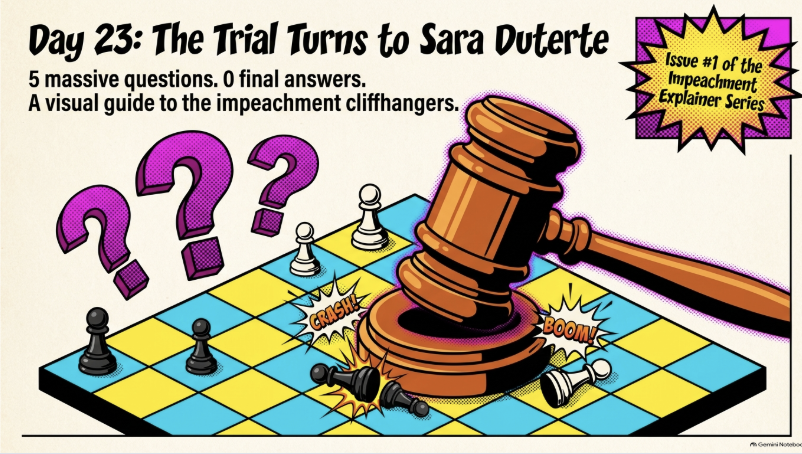
On September 8, House prosecutors dropped their 15 remaining witnesses for Article I, the charge involving the alleged misuse of P612.5 million in confidential funds of the Office of the Vice President and Department of Education.
Then prosecutor Lorna Kapunan told the court whom they ultimately wanted on the witness stand: Duterte herself.
That did not mean a subpoena had been issued. It had not. And by the end of the session, the court was also facing another unresolved question: if four senator-judges cannot participate, does conviction still require 16 votes?
Here are five things to remember from Day 23.
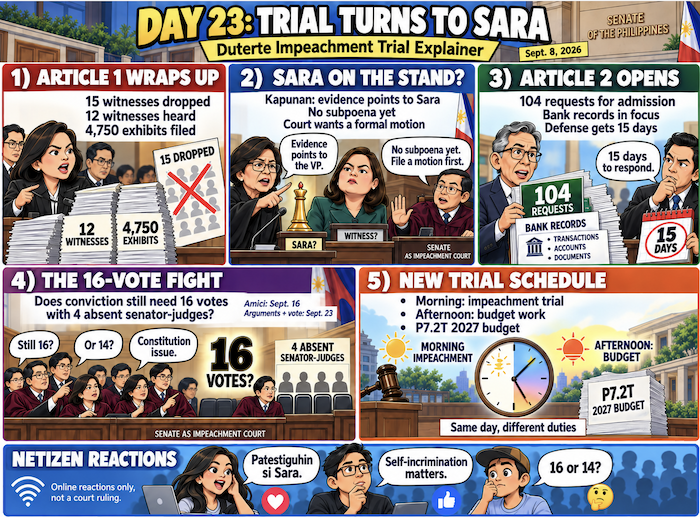
1. Prosecutors dropped their last 15 Article I witnesses
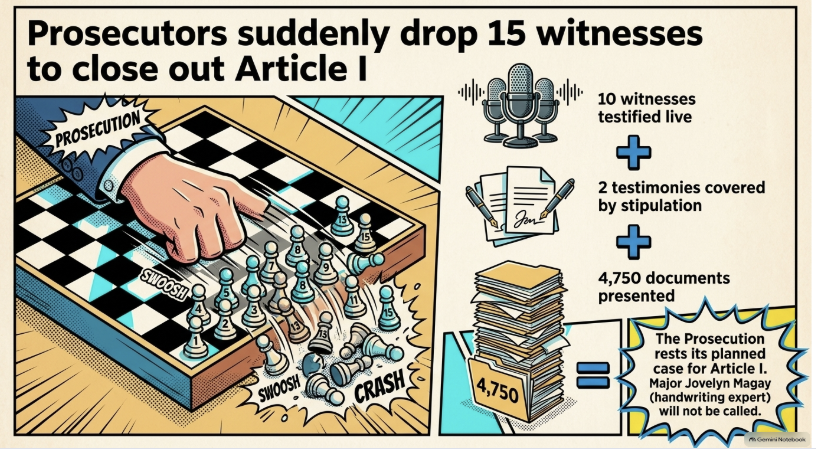
The prosecution had listed 27 witnesses for Article I. Ten testified before the court, while the testimony of two others was covered by stipulations. Kapunan said the prosecution was prepared to rely on those 12 witnesses and about 4,750 documents already presented rather than call the remaining 15.
That meant Police Major Jovelyn Magay, who had been expected to discuss handwriting on acknowledgment receipts, was no longer presented that day.
There is an important qualification here. Article I was not formally closed. Presiding Officer Francis “Chiz” Escudero told both sides not to rest their cases on the article yet because the impeachment court could still decide to call former Duterte security officers Col. Raymund Lachica and Col. Dennis Nolasco on its own.
So the prosecution has ended its planned Article I witness presentation. The court has not necessarily heard its last witness on confidential funds.

2. Prosecutors want Duterte to testify, but there is no subpoena yet
Kapunan used a chess analogy to explain the prosecution’s decision.
“All of these pawns and castles and horses and bishops point to only one person, and that accountable person is the Vice President.”
The prosecution said it intends to call Duterte after presenting evidence on the four impeachment articles. It considers her testimony material to the allegations.
The defense immediately objected.
Lead defense counsel Sheila Sison invoked Article III, Section 17 of the Constitution: “No person shall be compelled to be a witness against himself.” That constitutional protection is real. What has not been settled is exactly how it applies when prosecutors seek to compel the respondent in an impeachment proceeding to testify.
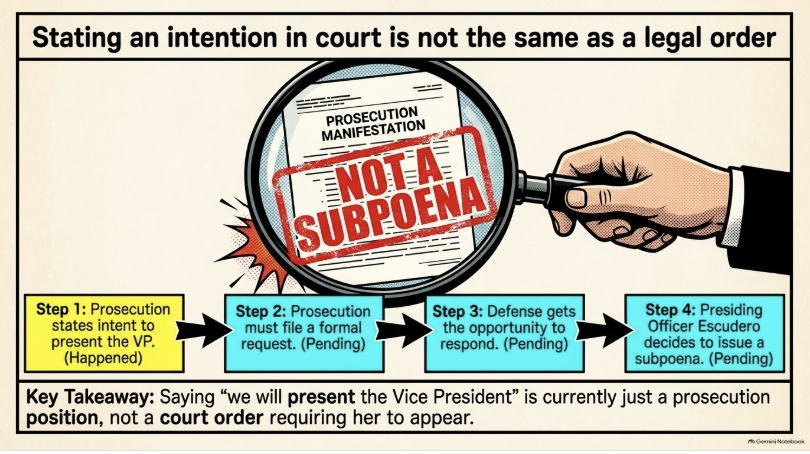
Escudero did not issue a subpoena. He required prosecutors to make a formal request first and give the defense an opportunity to respond. The court may hear arguments before deciding the question.
That distinction matters. Saying “we will present the Vice President” in court is a prosecution position. It is not yet an order requiring Duterte to appear.
3. Article II begins with 104 questions about financial records
The trial is now moving toward Article II, which covers the prosecution’s unexplained-wealth allegations.
House prosecutor Chel Diokno served Duterte’s defense with 104 requests for admission concerning bank records obtained through subpoenas. Prosecutors want Duterte to confirm whether the records are genuine and whether accounts identified in them belong to her individually or jointly with others.
Defense lawyer Michael Poa asked for 15 days to respond. Escudero granted the request, rather than the seven days proposed by prosecutors. The period does not stop the trial. Article II testimony is scheduled to begin on September 14. Prosecutors are also preparing more than 1,800 financial documents obtained through subpoenas.
There is another legal issue that should not be skipped. Escudero noted that Rule 26 on requests for admission is a civil-procedure rule and cited a Supreme Court ruling saying it does not apply to criminal proceedings. Diokno argued that impeachment is not a criminal trial. The impeachment court still has to determine how Rule 26 applies to this proceeding.
In other words, the 104 requests are requests, not 104 admissions by Duterte.

4. The court will revisit the 16-vote question
Senator-judge Erwin Tulfo then raised a problem that could affect the outcome of the entire trial.
The Constitution says that no official may be convicted in an impeachment trial without “the concurrence of two-thirds of all the Members of the Senate.” With 24 senators, Escudero ruled at the start of the trial that this means 16 votes.
But four senator-judges are currently unable to attend: Loren Legarda is abroad on medical leave, Ronald “Bato” dela Rosa has remained absent amid an International Criminal Court arrest warrant, while Jinggoy Estrada and Rodante Marcoleta are detained in separate plunder cases.
Tulfo asked a narrower question: who should be counted as “all the Members” when some senators are beyond the chamber’s ability to compel attendance?
The court will hear legal experts as amici curiae on September 16. The prosecution and defense will argue their positions on September 23, after which the senator-judges are scheduled to vote on the issue.
One point needs care. The 1949 Supreme Court case Avelino v. Cuenco has entered this debate because it allowed a Senate quorum to be calculated after excluding a senator who was abroad and beyond the chamber’s jurisdiction. But Avelino dealt with quorum, not the constitutional vote required to convict somebody in an impeachment trial.
It may inform the arguments. It does not automatically mean the impeachment threshold becomes 14 votes.

5. The trial now has to compete with the P7.2-trillion budget
The impeachment court also adopted a new calendar as the Senate prepares to work on the proposed 2027 national budget.
Trial sessions are scheduled from 10 a.m. to 2:30 p.m. on several September dates, followed by the regular Senate plenary session. Whole-day trials are planned for parts of October. Proceedings will then stop from October 16 through November 18 to make way for budget hearings and plenary debates.
The Department of Budget and Management has set the proposed FY 2027 national budget at P7.2 trillion, equivalent to 21.7 percent of projected GDP.
The schedule matters because senators are doing two jobs at once: sitting as judges in an impeachment trial while scrutinizing how trillions of pesos in public money will be spent next year.
What netizens were saying
Online comments are useful for seeing how people are processing the trial, but they are not public-opinion surveys. A few traceable reactions from Reddit show disagreement even among people closely following the proceedings.
After Kapunan announced the plan to call Duterte, one commenter asked whether anyone believed Duterte would actually end up taking the witness stand. Another saw the move as the prosecution narrowing responsibility directly toward her.
The voting-threshold debate drew sharper disagreement. Some commenters argued that the constitutional two-thirds requirement should reflect senators actually capable of voting. Others warned that changing the denominator could create a precedent that a future Senate majority might abuse. One commenter supporting impeachment still preferred keeping the present threshold rather than creating that risk.
The Day 23 megathread also showed how closely some people are following the legal exchanges themselves. Users anticipated the Kapunan-Vinluan confrontation, while another commenter said the prosecution evidence was becoming familiar and that they were more interested in seeing what new information the defense eventually presents.
That mix of impatience, legal argument and partisan suspicion is worth watching. But it should not be mistaken for a representative measure of Filipino opinion.
Three dates worth watching
Day 23 did not settle whether Duterte can be compelled to testify. It did not settle whether the conviction threshold stays at 16. And it did not turn the prosecution’s 104 requests into admissions.
Instead, it put those questions on a timetable.
Article II begins on September 14. Legal experts are scheduled to address the voting issue on September 16. The prosecution and defense argue the threshold question on September 23, when the senator-judges are also expected to vote.
For citizens following the trial, this is where careful reading matters. A prosecution manifestation is not a subpoena. A request for admission is not an admission. And a 1949 quorum ruling is not automatically an impeachment rule.
When September 23 comes, read what the impeachment court actually decides before accepting whichever political camp declares victory first.

Day 11 of Sara Duterte’s impeachment trial: When confidential funds met the receipts

Day 24 Sara Duterte Impeachment Trial: The trial paused, the financial records moved forward

Day 27: What SEC records revealed about Sara Duterte’s business roles
About The Author

Noemi Lardizabal-Dado
Noemi Lardizabal-Dado is a content strategist with over 19 years of experience in blogging, content management, citizen advocacy, and media literacy, and over 30 years in web development. Otherwise known as @MomBlogger on social media, she believes in making a difference in the lives of her children by advocating for social change that benefits the greater good. She is a co-founder and a member of the editorial board of Blog Watch . She is a resource speaker on media literacy, social media, blogging, digital citizenship, good governance, transparency, parenting, women’s rights, wellness, and cyber safety. Her personal blogs such as aboutmyrecovery.com (parenting) , pinoyfoodblog.com (recipes), techiegadgets.com (gadgets) and benguetarabica.coffee keep her busy outside of Blog Watch. Disclosure: I am an advocate. I am NOT neutral. I will NOT give social media mileage to members of political clans, epal, a previous candidate for the same position and those I believe are a waste of taxpayers' money. I do not support or belong to any political party. I was part of accredited media covering the Office of the Vice President and Leni Robredo as she ran as a presidential aspirant in the 2022 National and local elections. On August 5, 2021, YouTube announced that I was selected as one of 50 Program participants of its Creator Program for Independent Journalists She was a Senior Consultant for ALL media engagements for the PCOO-led Committee on Media Affairs & Strategic Communications (CMASC) under the ASEAN 2017 National Organizing Council from January 4 -July 5, 2017. Having been an ASEAN advocate since 2011, she has written extensively about the benefits of the ASEAN community and as a region of opportunities on Blog Watch and aboutmyrecovery.com. Organization affiliation includes Consortium on Democracy and Disinformation Updated June 6, 2022