Day 15 of the Sara Duterte impeachment trial: Confidential does not mean undocumented
If the Office of the Vice President says confidential funds were used to buy medicine, food or supplies, should there still be a receipt?
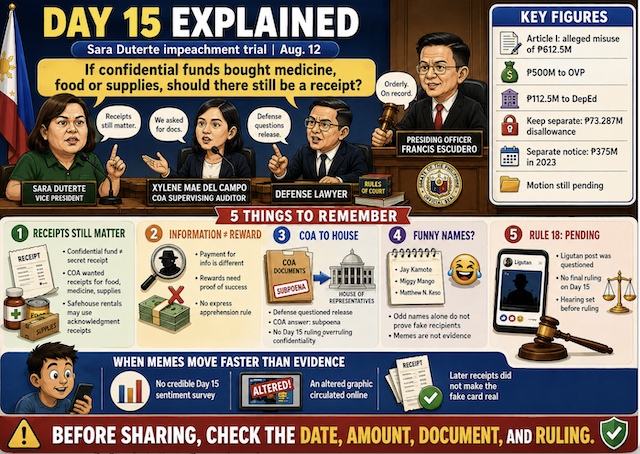
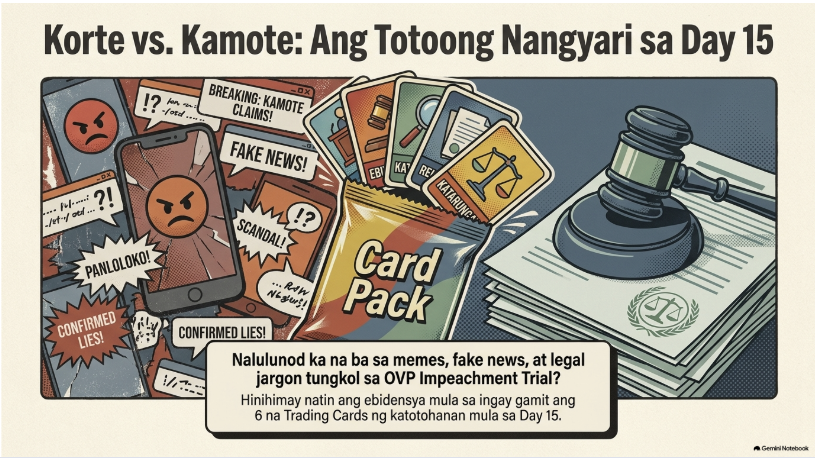
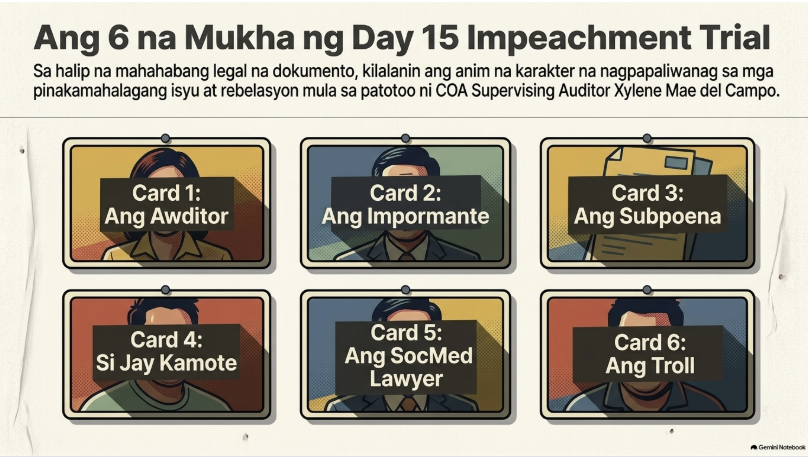
That basic question took up a good part of Day 15 of Vice President Sara Duterte’s impeachment trial on August 12.
Commission on Audit supervising auditor Xylene Mae del Campo was back on the witness stand, with Duterte’s lawyers continuing to question COA’s findings on how the OVP used its confidential funds.
Article I of the impeachment case deals with the alleged misuse of ?612.5 million in confidential funds. Of that amount, ?500 million went to the OVP from December 2022 to September 2023, while ?112.5 million was released to the Department of Education in 2023, when Duterte was still education secretary.
One amount, though, should not be mixed up with the rest. The ?73.287 million disallowance refers specifically to OVP spending from December 21 to 31, 2022, not to the 2023 confidential funds. COA’s Commission Proper affirmed the disallowance on April 10, 2026. The OVP filed a motion for reconsideration the following month, and that motion is still pending.
There is also a separate Notice of Disallowance, issued on March 31, covering the full ?375 million released to the OVP during the first three quarters of 2023.
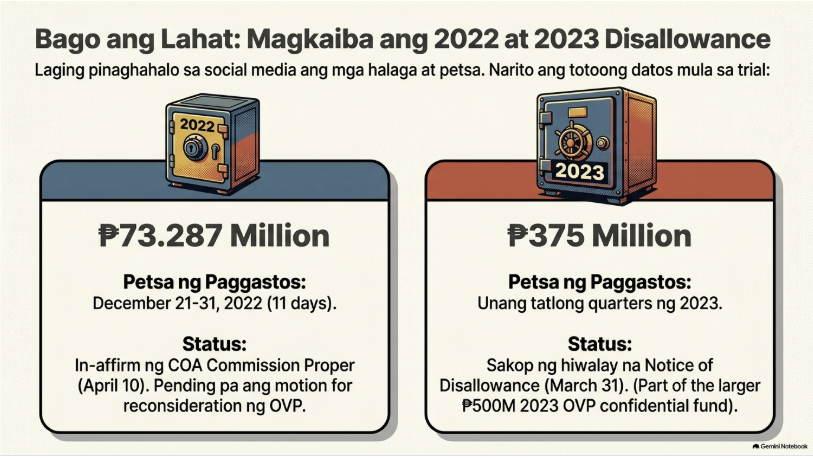
That distinction matters. Different amounts, periods and audit findings have repeatedly been mixed together in public discussion.
Five things to remember from Day 15
1. Buying something with confidential funds does not automatically make the seller or the receipt confidential.
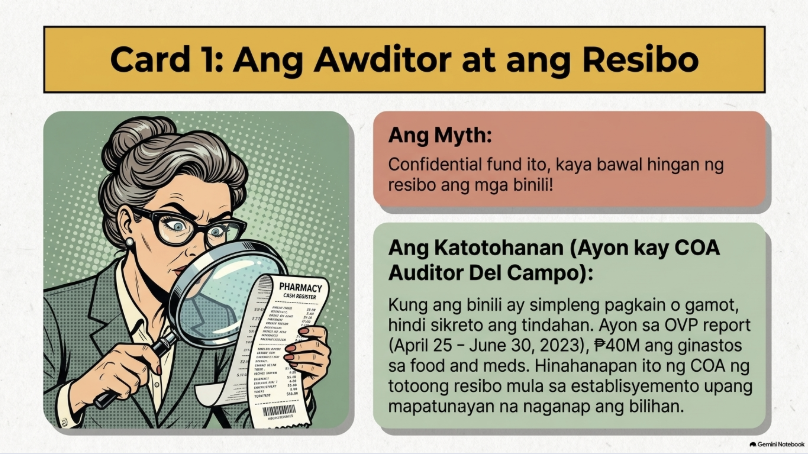
Del Campo said the purpose of an operation may be confidential, but the establishment that sold medicine, food or supplies is not necessarily secret. COA therefore expected invoices or receipts for purchases of this kind.
According to the OVP’s own accomplishment report for April 25 to June 30, 2023, ?40 million was spent on medicine and food. Del Campo said COA wanted receipts from the establishments to establish that those purchases actually took place. She also clarified that COA accepted acknowledgment receipts for expenses such as safehouse rentals, where disclosure could involve genuinely sensitive information.
So this was not an argument that every confidential expense needs an ordinary store receipt. The issue was whether an expense that supposedly involved an ordinary commercial purchase had the documents normally expected from such a purchase.
2. Paying for information and paying a reward are not the same thing under the audit rules.
This was one of the more useful clarifications from the cross-examination.
Del Campo said a payment for information does not require proof that the information eventually produced a successful operation. A reward however, must be backed by documents showing the success of the information-gathering or surveillance activity, based on Section 4.8.5 of the rules on confidential and intelligence funds.
There was also an important qualification that should not be lost. Joint Circular No. 2015-01 does not specifically say an apprehension must occur before a reward can be paid. Del Campo acknowledged this during cross-examination. Her view that an apprehension could demonstrate success came from her professional evaluation of the documents, not from an explicit apprehension requirement in the circular.
3. The defense questioned why COA gave confidential-fund documents to the House. COA's answer: subpoena.
Defense lawyer Kristine Ferrer questioned Del Campo about COA’s transmission of OVP documents to the House Committee on Justice. Ferrer cited Joint Circular No. 2015-01 and its confidentiality requirements.
Del Campo answered that the documents were provided because they had been requested through a subpoena. She also said ICFAO remains responsible for conducting the post-audit. Presiding Officer Francis Escudero eventually asked Ferrer to move on from the line of questioning.
One claim in the research goes too far: Day 15 did **not** establish a Senate ruling that Congress’ subpoena power had legally overridden the confidentiality provisions of the joint circular. What the testimony established was narrower. COA said it released the documents in response to a subpoena.
4. Strange names on receipts are not, by themselves, proof that the recipients are fictitious.
The names again became part of the hearing.
Among the acknowledgment receipts submitted for the OVP’s 2023 confidential fund liquidation were names such as Jay Kamote, Miggy Mango, Matthew N. Keso, Pia Piatos-Lim and Xiaomi Ocho.
Ferrer asked Del Campo whether an unusual or funny-sounding name automatically meant that the person was fictitious. Del Campo said she could not answer that question.
That is an important limitation on what we can say about the evidence. The receipts exist and the names appear on them. But Del Campo’s testimony on Day 15 did not establish that every unusual name belonged to a nonexistent person. The prosecution’s position was that the larger issue was how the funds were used and documented, rather than whether a name sounded amusing.
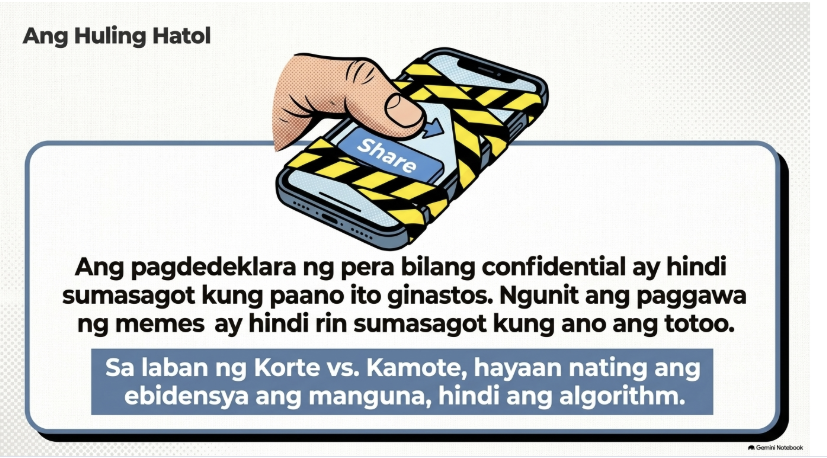
In other words, memes are not evidence. Neither is a strange name, standing alone.
5. The Rule 18 social-media dispute has not yet been finally decided.
The day’s courtroom tension eventually spilled onto Facebook.
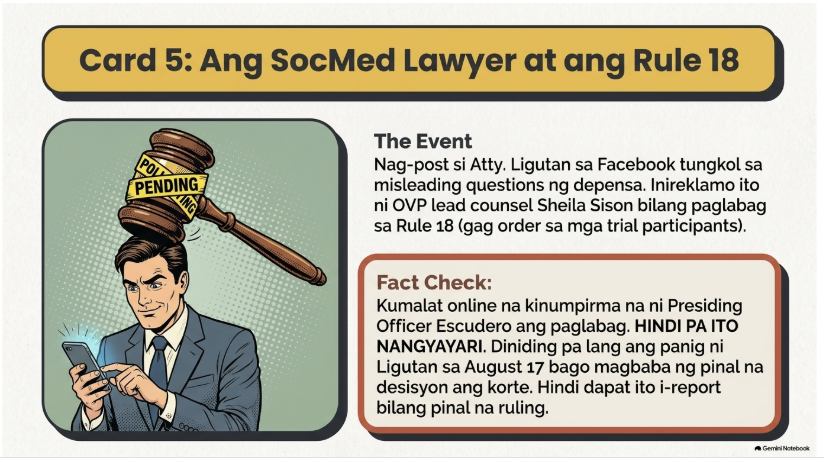
After an exchange between Ferrer and private prosecutor Lorna Kapunan over questioning during cross-examination, private prosecutor Armando Ligutan posted about the rule against misleading questions. Duterte lead counsel Sheila Sison called the court’s attention to the post and argued that it violated Rule 18, which restricts trial participants from commenting publicly on the case.
It says Escudero sustained the defense objection and confirmed that Ligutan’s post violated Rule 18.
Escudero noted Sison’s manifestation and said the court was preparing a ruling, warning and order concerning public statements by lawyers. He said Ligutan would be heard on Monday, August 17, before the court rules on the matter. Ligutan, for his part, said he did not believe his post violated the rule and said he would not delete it.
The issue is pending. It should not be reported as a final ruling.
Netizen reaction: when the memes move faster than the evidence
What can be documented is how quickly the unusual names attached to the confidential-fund issue became material for memes, and how easily real testimony became mixed with fabricated content online.
VERA Files fact-checked an altered Philstar.com graphic that circulated beginning August 3. The fake card expanded an authentic list of 11 names to 22 and inserted names including Jay Kamote and Miggy Mango. The earliest Facebook copies had accumulated 4,682 reactions, 537 comments and 989 shares, while three X posts received a combined 4,630 engagements. Some users believed the altered graphic was genuine and criticized the names appearing on it.
Then came an unusual twist.
Jay Kamote and Miggy Mango subsequently did appear in acknowledgment receipts for the OVP’s 2023 funds presented in the impeachment proceedings, according to GMA News.
That does not turn the earlier altered Philstar graphic into an authentic news card. The graphic was still doctored because those names had not been part of the evidence cited in the original August 3 card.
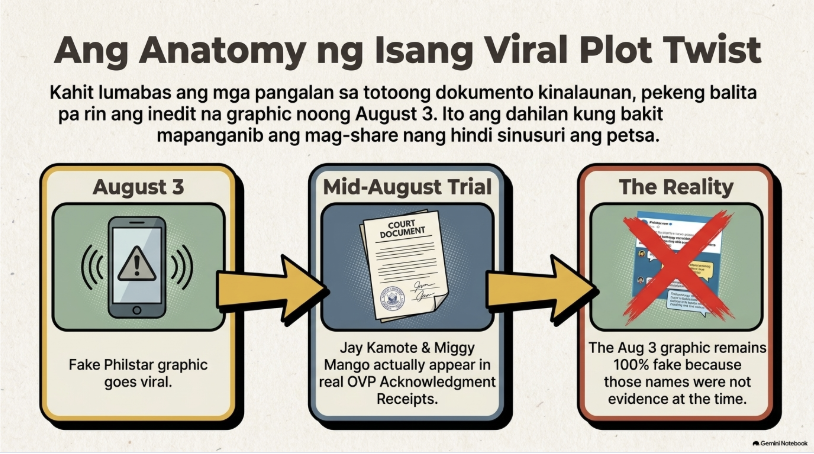
This is exactly why impeachment content needs to be checked against the date and source of the evidence. A name can later turn out to appear in a real document while an earlier post containing the same name remains fake.What Day 15 actually settled, and what it did not
Day 15 made the audit argument easier to understand.
Calling money confidential does not answer the question of how it was spent. If the reported expense was for food, medicine or supplies, COA’s witness said there should be proof of the purchase. If the payment was classified as a reward, the audit rules require proof showing the success of the activity.
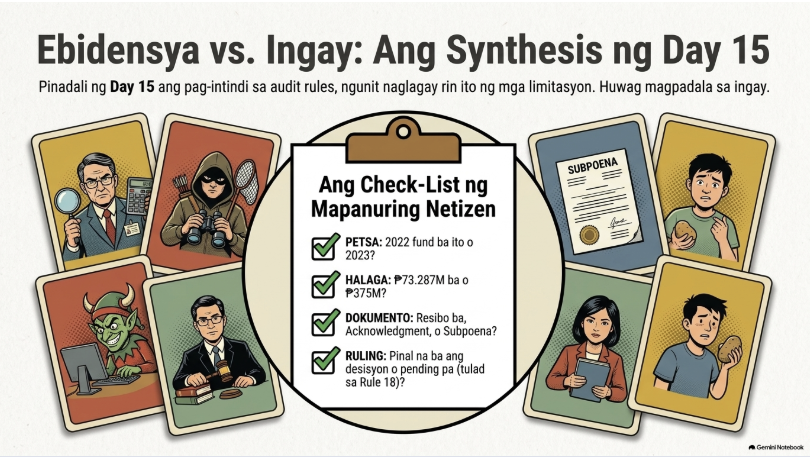
But the day’s testimony also set limits. An odd name does not automatically prove a fake recipient. The ?73.287-million disallowance is not the same as the ?375-million 2023 disallowance. And the impeachment court has not yet ruled on the Rule 18 dispute involving Ligutan.
Those distinctions may not fit easily into a meme. They matter if we want to know what the evidence actually proves.
Before sharing the next screenshot, receipt or viral list from this trial, check the date, amount, document and ruling attached to it. Day 15 showed how quickly one missing detail can turn an accurate fact into a misleading claim.
About The Author

Noemi Lardizabal-Dado
Noemi Lardizabal-Dado is a content strategist with over 19 years of experience in blogging, content management, citizen advocacy, and media literacy, and over 30 years in web development. Otherwise known as @MomBlogger on social media, she believes in making a difference in the lives of her children by advocating for social change that benefits the greater good. She is a co-founder and a member of the editorial board of Blog Watch . She is a resource speaker on media literacy, social media, blogging, digital citizenship, good governance, transparency, parenting, women’s rights, wellness, and cyber safety. Her personal blogs such as aboutmyrecovery.com (parenting) , pinoyfoodblog.com (recipes), techiegadgets.com (gadgets) and benguetarabica.coffee keep her busy outside of Blog Watch. Disclosure: I am an advocate. I am NOT neutral. I will NOT give social media mileage to members of political clans, epal, a previous candidate for the same position and those I believe are a waste of taxpayers' money. I do not support or belong to any political party. I was part of accredited media covering the Office of the Vice President and Leni Robredo as she ran as a presidential aspirant in the 2022 National and local elections. On August 5, 2021, YouTube announced that I was selected as one of 50 Program participants of its Creator Program for Independent Journalists She was a Senior Consultant for ALL media engagements for the PCOO-led Committee on Media Affairs & Strategic Communications (CMASC) under the ASEAN 2017 National Organizing Council from January 4 -July 5, 2017. Having been an ASEAN advocate since 2011, she has written extensively about the benefits of the ASEAN community and as a region of opportunities on Blog Watch and aboutmyrecovery.com. Organization affiliation includes Consortium on Democracy and Disinformation Updated June 6, 2022