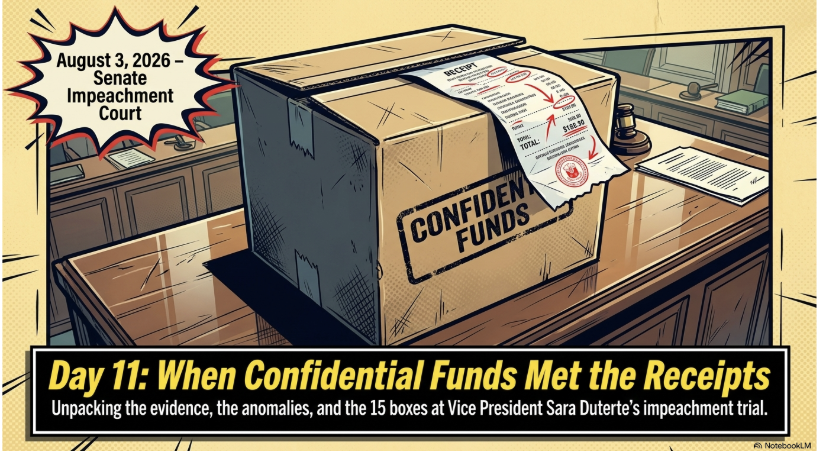
Day 11 of Sara Duterte’s impeachment trial: When confidential funds met the receipts
August 3, 2026
Fifteen boxes marked “Confidential Funds” entered the Senate impeachment court on Monday. By the time the hearing ended, the more telling evidence was no longer the number of boxes. It was what appeared on the papers inside them: tables, chairs, medicines, late-dated receipts and a P70,000 payment bearing the name “Mary Grace Piattos.”
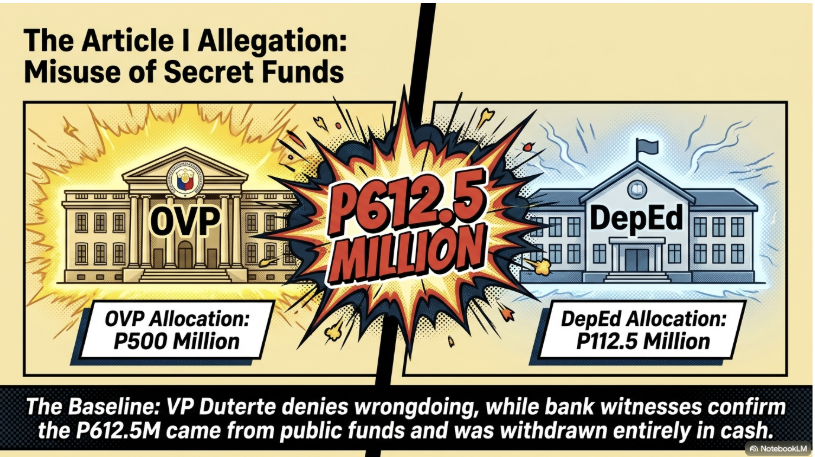
Day 11 moved the prosecution’s case deeper into Article I, which accuses Vice President Sara Duterte of misusing P612.5 million in confidential funds: P500 million released to the Office of the Vice President (OVP) and P112.5 million to the Department of Education (DepEd). The allegation remains for the prosecution to prove, and Duterte has denied wrongdoing. Bank witnesses had earlier testified that the P612.5 million came from public funds and was withdrawn in cash.
The day’s witness was Roderick Wamil, a former auditor with the Commission on Audit’s Intelligence and Confidential Fund Audit Office (COA-ICFAO). He audited confidential funds from 2014 until February 2024 and now leads an audit team at COA Pasig. His testimony did not by itself prove that Duterte stole money or personally benefited from it. It did put specific expenses and supporting records before the court, where the defense can challenge them.
Five highlights from Day 11
1. The defense accepted many records, but not 845 acknowledgment receipts
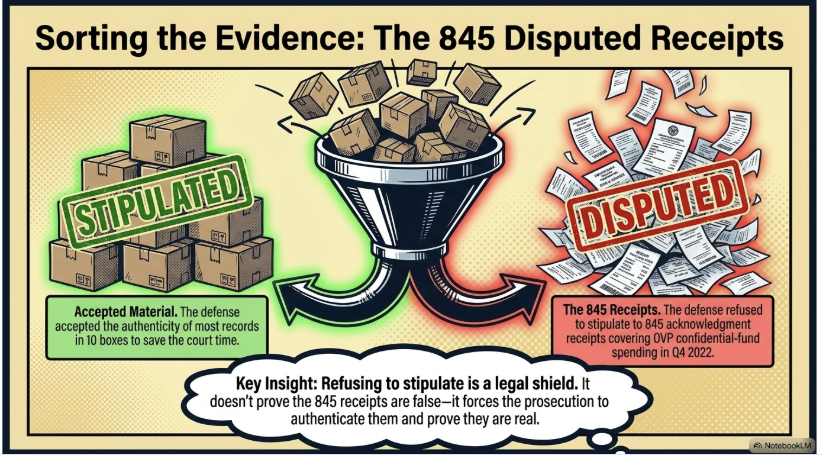
The prosecution arrived with 15 boxes of documents. After the parties discussed which records they could accept without requiring individual authentication, the defense stipulated to most of the material in 10 boxes. It refused to stipulate to the authenticity of 845 acknowledgment receipts covering the OVP’s confidential-fund spending in the fourth quarter of 2022. That distinction matters: refusing to stipulate does not prove the records are false. It preserves the defense’s right to question them. The court paused for more than 15 minutes while the parties reviewed the documents.

2. Wamil said the records did not show the required link to confidential operations
The rules are not simply “confidential funds can be spent confidentially.” The government’s Joint Circular No. 2015-01 limits how confidential and intelligence funds may be released, used, reported and audited.
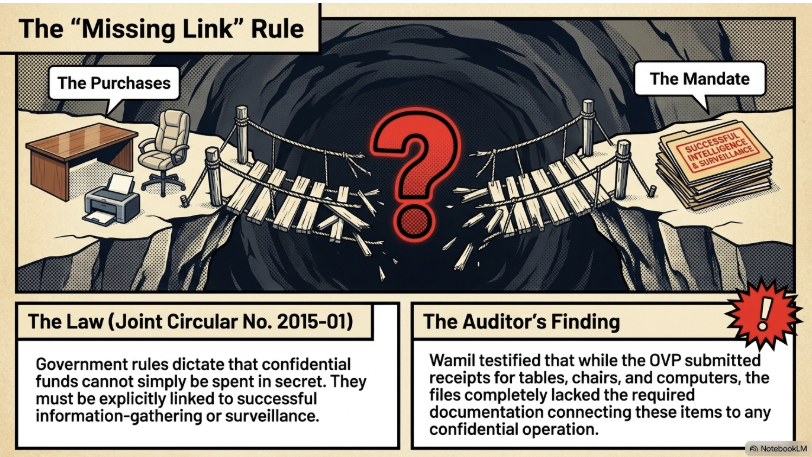
Wamil said the OVP submitted acknowledgment receipts for payments and purchases but, in many instances, did not provide documents showing that the spending produced successful information-gathering or surveillance. Records shown in court covered tables, chairs, desktop printers and computers. Wamil said purchases should have sales invoices or official receipts, and the files did not connect the items to a confidential operation. Presiding officer Francis Escudero allowed Wamil to explain his audit assessment after the defense tried to strike part of his answer.
3. P40 million in medical and food aid was charged to confidential funds
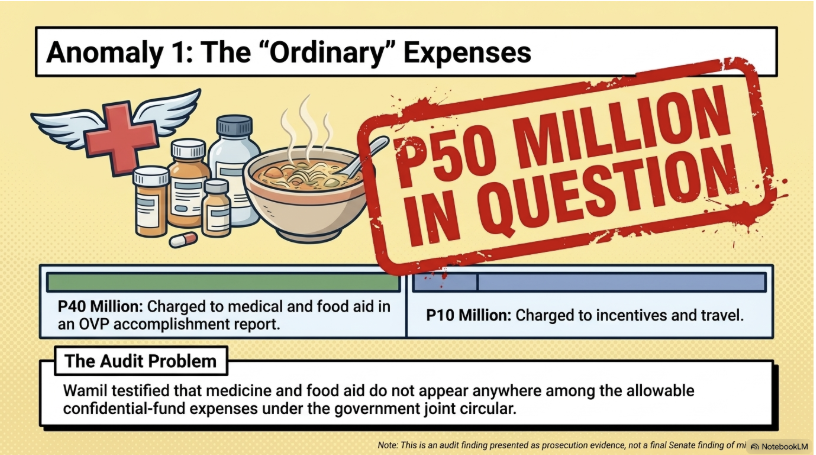
Wamil confirmed that an OVP accomplishment report placed P40 million under medical and food aid and another P10 million under incentives and travel. He testified that medicine and food aid do not appear among the allowable confidential-fund expenses in the joint circular. The revised accomplishment report identified confidential activities that were missing from the first version, but prosecutors argued that it still did not include proof connecting payments to successful confidential work. A separate account of the testimony reports that COA regarded the medical expenses as non-allowable.
This is an audit finding and part of the prosecution’s evidence. It should not be reported as a final Senate finding of misappropriation.
4. “Mary Grace Piattos” reached the trial record

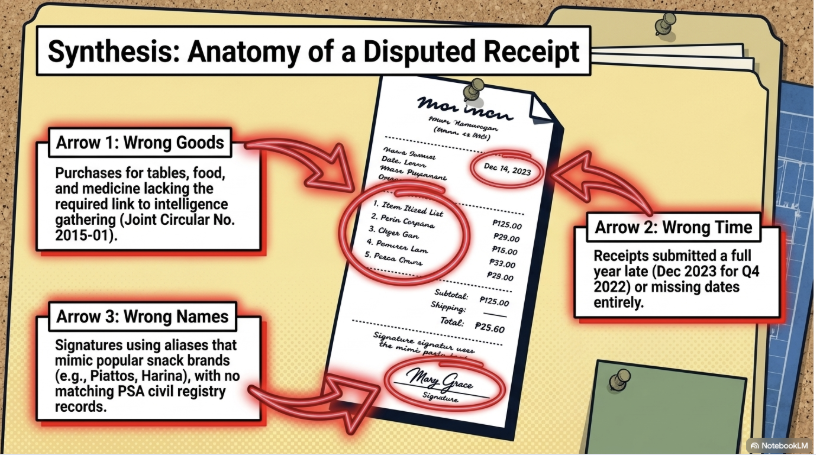
Among the receipts presented was one for P70,000, supposedly received by “Mary Grace Piattos” as a reward involving medicines. Other receipts carried names including Mico P. Harina, Nova Santos and Renan Piattos. Wamil said the Piattos receipt lacked documents showing the success required under the circular. The same set of records included a P295,000 receipt issued to Mico P. Harina for supplies.
The name has attracted attention because it resembles the Mary Grace restaurant chain and Piattos snack brand. But resemblance is not proof that the signer is fictitious. Earlier, the Philippine Statistics Authority said it found no birth, marriage or death record for a person with that name, while prosecutors included “Mary Grace Piattos” in their witness list. The defense said in February that it had not announced any plan to present the person as a witness.
5. Some receipts were late, undated or did not match the reported total
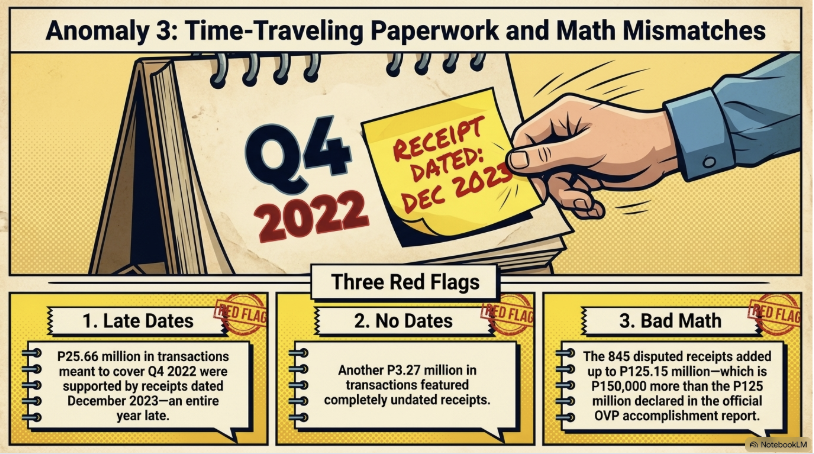
The notice of suspension examined in court listed P25.66 million in transactions supported by receipts dated December 2023, one year after the fourth-quarter 2022 period they purported to cover. Another P3.27 million had undated receipts. The 845 receipts added up to P125.15 million, P150,000 more than the P125 million in the OVP accomplishment report. Wamil said he did not know how the OVP later answered the notice because he had already transferred to another unit.
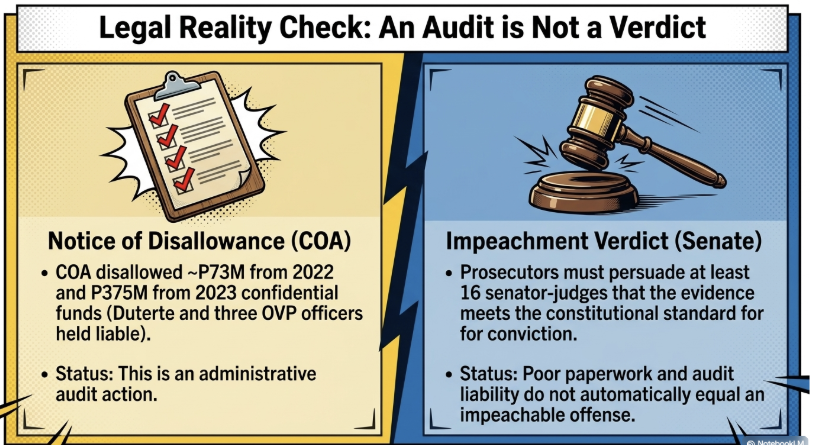
COA had also issued notices of disallowance covering about P73 million from the 2022 confidential funds and P375 million from the 2023 allocation. Reporting on the Day 11 testimony says Duterte and three OVP officers were among those held liable for the P375 million. A notice of disallowance is an audit action, however. It is not on its own a criminal conviction or an impeachment verdict.
What the defense position means
The defense’s refusal to accept the 845 receipts without further proof is not an admission that they came from the OVP. It means prosecutors may have to authenticate the disputed records and establish their relevance. The defense can question Wamil’s conclusions, explain the confidential operations when it presents its case, or argue that audit deficiencies do not amount to an impeachable offense.
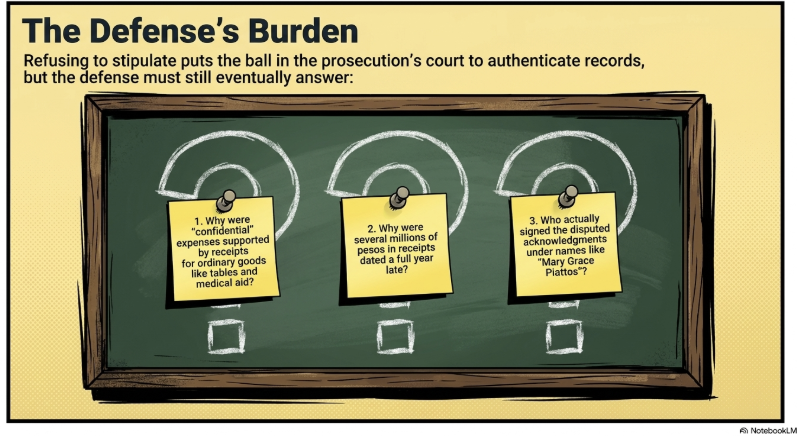
That legal gap is central to Article I. Prosecutors must do more than show poor paperwork. They must persuade at least 16 senator-judges that the evidence meets the constitutional standard for conviction. The defense, meanwhile, must answer why expenses described as confidential work were supported by receipts for ordinary goods, why several receipts were dated a year late, and who signed the disputed acknowledgments.
Netizen reactions: jokes, suspicion and a warning about proof
Public comments beneath news posts about Day 11 followed three visible themes. These reactions are anecdotal and should not be treated as a scientific measure of national opinion.
First came satire. The P70,000 “Mary Grace Piattos” receipt revived jokes about restaurant and snack-brand names appearing in government records. Some commenters treated the name itself as proof of fabrication. That conclusion goes beyond what Day 11 established: Wamil testified about missing support for the payment, not a final determination of the signer’s identity.
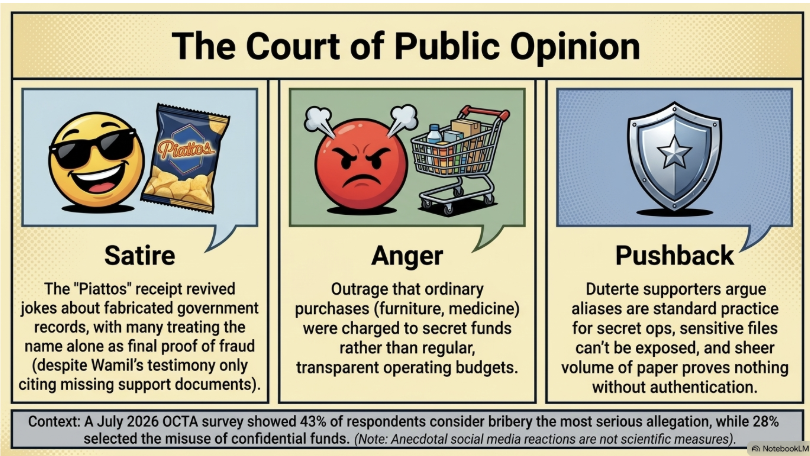
Second came anger over ordinary-looking purchases. Under reports about medicines, furniture and computer equipment, critics asked why these were charged to confidential funds instead of regular operating budgets. Their concern tracks the auditor’s testimony that the submitted files did not tie the purchases to authorized confidential activities. The official circular remains the proper test, not whether a purchase sounds suspicious on social media.
Third came pushback from Duterte supporters. Some argued that aliases are normal in confidential operations, that sensitive files cannot be exposed publicly, and that boxes of paper prove nothing without authentication. The last point is legally sound as a general rule: volume is not proof. Day 11 mattered because Wamil discussed particular entries, dates and missing documents under oath, not because the prosecution wheeled 15 boxes into the chamber.
A separate July 2026 OCTA Research survey found that 43% of respondents considered bribery the most serious allegation in the impeachment case, while 28% selected alleged misuse of confidential funds. That survey gives broader context, but it does not measure reactions to Wamil’s Day 11 testimony.
What happens next
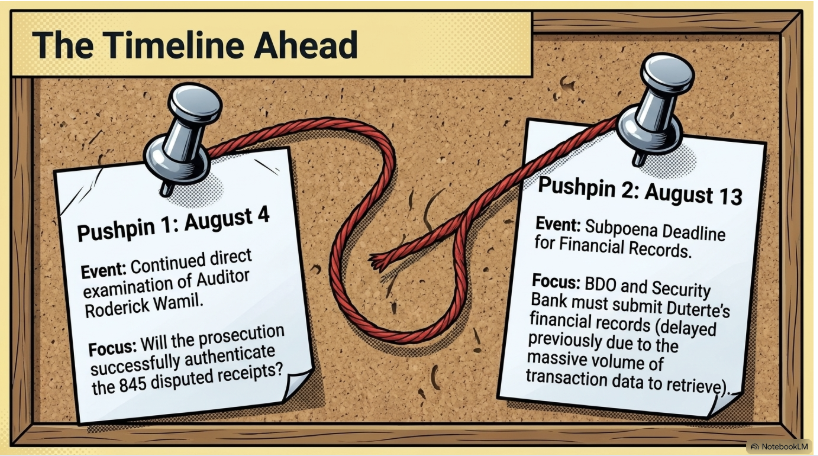
The court adjourned at about 2:30 p.m. and scheduled Wamil’s continued direct examination for August 4. Separately, Escudero gave BDO and Security Bank until August 13 to complete their responses to subpoenas for Duterte’s financial records. The banks said they needed more time because of the volume of records and the need to retrieve transaction data.
Day 11 did not settle whether the confidential funds were stolen, whether Duterte personally benefited, or whether the audit findings amount to an impeachable offense. It put a narrower question before the court: can the OVP show that the people, purchases and activities named in its records were real and allowable under the rules?
The public can follow that question document by document. For the next hearing, watch whether the prosecution authenticates the disputed receipts, whether the defense supplies the missing link to confidential operations, and whether the senator-judges keep audit violations separate from claims that have not yet been proved. Fifteen boxes make a photograph. The entries inside them must make the case.


Day 30 Sara Duterte Impeachment trial: GenCorp contracts, 51 firearms and the bank records fight
Day 16 of Sara Duterte’s impeachment trial: Who handled the 500 million?

Day 31 Sara Duterte Impeachment trial : Baste Duterte takes the stand as GenCorp ties come under scrutiny
About The Author

Noemi Lardizabal-Dado
Noemi Lardizabal-Dado is a content strategist with over 19 years of experience in blogging, content management, citizen advocacy, and media literacy, and over 30 years in web development. Otherwise known as @MomBlogger on social media, she believes in making a difference in the lives of her children by advocating for social change that benefits the greater good. She is a co-founder and a member of the editorial board of Blog Watch . She is a resource speaker on media literacy, social media, blogging, digital citizenship, good governance, transparency, parenting, women’s rights, wellness, and cyber safety. Her personal blogs such as aboutmyrecovery.com (parenting) , pinoyfoodblog.com (recipes), techiegadgets.com (gadgets) and benguetarabica.coffee keep her busy outside of Blog Watch. Disclosure: I am an advocate. I am NOT neutral. I will NOT give social media mileage to members of political clans, epal, a previous candidate for the same position and those I believe are a waste of taxpayers' money. I do not support or belong to any political party. I was part of accredited media covering the Office of the Vice President and Leni Robredo as she ran as a presidential aspirant in the 2022 National and local elections. On August 5, 2021, YouTube announced that I was selected as one of 50 Program participants of its Creator Program for Independent Journalists She was a Senior Consultant for ALL media engagements for the PCOO-led Committee on Media Affairs & Strategic Communications (CMASC) under the ASEAN 2017 National Organizing Council from January 4 -July 5, 2017. Having been an ASEAN advocate since 2011, she has written extensively about the benefits of the ASEAN community and as a region of opportunities on Blog Watch and aboutmyrecovery.com. Organization affiliation includes Consortium on Democracy and Disinformation Updated June 6, 2022