Relief, unease, and “Libertad”: Venezuela’s split reaction
On January 3, 2026, Nicolás Maduro was captured by U.S. forces. Within minutes, the story split into two timelines. One was on the ground in Venezuela. Soldiers on patrol. People staying cautious. Pockets of support still visible. A lot of unanswered questions about what happens next. The other timeline was online and abroad. Videos, flags, tears, and chants of “Liberty!” from Venezuelans in places like Doral, Florida.
It’s tempting to call that “public sentiment.” But this is one of those moments where volume can mislead. The loudest reactions often come from the people safest to speak. Diaspora communities, opposition voices, and accounts far from reprisals. Inside the country, where uncertainty and fear shape what people say and where they say it, the reaction can look quieter even when feelings run just as deep.
That’s why any honest read of Venezuelans’ mood after the capture has to hold two truths at once. Relief is real, and so is unease. Celebration exists alongside caution. Hope collides with questions about sovereignty, violence, and whether removing one man changes the system that kept him in power. Disinformation adds another layer, because what spreads fastest is not always what is most accurate.
Early coverage describes exactly that split. Among opposition supporters and the diaspora, relief and celebration look dominant. Inside Venezuela, reports describe a more restrained atmosphere, with calm streets, soldiers patrolling, and small pro-Maduro gatherings, including chants calling for his return. People interviewed on the ground sound mixed. Some express shock. Some sound relieved. Some sound wary about what comes next, and whether it will get worse before it gets better.
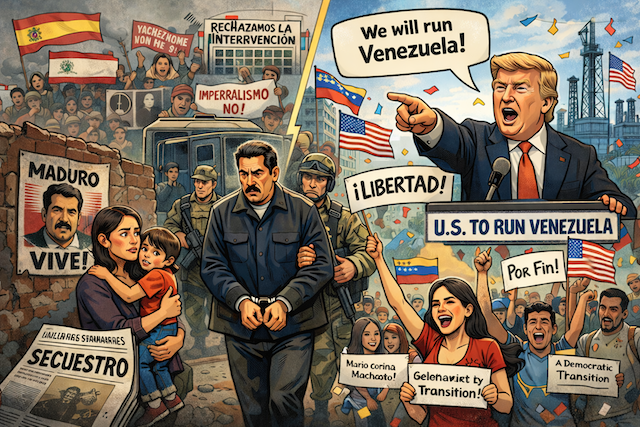
Then Trump poured gasoline on the interpretation war. He didn’t present it as a limited operation followed by Venezuelan-led transition. He presented it as something closer to U.S. control, saying the U.S. would “run” Venezuela for now. Reuters also reported him talking about restoring Venezuela’s oil infrastructure with U.S. oil companies, while Venezuelan Vice President Delcy Rodríguez denounced the operation as a “kidnapping.”
That matters because it changes the emotional math for a lot of people. Even among Venezuelans who wanted Maduro out, “relief” can coexist with discomfort when the language shifts from justice to management, from capture to control. And for Maduro loyalists, Trump’s framing made it easier to sell the moment as invasion, not accountability. The world reaction reflected that tension. Spain’s prime minister said Spain would not recognize the intervention if it violated international law.
There is also a basic measurement problem. There are no formal post-arrest polls yet. The event is too recent, and conditions inside the country make it difficult to measure sentiment safely and reliably. So the best anyone can do right now is combine what reporters observed with what pre-event surveys suggested about baseline attitudes.
One useful baseline is a Datanálisis poll conducted November 14–19, 2025 and reported by Al Jazeera on December 5, 2025. It found 55% of Venezuelans opposed foreign military intervention, with 23% in support. That does not tell us what Venezuelans feel after January 3, but it helps explain why “Maduro is gone” does not automatically translate into comfort with how it happened. People can want political change and still feel uneasy about foreign force.
Another set of numbers often cited points to a gap between Venezuelans abroad and Venezuelans inside the country. Some reporting citing an AtlasIntel poll from November 2025 suggests around 64% of Venezuelans abroad supported U.S. military intervention to remove Maduro, compared to 34% inside Venezuela. The safest way to treat this is as an indicator of a diaspora versus domestic divide, not a definitive read of today’s mood. The capture changed the situation. The poll was before the capture. And in a country under pressure, the ability to answer surveys is never evenly distributed.
What is easier to observe is how people responded in public, especially outside Venezuela. In U.S. Venezuelan communities like Doral, Florida, celebrations were visible and the language was direct. “Liberty!” is not a policy proposal. It’s a release of emotion. It also reflects what many exile communities have carried for years, and how quickly a geopolitical event becomes personal, family-level, and urgent.
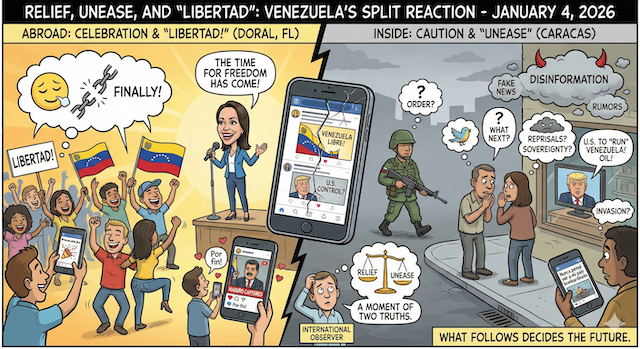
Opposition leaders moved quickly to frame the capture as the opening of a transition. In a letter published by CBS News on January 3, 2026, María Corina Machado declared, “The time for freedom has come!” and called for a democratic transition. At the same time, Reuters reported Trump rejecting the idea of working with Machado. That gap is important. It hints at a messy next chapter, where the loudest pro-democracy messaging may not match who actually gets to steer the transition.
Then there is X, which is where many people are processing the story in real time. Viral posts from Venezuelans and the diaspora are packed with joy, relief, and hope. People share clips of celebrations, tears, and hugs. Posts use phrases like “Por fin puedo volver a mi país” and repeat chants of “libertad.” The emotional register is unmistakable. For many, this feels like a door finally cracking open.
But X also carries the other side, even if it is less amplified. Some posts reflect shock at the violence itself, including “Nunca pensé ver a mi país bombardeado.” Others worry about sovereignty, U.S. intentions, and what happens if the power structure remains intact even after Maduro is removed. Some describe subdued reactions or fear of reprisals. And that matters, because fear changes what “sentiment” looks like. Silence can mean approval, but it can also mean survival.
The safest way to treat X is as a window into what is circulating and what language is being used, not as proof of what the country feels as a whole. It’s also worth noting that disinformation spiked immediately after the operation, including recycled footage and synthetic media mixed into real updates.
Alongside the question of sentiment is a second argument about what the operation represents, and Trump sits at the center of it. Supporters frame it as justice against a criminal regime and a chance to break a cycle of repression. Critics frame it as unlawful overreach and a precedent that normalizes force without consent or clear international legitimacy. Trump’s own language about “running” Venezuela, and the emphasis on oil infrastructure, gives both sides more material to fight over.
So what can be said about Venezuelan sentiment right now? It is mixed, and the mix makes sense. Geography matters. Safety matters. Access to information matters. Diaspora celebration is loud because it can be loud. Domestic caution is real because domestic risk is real. Trump’s framing matters because it shapes whether people interpret the capture as justice, invasion, or something in between.
The next shift in sentiment will not come from another viral clip. It will come from outcomes. Who governs. Who controls the security forces. Whether political prisoners are released. Whether institutions restart or fracture. Whether daily life changes for ordinary people. The capture created a moment. What follows decides what that moment becomes.
Rep Garin believes country not ready for new Kasambahay Act
GILAS: Public schools on the information highway (Part 1)
President Aquino Should Sign Landmark Disappearances Law
About The Author

Noemi Lardizabal-Dado
Noemi Lardizabal-Dado is a content strategist with over 19 years of experience in blogging, content management, citizen advocacy, and media literacy, and over 30 years in web development. Otherwise known as @MomBlogger on social media, she believes in making a difference in the lives of her children by advocating for social change that benefits the greater good. She is a co-founder and a member of the editorial board of Blog Watch . She is a resource speaker on media literacy, social media, blogging, digital citizenship, good governance, transparency, parenting, women’s rights, wellness, and cyber safety. Her personal blogs such as aboutmyrecovery.com (parenting) , pinoyfoodblog.com (recipes), techiegadgets.com (gadgets) and benguetarabica.coffee keep her busy outside of Blog Watch. Disclosure: I am an advocate. I am NOT neutral. I will NOT give social media mileage to members of political clans, epal, a previous candidate for the same position and those I believe are a waste of taxpayers' money. I do not support or belong to any political party. I was part of accredited media covering the Office of the Vice President and Leni Robredo as she ran as a presidential aspirant in the 2022 National and local elections. On August 5, 2021, YouTube announced that I was selected as one of 50 Program participants of its Creator Program for Independent Journalists She was a Senior Consultant for ALL media engagements for the PCOO-led Committee on Media Affairs & Strategic Communications (CMASC) under the ASEAN 2017 National Organizing Council from January 4 -July 5, 2017. Having been an ASEAN advocate since 2011, she has written extensively about the benefits of the ASEAN community and as a region of opportunities on Blog Watch and aboutmyrecovery.com. Organization affiliation includes Consortium on Democracy and Disinformation Updated June 6, 2022