In early December 2025, something happened that many Filipinos have been hearing promised, but rarely delivered. President Ferdinand “Bongbong” Marcos Jr. told the 19th Congress to move the Anti-Political Dynasty bill up the agenda. The directive came during the December 9 meeting of the Legislative-Executive Development Advisory Council (LEDAC), effectively pulling a long-neglected issue back into the administration’s list of priorities.
At first glance, it felt like a possible shift. The 1987 Constitution has been clear on this point from the start: political dynasties are supposed to be prohibited, once defined by law. And yet, nearly forty years on, Congress has still not produced legislation that seriously tackles the problem. For many, the announcement stirred cautious interest—mixed, inevitably, with doubt shaped by history.This time, the administration moved quickly. Just two days after the LEDAC meeting, Speaker Faustino “Bojie” Dy III and House Majority Leader Sandro Marcos jointly filed House Bill No. 06771.
The speed alone raised eyebrows. So did the optics: a bill against political dynasties filed by the President’s son, under an administration rooted in one of the country’s most established political families.
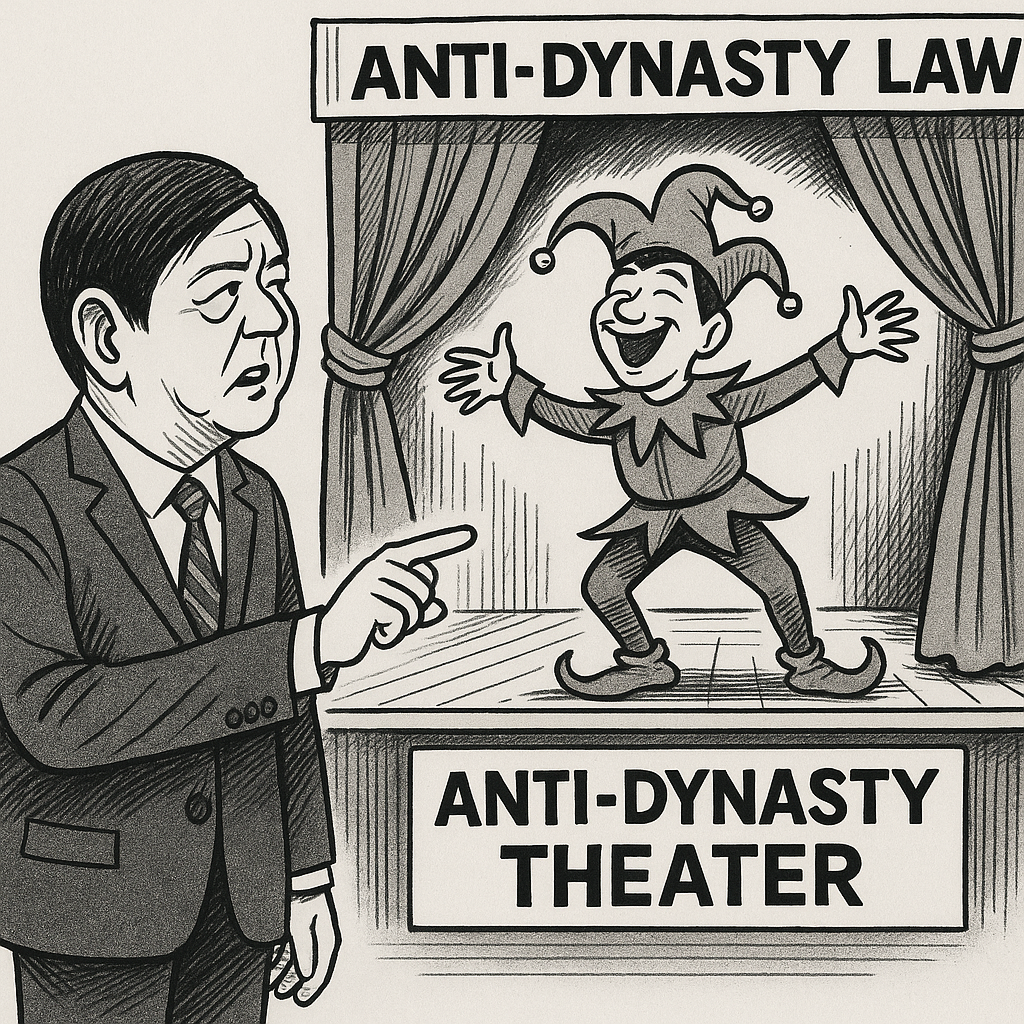
Supporters framed HB 06771 as “historic.” Critics were less convinced.
What the bill does—and doesn’t—do
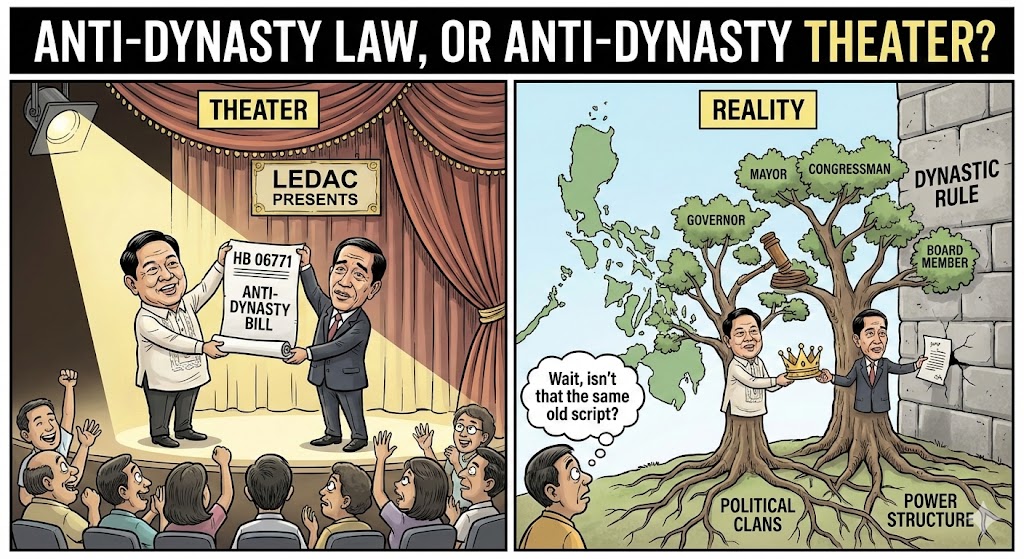
House Bill No. 06771 sets out to bar relatives within the fourth civil degree of consanguinity or affinity from seeking public office. On paper, that sounds sweeping. In reality, the ban is tightly drawn. What it mostly stops is family members running for, or holding, the same position in the same place at the same time.
And that’s where questions start creeping in.
Political dynasties in the Philippines rarely work that way. They don’t usually clash over a single seat. Power is passed on instead—one family member stepping in when another hits a term limit. Or it spreads sideways, with relatives occupying different posts within the same province or city. A governor here, a mayor there, maybe a congressman or board member in the mix. This playbook has been around for decades.
None of that is really addressed by HB 06771.
Because of this, reform groups say the bill ends up policing situations that either can’t happen or barely exist, while leaving untouched the very practices that allow political families to stay entrenched in power.
A response from reform advocates
The Anti-Dynasty Network was quick to release a statement outlining these concerns. Below is their full statement, reproduced verbatim:
> ????????? ?? ??? ????-??????? ??????? ?? ????? ???? ??. ?????
Filed by Speaker Faustino G. Dy III and Rep. Ferdinand Alexander A. Marcos
12 December 2025
Nice try, but Filipinos deserve a responsive and more meaningful anti-dynasty measure.
While House Bill No. 06771 is presented as a reform measure, our initial review shows that it includes scenarios that cannot actually occur and leaves untouched the real mechanisms through which political clans entrench themselves in power. For instance, Section 5(2) of the said bill prohibits relatives from holding or running for the same position in the same legislative district, yet this is already impossible under the Constitution because each district can only have one representative at any given time.
Equally concerning is what the bill omits. It imposes no limit on how many relatives may simultaneously hold public office, does not address overlapping constituencies, and does not tackle dynastic succession, which is the most common method political dynasties use to pass power from one member to another. These gaps are substantial and render the measure too narrow and too weak to fulfill the Constitution’s explicit mandate.
Unless these flaws are addressed, the measure risks reinforcing the very dynasties it claims to regulate. A law this limited can easily become a performative measure that appears to introduce reform even if it falls short of what the Constitution instructs: prevent the concentration of political power in the hands of a few and the protection of equal access to opportunities for public service.
We call on other members of Congress to stand with the Filipino people and take these gaps seriously. A genuine and comprehensive anti-dynasty law is long overdue. It is time to enact legislation that curbs the concentration of political power, strengthens democratic participation, and lives up to the Constitution’s promise of equal opportunity for all.
Reform, symbolism, or both?
The President’s directive matters. It signals that Malacañang is at least willing to place the issue back on the legislative agenda. That alone breaks a long pattern of silence or avoidance.
But laws are judged by their substance, not their symbolism.
An anti-dynasty bill that avoids succession and overlapping jurisdictions risks becoming a box-ticking exercise—technically compliant with the Constitution’s mandate, yet ineffective in changing political realities on the ground. At worst, it becomes a convenient shield—something that looks like reform on the surface, but leaves existing power structures largely intact.
What happens next depends on Congress. The next few weeks will make it clear whether HB 06771 is meant to open a real discussion, or if this is as far as the effort is supposed to go. Amendments are still possible. Hearings can still reshape the bill. Public pressure can still matter.
For many Filipinos, the question is no longer whether an anti-dynasty law should exist. That debate was settled in 1987. The real question now is whether lawmakers are willing to pass one that actually works.
About The Author

Noemi Lardizabal-Dado
Noemi Lardizabal-Dado is a content strategist with over 19 years of experience in blogging, content management, citizen advocacy, and media literacy, and over 30 years in web development. Otherwise known as @MomBlogger on social media, she believes in making a difference in the lives of her children by advocating for social change that benefits the greater good.
She is a co-founder and a member of the editorial board of Blog Watch . She is a resource speaker on media literacy, social media, blogging, digital citizenship, good governance, transparency, parenting, women’s rights, wellness, and cyber safety.
Her personal blogs such as aboutmyrecovery.com (parenting) , pinoyfoodblog.com (recipes), techiegadgets.com (gadgets) and benguetarabica.coffee keep her busy outside of Blog Watch.
Disclosure:
I am an advocate. I am NOT neutral. I will NOT give social media mileage to members of political clans, epal, a previous candidate for the same position and those I believe are a waste of taxpayers' money.
I do not support or belong to any political party. I was part of accredited media covering the Office of the Vice President and Leni Robredo as she ran as a presidential aspirant in the 2022 National and local elections.
On August 5, 2021, YouTube announced that I was selected as one of 50 Program participants of its Creator Program for Independent Journalists
She was a Senior Consultant for ALL media engagements for the PCOO-led Committee on Media Affairs & Strategic Communications (CMASC) under the ASEAN 2017 National Organizing Council from January 4 -July 5, 2017. Having been an ASEAN advocate since 2011, she has written extensively about the benefits of the ASEAN community and as a region of opportunities on Blog Watch and aboutmyrecovery.com.
Organization affiliation includes Consortium on Democracy and Disinformation
Updated June 6, 2022

Anti-Dynasty law, or Anti-Dynasty theater?
In early December 2025, something happened that many Filipinos have been hearing promised, but rarely delivered. President Ferdinand “Bongbong” Marcos Jr. told the 19th Congress to move the Anti-Political Dynasty bill up the agenda. The directive came during the December 9 meeting of the Legislative-Executive Development Advisory Council (LEDAC), effectively pulling a long-neglected issue back into the administration’s list of priorities.
At first glance, it felt like a possible shift. The 1987 Constitution has been clear on this point from the start: political dynasties are supposed to be prohibited, once defined by law. And yet, nearly forty years on, Congress has still not produced legislation that seriously tackles the problem. For many, the announcement stirred cautious interest—mixed, inevitably, with doubt shaped by history.This time, the administration moved quickly. Just two days after the LEDAC meeting, Speaker Faustino “Bojie” Dy III and House Majority Leader Sandro Marcos jointly filed House Bill No. 06771.
The speed alone raised eyebrows. So did the optics: a bill against political dynasties filed by the President’s son, under an administration rooted in one of the country’s most established political families.

Supporters framed HB 06771 as “historic.” Critics were less convinced.
What the bill does—and doesn’t—do
House Bill No. 06771 sets out to bar relatives within the fourth civil degree of consanguinity or affinity from seeking public office. On paper, that sounds sweeping. In reality, the ban is tightly drawn. What it mostly stops is family members running for, or holding, the same position in the same place at the same time.
And that’s where questions start creeping in.
Political dynasties in the Philippines rarely work that way. They don’t usually clash over a single seat. Power is passed on instead—one family member stepping in when another hits a term limit. Or it spreads sideways, with relatives occupying different posts within the same province or city. A governor here, a mayor there, maybe a congressman or board member in the mix. This playbook has been around for decades.
None of that is really addressed by HB 06771.
Because of this, reform groups say the bill ends up policing situations that either can’t happen or barely exist, while leaving untouched the very practices that allow political families to stay entrenched in power.
A response from reform advocates
The Anti-Dynasty Network was quick to release a statement outlining these concerns. Below is their full statement, reproduced verbatim:
Reform, symbolism, or both?
The President’s directive matters. It signals that Malacañang is at least willing to place the issue back on the legislative agenda. That alone breaks a long pattern of silence or avoidance.
But laws are judged by their substance, not their symbolism.
An anti-dynasty bill that avoids succession and overlapping jurisdictions risks becoming a box-ticking exercise—technically compliant with the Constitution’s mandate, yet ineffective in changing political realities on the ground. At worst, it becomes a convenient shield—something that looks like reform on the surface, but leaves existing power structures largely intact.
What happens next depends on Congress. The next few weeks will make it clear whether HB 06771 is meant to open a real discussion, or if this is as far as the effort is supposed to go. Amendments are still possible. Hearings can still reshape the bill. Public pressure can still matter.
For many Filipinos, the question is no longer whether an anti-dynasty law should exist. That debate was settled in 1987. The real question now is whether lawmakers are willing to pass one that actually works.
Related Posts
Share your thoughts on HB No. 1799, the Divorce Bill
Day 13 Highlights
#CJTrialWatch: Your role as Filipino Citizens
About The Author
Noemi Lardizabal-Dado
Noemi Lardizabal-Dado is a content strategist with over 19 years of experience in blogging, content management, citizen advocacy, and media literacy, and over 30 years in web development. Otherwise known as @MomBlogger on social media, she believes in making a difference in the lives of her children by advocating for social change that benefits the greater good. She is a co-founder and a member of the editorial board of Blog Watch . She is a resource speaker on media literacy, social media, blogging, digital citizenship, good governance, transparency, parenting, women’s rights, wellness, and cyber safety. Her personal blogs such as aboutmyrecovery.com (parenting) , pinoyfoodblog.com (recipes), techiegadgets.com (gadgets) and benguetarabica.coffee keep her busy outside of Blog Watch. Disclosure: I am an advocate. I am NOT neutral. I will NOT give social media mileage to members of political clans, epal, a previous candidate for the same position and those I believe are a waste of taxpayers' money. I do not support or belong to any political party. I was part of accredited media covering the Office of the Vice President and Leni Robredo as she ran as a presidential aspirant in the 2022 National and local elections. On August 5, 2021, YouTube announced that I was selected as one of 50 Program participants of its Creator Program for Independent Journalists She was a Senior Consultant for ALL media engagements for the PCOO-led Committee on Media Affairs & Strategic Communications (CMASC) under the ASEAN 2017 National Organizing Council from January 4 -July 5, 2017. Having been an ASEAN advocate since 2011, she has written extensively about the benefits of the ASEAN community and as a region of opportunities on Blog Watch and aboutmyrecovery.com. Organization affiliation includes Consortium on Democracy and Disinformation Updated June 6, 2022