
Day 27: What SEC records revealed about Sara Duterte’s business roles
“Participate in any business.”
Those words in Article VII, Section 13 of the 1987 Constitution became the center of Vice President Sara Duterte’s impeachment trial on September 21.
Day 27 moved deeper into Article II, which covers allegations involving Duterte’s declared wealth, SALNs and business interests. Securities and Exchange Commission official Gerardo Fernando del Rosario took the witness stand to explain corporate records involving companies associated with Duterte and her husband, lawyer Manases Carpio.
The records produced numbers, company names and years. But the hearing also exposed a harder legal question: What does it mean for a sitting vice president to “participate in any business”?
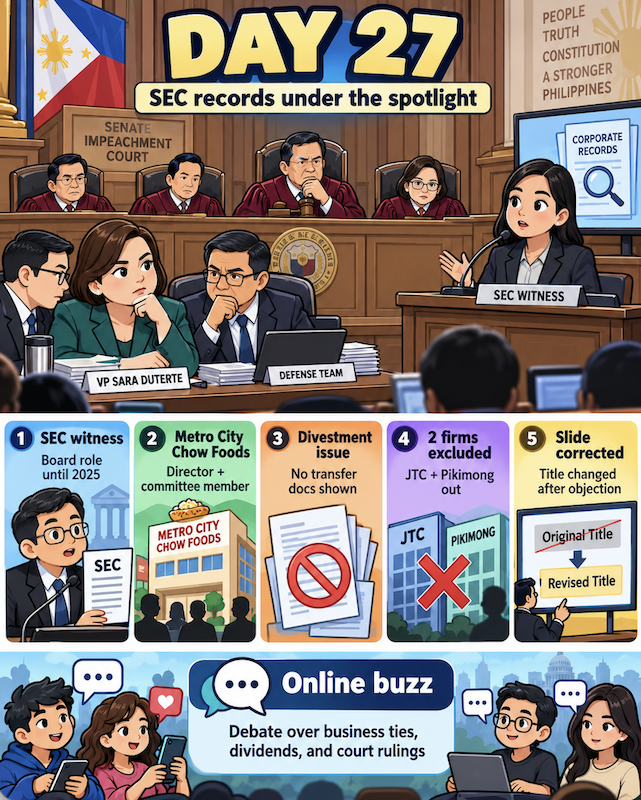
Here are five points from Day 27 that are supported by the public record.

1. SEC records kept Duterte on a company board through 2025
Del Rosario testified that General Information Sheets filed with the SEC listed Duterte as a member of the board of Metro City Chow Foods Corp. from 2022 through 2025, covering the period after she became vice president.
The records also listed her as a member of the company’s compensation committee. Duterte had been an incorporator of Metro City Chow Foods, with 500 shares representing a 20 percent stake.
That matters because a corporate board is not simply a list of shareholders. Under corporate law, the board exercises corporate powers and directs the corporation’s business. Del Rosario told the impeachment court that a corporation cannot conduct its business without its board.
The prosecution says those corporate positions show Duterte continued participating in a private business while serving as vice president.
The defense has not yet completed its challenge to that evidence.
2. The Constitution says “participate in any business,” not simply “own shares”

This distinction came up repeatedly during the hearing.
Article VII, Section 13 states that the President, Vice President, Cabinet members and their deputies or assistants shall not, during their tenure, “directly or indirectly, practice any other profession, participate in any business” or hold a financial interest in certain government contracts, franchises or special privileges.
Presiding Officer Francis “Chiz” Escudero pointed out that the provision does not use the broader phrase “business interests.” The question before the impeachment court is whether Duterte’s documented roles, particularly her board and compensation committee positions, amounted to prohibited participation.
Del Rosario did not make the final legal judgment himself. When Senate President Sherwin Gatchalian asked whether Duterte’s corporate roles could violate the constitutional restriction, the SEC official said it would ultimately be for the Senate to determine whether there was a violation.
That qualification matters. SEC records can establish what was filed with the agency. Whether those facts amount to a culpable constitutional violation is a separate question for the impeachment court.

3. Questions emerged over divestment and Gencorp
Another issue was whether Duterte had formally transferred interests in companies where her name later disappeared from corporate filings.
Del Rosario said his SEC office did not have separate deeds or documents showing that Duterte transferred ownership to another person in some of the companies being examined. Later General Information Sheets did show her name disappearing from certain corporate records, but the witness distinguished those filings from independent documentation of a transfer.

Then there was Gencorp Industries Inc.
Duterte listed Gencorp among her business interests in her SALNs, including her 2023, 2024 and 2025 declarations. But Del Rosario testified that Duterte’s name did not appear as an incorporator or director in the Gencorp corporate records examined by the SEC.
That creates a discrepancy the prosecution still has to explain.
A SALN declaration by itself does not establish how Duterte held an interest in Gencorp. Likewise, the absence of her name from the company’s SEC documents does not by itself establish concealed ownership.
Those links still have to be proven.
4. The companies had large sales, but “zero dividends” is not the same as “zero income”
The financial figures drew some of the strongest reactions during Day 27.
Metro City Chow Foods reported about P309 million in gross sales from 2017 through 2025, while posting a cumulative net loss of about P3.15 million and declaring no dividends during that period.
Gencorp reported roughly P1.04 billion in sales from 2021 through 2024 and about P8 million in net income, but also reported no dividends.
The prosecution connected those figures to Duterte and Carpio’s declared net worth, which rose from around P71 million in 2022 to P98.6 million in 2025. Duterte’s 2025 SALN showing the P98.6 million net worth was independently reported months before the Day 27 hearing.
Prosecution spokesperson Zia Alonto Adiong questioned how the increase should be reconciled with corporations that apparently paid no dividends.

But this point needs care.
No declared dividends does not mean a shareholder necessarily received “zero income,” and large corporate sales are not personal income. Del Rosario explained that a director or shareholder could receive authorized salaries or per diems, while corporations may also retain earnings instead of distributing dividends.
So Day 27 did not prove that the P27-million increase in declared net worth was unexplained.
It established one part of the prosecution’s theory. The prosecution still has to trace the sources of the increase and show why they do, or do not, match Duterte’s lawful income and declarations.
5. The court drew lines around what the prosecution could present
Day 27 was also a reminder that evidence is not admitted simply because prosecutors say it is connected.
The defense objected when prosecutors tried to identify corporate records involving JTC Group of Companies and Pikimong Pikimong Philippines Corp. An earlier ruling had excluded bank and other records involving the two companies because a sufficient connection to Duterte had not been established.
Escudero sustained the objection to bringing those corporate records into the presentation through the SEC witness.
Another dispute involved a prosecution summary labeled “Summary of Vice President Sara Duterte’s Shareholdings.”
Defense lawyer Justin Nicol Gular pointed out that some figures shown under the heading were actually authorized capital, subscribed capital and other figures belonging to entire corporations, rather than Duterte personally.
Senator-judge Alan Peter Cayetano agreed that an inaccurate heading could give viewers the wrong impression. Escudero ordered the title corrected while allowing the underlying corporate information to be presented.
Later, after prosecutor Terry Ridon objected to Gular’s language, Escudero ordered “misrepresentation” replaced with “inaccuracies” in the record. He also changed the defense phrase “to condition the mind of the public” to “to make conclusions of fact to the public.”
That exchange may look like courtroom wordplay, but it carries a practical lesson: figures shown on television should not be confused with what those figures legally prove.
What netizens were talking about
Online discussion during Day 27 centered heavily on the SEC records, the corporate earnings and the exclusion of JTC and Pikimong Pikimong.
In the r/Philippines Day 27 discussion, some commenters questioned why the JTC and Pikimong records could not be explored further and debated whether the earlier exclusion of bank records should also keep SEC documents out. Others treated Duterte’s continued listing on a corporate board as the more important issue.
A separate discussion about the low net income reported by Metro City Chow Foods and Gencorp produced a useful counterpoint. One commenter noted that businesses can have large sales and low profits, while separating that issue from the question of whether Duterte should have divested or stopped participating in the businesses.
These are individual online reactions, not polling. They should not be treated as representative of Filipino public opinion.
They do show where some of the public confusion lies: corporate sales are being mixed with personal wealth, ownership is being mixed with participation, and suspicion is sometimes being stated as proof before the evidentiary links have been completed.

The unresolved question after Day 27
Day 27 placed something concrete on the record: SEC filings continued to identify Duterte as a board director and compensation committee member of Metro City Chow Foods after she became vice president.
What those records prove beyond that remains contested.
The Constitution gives us a useful test because its wording is specific. It prohibits a vice president from “participating in any business.” The prosecution therefore has to show what Duterte actually did, directly or indirectly, while in office. The defense, in turn, has to deal with corporate filings carrying her name and positions through 2025.
For citizens following the trial, the P309 million and P1.04 billion figures may grab attention. They are not the question the Senate eventually has to answer.
The better question to keep watching is simpler: What evidence connects the corporate records to Duterte’s actual participation, income and declarations while she was vice president?

Day 18 of Sara Duterte Impeachment Trial: The P250M request came before the plan

Day 26 Sara Duterte Impeachment trial : What her SALNs show, and what they don’t

Day 20 Sara Duterte Impeachment Trial: Certificates without a money trail
About The Author

Noemi Lardizabal-Dado
Noemi Lardizabal-Dado is a content strategist with over 19 years of experience in blogging, content management, citizen advocacy, and media literacy, and over 30 years in web development. Otherwise known as @MomBlogger on social media, she believes in making a difference in the lives of her children by advocating for social change that benefits the greater good. She is a co-founder and a member of the editorial board of Blog Watch . She is a resource speaker on media literacy, social media, blogging, digital citizenship, good governance, transparency, parenting, women’s rights, wellness, and cyber safety. Her personal blogs such as aboutmyrecovery.com (parenting) , pinoyfoodblog.com (recipes), techiegadgets.com (gadgets) and benguetarabica.coffee keep her busy outside of Blog Watch. Disclosure: I am an advocate. I am NOT neutral. I will NOT give social media mileage to members of political clans, epal, a previous candidate for the same position and those I believe are a waste of taxpayers' money. I do not support or belong to any political party. I was part of accredited media covering the Office of the Vice President and Leni Robredo as she ran as a presidential aspirant in the 2022 National and local elections. On August 5, 2021, YouTube announced that I was selected as one of 50 Program participants of its Creator Program for Independent Journalists She was a Senior Consultant for ALL media engagements for the PCOO-led Committee on Media Affairs & Strategic Communications (CMASC) under the ASEAN 2017 National Organizing Council from January 4 -July 5, 2017. Having been an ASEAN advocate since 2011, she has written extensively about the benefits of the ASEAN community and as a region of opportunities on Blog Watch and aboutmyrecovery.com. Organization affiliation includes Consortium on Democracy and Disinformation Updated June 6, 2022