Day 10 of Sara Duterte’s impeachment trial: What “unusual but not suspicious” really means
“Unusual, but not suspicious.”
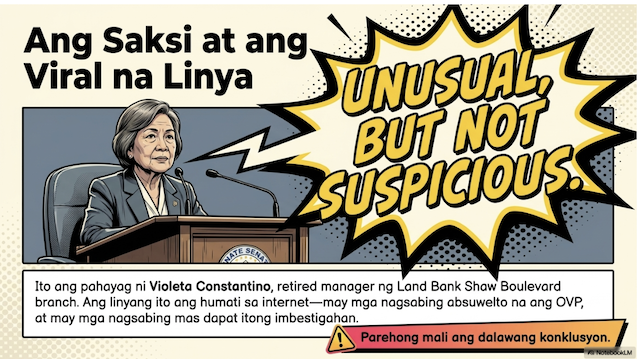
That was the phrase that followed Day 10 of Vice President Sara Duterte’s impeachment trial across news reports and social media. Depending on which word people chose to emphasize, the testimony either cleared the Office of the Vice President or gave the prosecution another reason to keep following the money.
Both conclusions are premature.
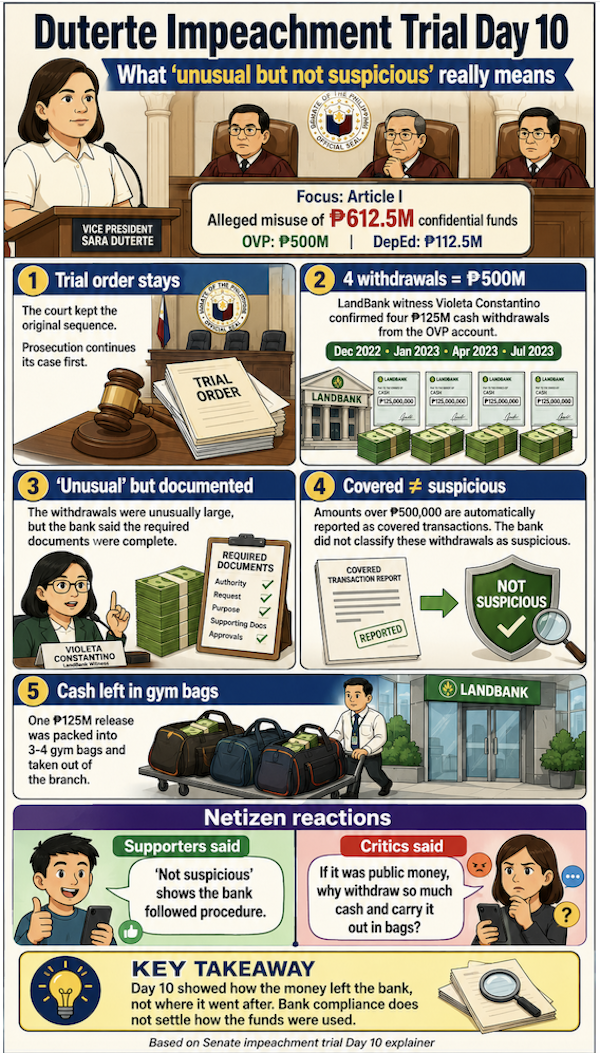
The Senate impeachment court had moved from Article IV, involving Duterte’s alleged threats, to Article I. This charge covers the alleged misuse and irregular liquidation of ?612.5 million in confidential funds: ?500 million under the Office of the Vice President and ?112.5 million under the Department of Education. The prosecution’s first witness was Violeta Constantino, the retired manager of Land Bank’s Shaw Boulevard branch.
Her testimony established how the money left the bank. It did not yet establish where the cash went afterward.
Five highlights from Day 10
1. The court kept the original order of trial
Before the witness was called, lead House prosecutor Gerville Luistro asked the court to change how evidence would be presented.
Under the proposed arrangement, the prosecution would present its evidence for one article, followed immediately by the defense’s response to that article. The court would then move to the next charge.
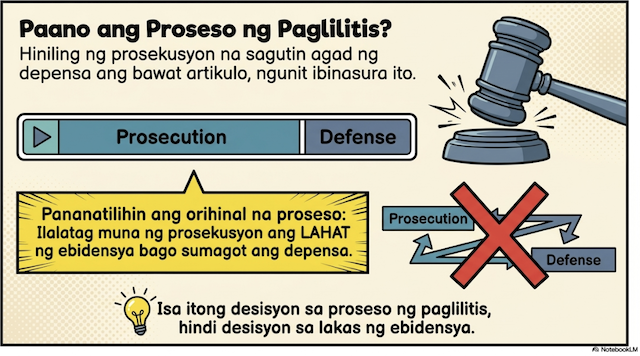
The defense rejected the proposal. It maintained that the prosecution should first complete its presentation for all the articles before the defense begins presenting its case. Without agreement from both sides, the court retained the original sequence.
This was a ruling about trial procedure. It was not a ruling on the strength of Article I.
2. Four checks moved ?500 million out of the OVP account
Constantino identified four checks worth ?125 million each, all payable to OVP special disbursing officer Gina Acosta.
The checks were dated:
- December 20, 2022
- January 31, 2023
- April 18, 2023
- July 13, 2023
Together, they amounted to ?500 million.
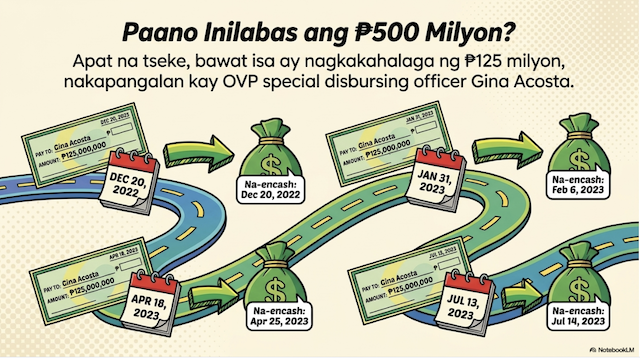
There is an important correction to the research document. It presents the check dates as the dates when all four withdrawals were completed. Available reporting distinguishes between the dates written on the checks and the dates of actual encashment.
The reported encashment dates were December 20, 2022; February 6, 2023; April 25, 2023; and July 14, 2023.
That difference should be reflected in any infographic or timeline about the transactions.
3. The withdrawals were unusual, but the bank had the required documents
During questioning by Senator-Judge Erwin Tulfo, Constantino said that she had not encountered a ?125 million cash withdrawal in her 32 years at Land Bank.
She described the transactions as unusual because of the amount being withdrawn in physical cash. But the OVP had sent advance notices. The bank also verified the checks, signatures, identification and authority of the disbursing officer before releasing the money.
This explains the apparent contradiction.
“Unusual” described the size and physical form of the withdrawals. “Not suspicious” described the bank’s assessment of the documents and the authority of the person withdrawing the cash.
Neither description tells us how the money was ultimately spent.
4. A covered transaction is not the same as a suspicious transaction
Senator-Judge Bam Aquino asked about the bank’s obligations under the Anti-Money Laundering Act.
Transactions exceeding ?500,000 in one banking day are generally reported as covered transactions. All four ?125 million withdrawals were therefore far above the reporting threshold. Constantino said the bank complied with its reporting obligations but did not regard the withdrawals as suspicious at the branch level.
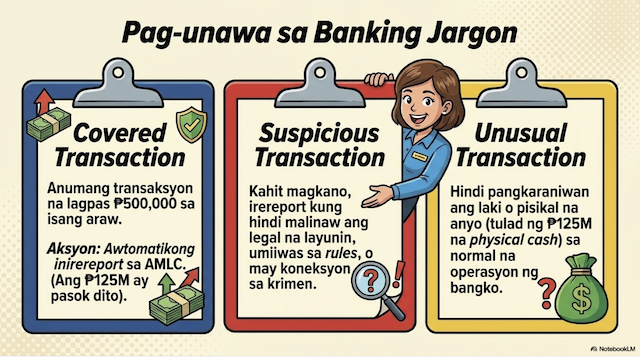
The two terms should not be treated as opposites.
A covered transaction is reported because it exceeds the amount set by law. A suspicious transaction may be reported regardless of its amount when there are indicators such as an unclear legal purpose, unusual movement inconsistent with the client’s profile, attempts to evade reporting rules or a possible connection to unlawful activity.
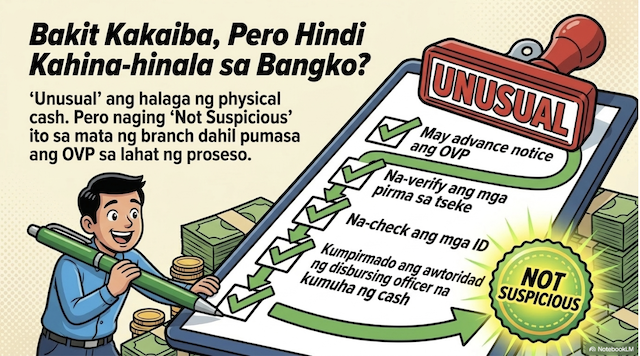
The bank’s decision to release the cash shows that the checks and authority documents passed its verification process. It does not certify the accuracy of later liquidation reports or prove that every peso was used for an authorized confidential expense.
5. The money left the bank in gym bags
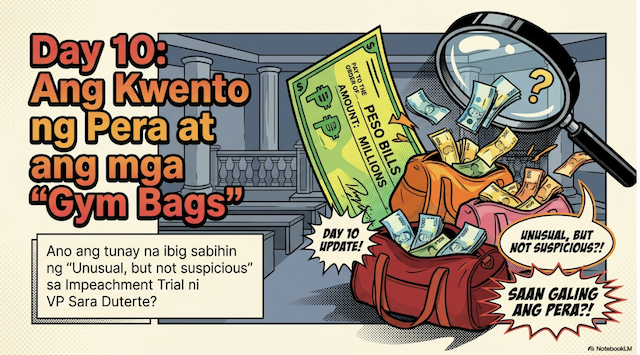
Constantino also testified that a ?125 million cash release was placed in three or four gym bags. Acosta and OVP security officer Lemuel Ortonio then left the branch with the money. Bank personnel provided a trolley but did not accompany them after the cash was released.
The image of public money leaving a bank in gym bags quickly became one of the most discussed details of the hearing.
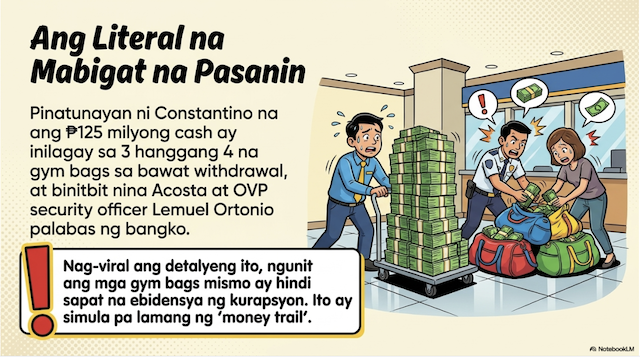
But the bags themselves are not proof of misappropriation. They point to the next set of questions:
Who maintained custody of the cash after it left the bank? Who received it? What records documented each payment? Do the names, signatures, dates and amounts in the liquidation papers match real recipients and completed activities?
Those questions belong to the prosecution’s remaining witnesses and documents.
What netizens took from the testimony
Online reactions split around the words “unusual” and “not suspicious.”
Supporters of Duterte focused on the second phrase. They argued that the bank processed the checks, confirmed Acosta’s authority and did not identify the withdrawals as suspicious. Posts carrying the “unusual but not suspicious” framing were shared as evidence that the transactions complied with banking rules.

Critics focused on the first phrase. They questioned why a government office needed to withdraw ?125 million in physical cash at a time and why the money had to be carried away in bags instead of being transferred through traceable electronic payments. News posts framed the public question plainly: unusual, but does that mean there was nothing wrong?
These reactions show how easily one piece of testimony can be cut into competing political messages.
However, they should not be presented as a scientific measure of public sentiment. The research provides no sample size, platform data, engagement totals or method for classifying reactions. Its claim that discussion reached “high levels” under several hashtags cannot be independently confirmed from the evidence it cites.
What Day 10 proved, and what it did not
Day 10 placed several facts on the record.
The OVP withdrew ?500 million through four checks. Each check was worth ?125 million. The bank received advance notice and verified the documents. The branch regarded the amount of physical cash as unusual but did not stop the transactions.
What the hearing did not yet establish was the lawful end use of the money.
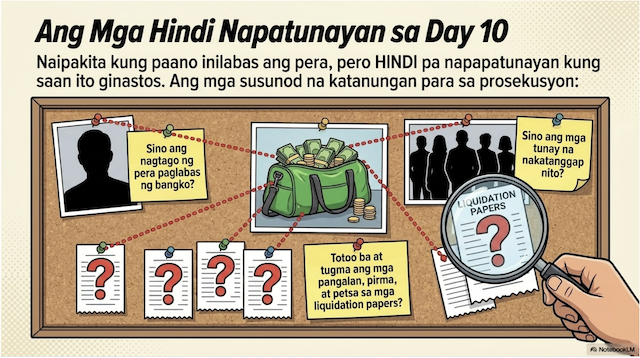
Bank compliance and public accountability are separate tests. Land Bank was responsible for checking whether the account had funds, whether the checks were valid and whether the person claiming the cash had authority to receive it. The impeachment court must examine what happened after the cash crossed the bank counter.
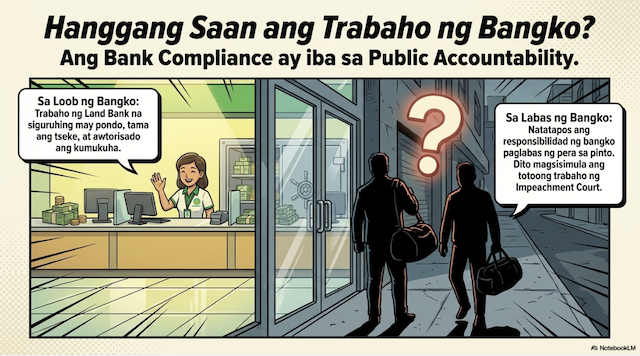
That is where Article I will be decided.
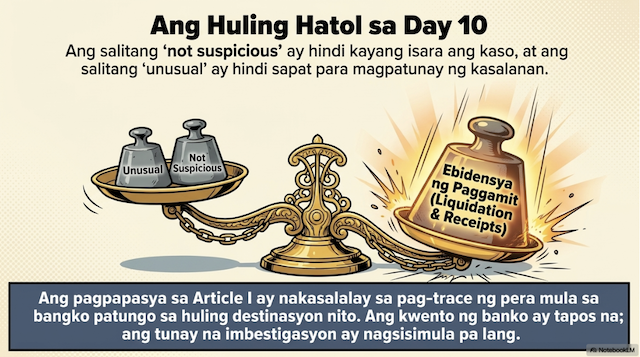
The phrase “not suspicious” cannot close the case. The word “unusual” cannot prove it either. The evidence must trace the cash from the four checks to the people, operations and liquidation records offered to justify its use.
The bank trail ends when the money leaves the branch. The public’s questions begin there.
Day 19 of Sara Duterte Impeachment Trial: Who Checked the Receipts?

Day 2 of Sara Duterte’s impeachment trial: the video is now on record

Day 25 Sara Duterte Impeachment trial : What her SALNs show, and what they don’t
About The Author

Noemi Lardizabal-Dado
Noemi Lardizabal-Dado is a content strategist with over 19 years of experience in blogging, content management, citizen advocacy, and media literacy, and over 30 years in web development. Otherwise known as @MomBlogger on social media, she believes in making a difference in the lives of her children by advocating for social change that benefits the greater good. She is a co-founder and a member of the editorial board of Blog Watch . She is a resource speaker on media literacy, social media, blogging, digital citizenship, good governance, transparency, parenting, women’s rights, wellness, and cyber safety. Her personal blogs such as aboutmyrecovery.com (parenting) , pinoyfoodblog.com (recipes), techiegadgets.com (gadgets) and benguetarabica.coffee keep her busy outside of Blog Watch. Disclosure: I am an advocate. I am NOT neutral. I will NOT give social media mileage to members of political clans, epal, a previous candidate for the same position and those I believe are a waste of taxpayers' money. I do not support or belong to any political party. I was part of accredited media covering the Office of the Vice President and Leni Robredo as she ran as a presidential aspirant in the 2022 National and local elections. On August 5, 2021, YouTube announced that I was selected as one of 50 Program participants of its Creator Program for Independent Journalists She was a Senior Consultant for ALL media engagements for the PCOO-led Committee on Media Affairs & Strategic Communications (CMASC) under the ASEAN 2017 National Organizing Council from January 4 -July 5, 2017. Having been an ASEAN advocate since 2011, she has written extensively about the benefits of the ASEAN community and as a region of opportunities on Blog Watch and aboutmyrecovery.com. Organization affiliation includes Consortium on Democracy and Disinformation Updated June 6, 2022