2025 was loud. Hearings were livestreamed. Clips traveled faster than transcripts. Scandals were documented in real time. And yet the year still ended with the same feeling: exposure didn’t automatically turn into consequence.
So for 2026, here’s the wishlist not the feel-good kind, but the “what would actually change daily life” kind.
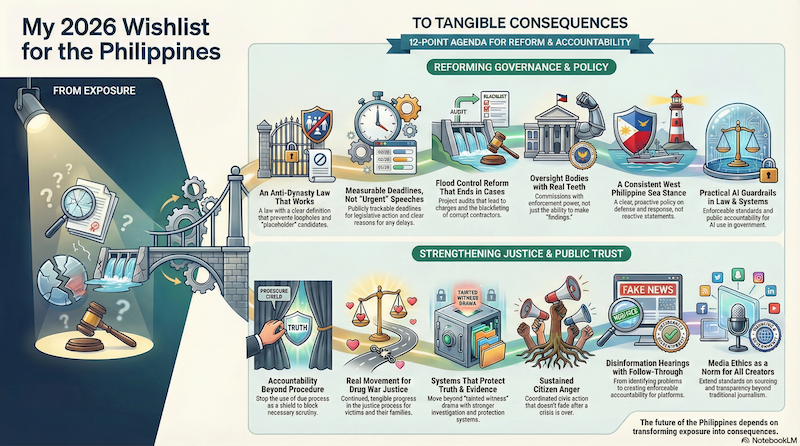
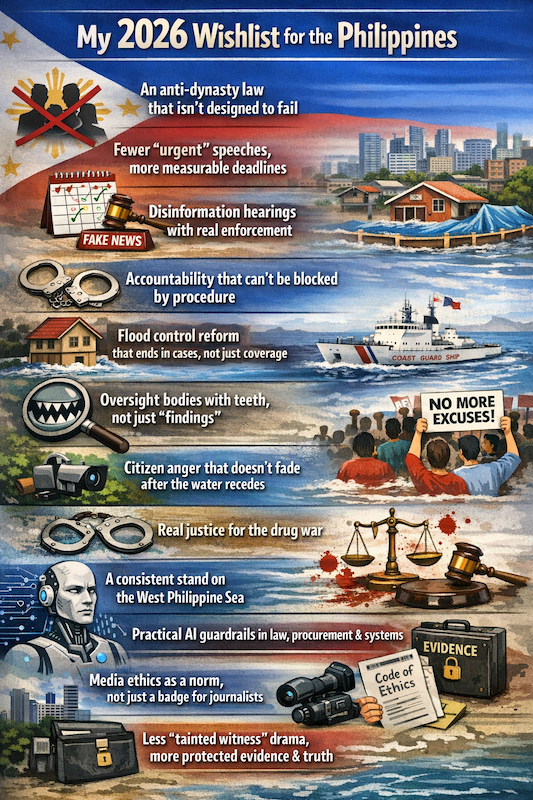
1) An anti-dynasty law that isn’t designed to fail
Not a bill that looks strict in headlines but quietly allows succession, placeholder candidates, and family “rotation.” If the Constitution already points to banning dynasties, then the next step is a definition that can’t be gamed.
2) Fewer “urgent” speeches, more measurable deadlines
2025 reminded us how easy it is for leaders to say the right thing without moving anything. In 2026, I want deadlines the public can track: filing dates, committee votes, published versions of drafts, and reasons for delay, on the record.
3) Disinformation hearings that produce enforceable follow-through
If Senate hearings keep naming the problem but stop short of outcomes, then the country stays stuck in diagnosis mode. In 2026, the wishlist is simple: clear enforcement pathways, platform accountability that’s not cosmetic, and public reporting that doesn’t disappear when the news cycle shifts.
4) Accountability that can’t be blocked by procedure alone
The Supreme Court ruling on the Sara Duterte impeachment fight sharpened a hard truth: procedure can protect fairness, but it can also become a shield that prevents scrutiny. In 2026, the goal is not “ignore due process.” It’s “stop using due process as the end of the story.”
5) Flood control reform that ends in cases, not just coverage
Flooding isn’t an abstract policy failure. It’s water in homes, lost income, ruined school days. If 2025 taught anything, it’s that corruption becomes most undeniable when it’s physical. In 2026, I want outcomes: project audits that lead to charges where warranted, blacklisting of repeat offenders, and procurement that the public can inspect.
6) Oversight bodies with teeth (not just “findings”)
A commission that can only “recommend” is easy to ignore. In 2026, the wishlist is real enforcement: stronger mandates, adequate staffing, and a public trail of what happens after the reports are submitted.
7) Citizen anger that doesn’t fade after the water recedes
“Baha sa Luneta” mattered because it pushed frustration out of comment sections and into real space. In 2026, I want more civic action that’s sustained, coordinated, and protected especially beyond Metro Manila.
8) Real movement toward justice for drug war victims
Blocking interim release at the ICC mattered to families because it signaled that the process is still alive. But 2026 needs more than symbolic weight. The wishlist is continued traction without losing the human faces behind the case.
9) A West Philippine Sea stance that’s consistent, not reactive
I want fewer “incident-by-incident” reactions and more clarity: what the Philippines will defend, how it will respond, and how it will keep citizens informed without sugarcoating risk. Consistency is policy. Confusion is vulnerability.
10) Practical AI guardrails that show up in law, procurement, and daily systems
Calls for “AI red lines” are a reminder that speed without limits has real costs. In 2026, I want guardrails that don’t stay as global statements: standards, audits, and public accountability for how AI is used in government, elections, and security.
11) Media ethics as a norm for creators, not a badge for journalists
If more people now shape public opinion than traditional newsrooms, then ethical standards can’t stay locked inside journalism. In 2026: clearer norms on sourcing, labeling, corrections, and transparency—because credibility is infrastructure too.
12) Less “tainted witness” drama, more systems that protect evidence and truth
The “bagman” storyline is a reminder that high-stakes allegations often arrive through messy messengers. In 2026, the wishlist is better safeguards: credible investigation, stronger witness protection where needed, and less reliance on spectacle as “proof.”
If 2025 was the year of exposure, 2026 should be the year consequences finally catch up.
About The Author

Noemi Lardizabal-Dado
Noemi Lardizabal-Dado is a content strategist with over 19 years of experience in blogging, content management, citizen advocacy, and media literacy, and over 30 years in web development. Otherwise known as @MomBlogger on social media, she believes in making a difference in the lives of her children by advocating for social change that benefits the greater good.
She is a co-founder and a member of the editorial board of Blog Watch . She is a resource speaker on media literacy, social media, blogging, digital citizenship, good governance, transparency, parenting, women’s rights, wellness, and cyber safety.
Her personal blogs such as aboutmyrecovery.com (parenting) , pinoyfoodblog.com (recipes), techiegadgets.com (gadgets) and benguetarabica.coffee keep her busy outside of Blog Watch.
Disclosure:
I am an advocate. I am NOT neutral. I will NOT give social media mileage to members of political clans, epal, a previous candidate for the same position and those I believe are a waste of taxpayers' money.
I do not support or belong to any political party. I was part of accredited media covering the Office of the Vice President and Leni Robredo as she ran as a presidential aspirant in the 2022 National and local elections.
On August 5, 2021, YouTube announced that I was selected as one of 50 Program participants of its Creator Program for Independent Journalists
She was a Senior Consultant for ALL media engagements for the PCOO-led Committee on Media Affairs & Strategic Communications (CMASC) under the ASEAN 2017 National Organizing Council from January 4 -July 5, 2017. Having been an ASEAN advocate since 2011, she has written extensively about the benefits of the ASEAN community and as a region of opportunities on Blog Watch and aboutmyrecovery.com.
Organization affiliation includes Consortium on Democracy and Disinformation
Updated June 6, 2022
My 2026 wishlist for the Philippines
2025 was loud. Hearings were livestreamed. Clips traveled faster than transcripts. Scandals were documented in real time. And yet the year still ended with the same feeling: exposure didn’t automatically turn into consequence.
So for 2026, here’s the wishlist not the feel-good kind, but the “what would actually change daily life” kind.
1) An anti-dynasty law that isn’t designed to fail
Not a bill that looks strict in headlines but quietly allows succession, placeholder candidates, and family “rotation.” If the Constitution already points to banning dynasties, then the next step is a definition that can’t be gamed.
2) Fewer “urgent” speeches, more measurable deadlines
2025 reminded us how easy it is for leaders to say the right thing without moving anything. In 2026, I want deadlines the public can track: filing dates, committee votes, published versions of drafts, and reasons for delay, on the record.
3) Disinformation hearings that produce enforceable follow-through
If Senate hearings keep naming the problem but stop short of outcomes, then the country stays stuck in diagnosis mode. In 2026, the wishlist is simple: clear enforcement pathways, platform accountability that’s not cosmetic, and public reporting that doesn’t disappear when the news cycle shifts.
4) Accountability that can’t be blocked by procedure alone
The Supreme Court ruling on the Sara Duterte impeachment fight sharpened a hard truth: procedure can protect fairness, but it can also become a shield that prevents scrutiny. In 2026, the goal is not “ignore due process.” It’s “stop using due process as the end of the story.”
5) Flood control reform that ends in cases, not just coverage
Flooding isn’t an abstract policy failure. It’s water in homes, lost income, ruined school days. If 2025 taught anything, it’s that corruption becomes most undeniable when it’s physical. In 2026, I want outcomes: project audits that lead to charges where warranted, blacklisting of repeat offenders, and procurement that the public can inspect.
6) Oversight bodies with teeth (not just “findings”)
A commission that can only “recommend” is easy to ignore. In 2026, the wishlist is real enforcement: stronger mandates, adequate staffing, and a public trail of what happens after the reports are submitted.
7) Citizen anger that doesn’t fade after the water recedes
“Baha sa Luneta” mattered because it pushed frustration out of comment sections and into real space. In 2026, I want more civic action that’s sustained, coordinated, and protected especially beyond Metro Manila.
8) Real movement toward justice for drug war victims
Blocking interim release at the ICC mattered to families because it signaled that the process is still alive. But 2026 needs more than symbolic weight. The wishlist is continued traction without losing the human faces behind the case.
9) A West Philippine Sea stance that’s consistent, not reactive
I want fewer “incident-by-incident” reactions and more clarity: what the Philippines will defend, how it will respond, and how it will keep citizens informed without sugarcoating risk. Consistency is policy. Confusion is vulnerability.
10) Practical AI guardrails that show up in law, procurement, and daily systems
Calls for “AI red lines” are a reminder that speed without limits has real costs. In 2026, I want guardrails that don’t stay as global statements: standards, audits, and public accountability for how AI is used in government, elections, and security.
11) Media ethics as a norm for creators, not a badge for journalists
If more people now shape public opinion than traditional newsrooms, then ethical standards can’t stay locked inside journalism. In 2026: clearer norms on sourcing, labeling, corrections, and transparency—because credibility is infrastructure too.
12) Less “tainted witness” drama, more systems that protect evidence and truth
The “bagman” storyline is a reminder that high-stakes allegations often arrive through messy messengers. In 2026, the wishlist is better safeguards: credible investigation, stronger witness protection where needed, and less reliance on spectacle as “proof.”
If 2025 was the year of exposure, 2026 should be the year consequences finally catch up.
Related Posts
7 reasons why Duterte critics still fail to make a dent (Part 1 of 2)
Is Willie Revillame Really Helping the Poor?
Ang sistema ay hindi perpekto
About The Author
Noemi Lardizabal-Dado
Noemi Lardizabal-Dado is a content strategist with over 19 years of experience in blogging, content management, citizen advocacy, and media literacy, and over 30 years in web development. Otherwise known as @MomBlogger on social media, she believes in making a difference in the lives of her children by advocating for social change that benefits the greater good. She is a co-founder and a member of the editorial board of Blog Watch . She is a resource speaker on media literacy, social media, blogging, digital citizenship, good governance, transparency, parenting, women’s rights, wellness, and cyber safety. Her personal blogs such as aboutmyrecovery.com (parenting) , pinoyfoodblog.com (recipes), techiegadgets.com (gadgets) and benguetarabica.coffee keep her busy outside of Blog Watch. Disclosure: I am an advocate. I am NOT neutral. I will NOT give social media mileage to members of political clans, epal, a previous candidate for the same position and those I believe are a waste of taxpayers' money. I do not support or belong to any political party. I was part of accredited media covering the Office of the Vice President and Leni Robredo as she ran as a presidential aspirant in the 2022 National and local elections. On August 5, 2021, YouTube announced that I was selected as one of 50 Program participants of its Creator Program for Independent Journalists She was a Senior Consultant for ALL media engagements for the PCOO-led Committee on Media Affairs & Strategic Communications (CMASC) under the ASEAN 2017 National Organizing Council from January 4 -July 5, 2017. Having been an ASEAN advocate since 2011, she has written extensively about the benefits of the ASEAN community and as a region of opportunities on Blog Watch and aboutmyrecovery.com. Organization affiliation includes Consortium on Democracy and Disinformation Updated June 6, 2022