While Congress debates what kind of anti-dynasty law it is actually willing to approve, fresh survey data gives a clearer view of public sentiment. And it’s not as straightforward as official talking points would suggest.
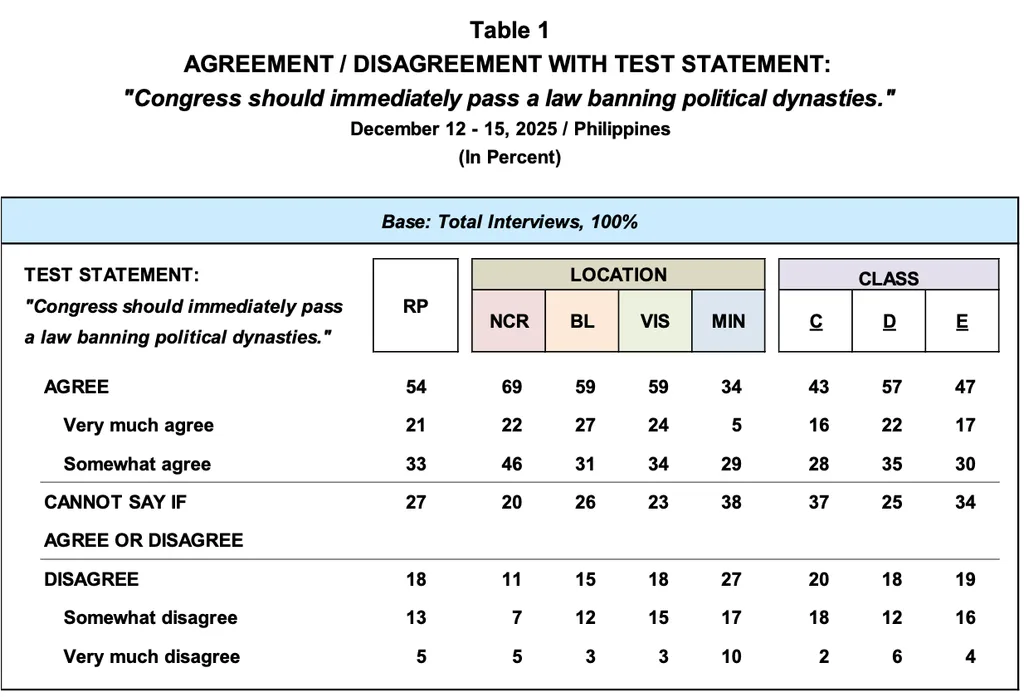
The December 2025 Pulse Asia survey points to a cautious kind of support. A slim majority of Filipinos say they want an anti-dynasty law passed now. Fifty-four percent favor Congress acting immediately to ban political dynasties, not exactly a landslide, but not insignificant either.
Support is strongest in Metro Manila, where nearly 69% of respondents agree. It holds up as well in the rest of Luzon and in the Visayas, both registering the rest of Luzon (59%), the Visayas (59%), and Class D (57%) favor immediate passage.
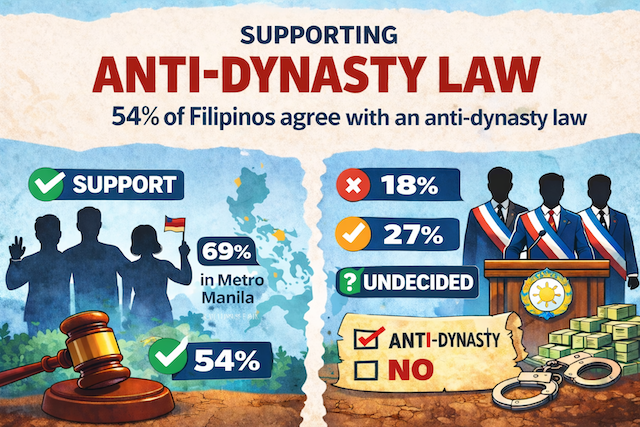
Mindanao looks different. There, opinion is scattered. Only 34% say they agree with passing an anti-dynasty law now, while 38% are undecided and 27% disagree. Nationwide, hesitation outweighs rejection. More people are still weighing it than rejecting it outright. Twenty-seven percent say they’re undecided, while a smaller 18% say they are against an anti-dynasty law. The final figure is that 54% agree with the proposed anti-dynasty law.
The timing of the survey adds another layer. It was conducted from December 12 to 15, only a few days after President Ferdinand Marcos Jr. told Congress to prioritize an anti-dynasty bill. Yet the measure was never certified as urgent. Critics pointed to that omission almost immediately, and for many observers, it underscored the familiar gap between strong language and concrete action.
Not all anti-dynasty bills are alike
There is no shortage of proposals. At least 11 anti-dynasty bills have been filed in Congress. At first glance, that sounds like progress. A closer look suggests otherwise.
The joint bill filed by House Majority Leader Sandro Marcos and Speaker Bojie Dy has attracted the most attention. Its limits apply only to relatives holding office at the same level or within the same jurisdiction. In real terms, that means it would barely touch large political clans, including their own.
Bills filed by opposition lawmakers, particularly from Makabayan and Akbayan, go much further. These proposals bar relatives up to the fourth degree of consanguinity from holding any national or local elective post. They also block immediate succession, which remains the most common way political families retain power.
Data from the Philippine Center for Investigative Journalism (PCIJ) on December 2024 shows why these distinctions matter. According to PCIJ, 71 out of 82 provincial governments, roughly 87%, are currently led by members of political dynasties.
The principle itself is not up for debate. The 1987 Constitution already states that political dynasties must be prohibited, once defined by law. What is still missing is that law. Congress, dominated by dynastic politicians, has never passed the needed enabling measure. Petitions asking the Supreme Court to compel Congress to act have been sitting unresolved since April 2025.
A related call for stronger oversight

The same Pulse Asia survey points to broader dissatisfaction with accountability. Fifty-two percent of Filipinos want Congress to pass a law creating a fully empowered Independent Commission for Infrastructure (ICI).
Public interest in the commission grew alongside investigations into flood control projects, many of which involve officials from political families who are also contractors. That momentum has slowed. Hearings are no longer being livestreamed in full, and two of the three commissioners have since stepped down. That leaves the chair carrying the work largely on their own.
The ICI itself was created through an executive order, and it comes with a clear limitation. It has no power to prosecute anyone.Its findings are simply forwarded to agencies that may already be investigating the same issues.
What the numbers point to
Support for an anti-dynasty law is real, but it is uneven. In some regions, hesitation nearly matches agreement. That makes the substance of whatever bill Congress passes harder to ignore.
Filipinos may not agree on how strict an anti-dynasty law should be. But the survey sends a clear message. Performative reform will not be enough. A law that avoids succession and overlapping power risks losing the very public support lawmakers now cite.
About The Author

Noemi Lardizabal-Dado
Noemi Lardizabal-Dado is a content strategist with over 19 years of experience in blogging, content management, citizen advocacy, and media literacy, and over 30 years in web development. Otherwise known as @MomBlogger on social media, she believes in making a difference in the lives of her children by advocating for social change that benefits the greater good.
She is a co-founder and a member of the editorial board of Blog Watch . She is a resource speaker on media literacy, social media, blogging, digital citizenship, good governance, transparency, parenting, women’s rights, wellness, and cyber safety.
Her personal blogs such as aboutmyrecovery.com (parenting) , pinoyfoodblog.com (recipes), techiegadgets.com (gadgets) and benguetarabica.coffee keep her busy outside of Blog Watch.
Disclosure:
I am an advocate. I am NOT neutral. I will NOT give social media mileage to members of political clans, epal, a previous candidate for the same position and those I believe are a waste of taxpayers' money.
I do not support or belong to any political party. I was part of accredited media covering the Office of the Vice President and Leni Robredo as she ran as a presidential aspirant in the 2022 National and local elections.
On August 5, 2021, YouTube announced that I was selected as one of 50 Program participants of its Creator Program for Independent Journalists
She was a Senior Consultant for ALL media engagements for the PCOO-led Committee on Media Affairs & Strategic Communications (CMASC) under the ASEAN 2017 National Organizing Council from January 4 -July 5, 2017. Having been an ASEAN advocate since 2011, she has written extensively about the benefits of the ASEAN community and as a region of opportunities on Blog Watch and aboutmyrecovery.com.
Organization affiliation includes Consortium on Democracy and Disinformation
Updated June 6, 2022

Public support for an anti-dynasty Law is there, but not everywhere
While Congress debates what kind of anti-dynasty law it is actually willing to approve, fresh survey data gives a clearer view of public sentiment. And it’s not as straightforward as official talking points would suggest.
The December 2025 Pulse Asia survey points to a cautious kind of support. A slim majority of Filipinos say they want an anti-dynasty law passed now. Fifty-four percent favor Congress acting immediately to ban political dynasties, not exactly a landslide, but not insignificant either.
Support is strongest in Metro Manila, where nearly 69% of respondents agree. It holds up as well in the rest of Luzon and in the Visayas, both registering the rest of Luzon (59%), the Visayas (59%), and Class D (57%) favor immediate passage.
Mindanao looks different. There, opinion is scattered. Only 34% say they agree with passing an anti-dynasty law now, while 38% are undecided and 27% disagree. Nationwide, hesitation outweighs rejection. More people are still weighing it than rejecting it outright. Twenty-seven percent say they’re undecided, while a smaller 18% say they are against an anti-dynasty law. The final figure is that 54% agree with the proposed anti-dynasty law.
The timing of the survey adds another layer. It was conducted from December 12 to 15, only a few days after President Ferdinand Marcos Jr. told Congress to prioritize an anti-dynasty bill. Yet the measure was never certified as urgent. Critics pointed to that omission almost immediately, and for many observers, it underscored the familiar gap between strong language and concrete action.
Not all anti-dynasty bills are alike
There is no shortage of proposals. At least 11 anti-dynasty bills have been filed in Congress. At first glance, that sounds like progress. A closer look suggests otherwise.
The joint bill filed by House Majority Leader Sandro Marcos and Speaker Bojie Dy has attracted the most attention. Its limits apply only to relatives holding office at the same level or within the same jurisdiction. In real terms, that means it would barely touch large political clans, including their own.
Bills filed by opposition lawmakers, particularly from Makabayan and Akbayan, go much further. These proposals bar relatives up to the fourth degree of consanguinity from holding any national or local elective post. They also block immediate succession, which remains the most common way political families retain power.
Data from the Philippine Center for Investigative Journalism (PCIJ) on December 2024 shows why these distinctions matter. According to PCIJ, 71 out of 82 provincial governments, roughly 87%, are currently led by members of political dynasties.
The principle itself is not up for debate. The 1987 Constitution already states that political dynasties must be prohibited, once defined by law. What is still missing is that law. Congress, dominated by dynastic politicians, has never passed the needed enabling measure. Petitions asking the Supreme Court to compel Congress to act have been sitting unresolved since April 2025.
A related call for stronger oversight
The same Pulse Asia survey points to broader dissatisfaction with accountability. Fifty-two percent of Filipinos want Congress to pass a law creating a fully empowered Independent Commission for Infrastructure (ICI).
Public interest in the commission grew alongside investigations into flood control projects, many of which involve officials from political families who are also contractors. That momentum has slowed. Hearings are no longer being livestreamed in full, and two of the three commissioners have since stepped down. That leaves the chair carrying the work largely on their own.
The ICI itself was created through an executive order, and it comes with a clear limitation. It has no power to prosecute anyone.Its findings are simply forwarded to agencies that may already be investigating the same issues.
What the numbers point to
Support for an anti-dynasty law is real, but it is uneven. In some regions, hesitation nearly matches agreement. That makes the substance of whatever bill Congress passes harder to ignore.
Filipinos may not agree on how strict an anti-dynasty law should be. But the survey sends a clear message. Performative reform will not be enough. A law that avoids succession and overlapping power risks losing the very public support lawmakers now cite.
Related Posts
Why the arrest of Maria Ressa is worrisome and why we need to speak up
Mingling with the Masters of Delay
The American Food Crisis: Rise of cancer food –fall of health food
About The Author
Noemi Lardizabal-Dado
Noemi Lardizabal-Dado is a content strategist with over 19 years of experience in blogging, content management, citizen advocacy, and media literacy, and over 30 years in web development. Otherwise known as @MomBlogger on social media, she believes in making a difference in the lives of her children by advocating for social change that benefits the greater good. She is a co-founder and a member of the editorial board of Blog Watch . She is a resource speaker on media literacy, social media, blogging, digital citizenship, good governance, transparency, parenting, women’s rights, wellness, and cyber safety. Her personal blogs such as aboutmyrecovery.com (parenting) , pinoyfoodblog.com (recipes), techiegadgets.com (gadgets) and benguetarabica.coffee keep her busy outside of Blog Watch. Disclosure: I am an advocate. I am NOT neutral. I will NOT give social media mileage to members of political clans, epal, a previous candidate for the same position and those I believe are a waste of taxpayers' money. I do not support or belong to any political party. I was part of accredited media covering the Office of the Vice President and Leni Robredo as she ran as a presidential aspirant in the 2022 National and local elections. On August 5, 2021, YouTube announced that I was selected as one of 50 Program participants of its Creator Program for Independent Journalists She was a Senior Consultant for ALL media engagements for the PCOO-led Committee on Media Affairs & Strategic Communications (CMASC) under the ASEAN 2017 National Organizing Council from January 4 -July 5, 2017. Having been an ASEAN advocate since 2011, she has written extensively about the benefits of the ASEAN community and as a region of opportunities on Blog Watch and aboutmyrecovery.com. Organization affiliation includes Consortium on Democracy and Disinformation Updated June 6, 2022