At 2:30 in the morning of May 14, Sen. Ronald “Bato” dela Rosa walked out of the Senate building with Sen. Robinhood Padilla. He has not been seen since. His own wife later apologized for what she called his escape.
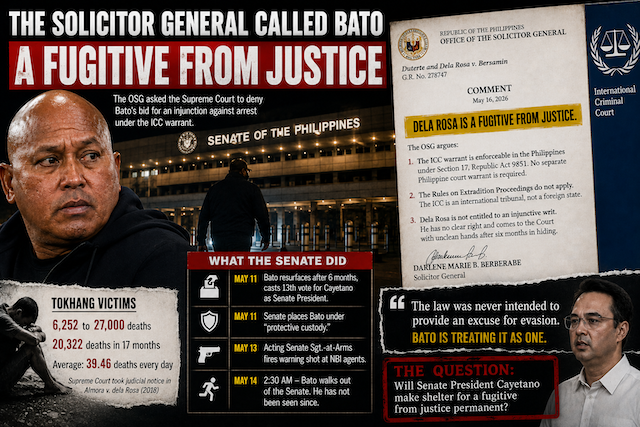
Two days later, the Office of the Solicitor General filed a Comment with the Supreme Court that did not soften any of this. The OSG called Bato a fugitive from justice. It asked the Court to deny his petition for an injunction against arrest under the International Criminal Court warrant.
What the Solicitor General actually said
The Comment in Duterte and Dela Rosa v. Bersamin (G.R. No. 278747), signed by Solicitor General Darlene Marie Berberabe and dated May 16, 2026, makes three points worth reading in plain language.
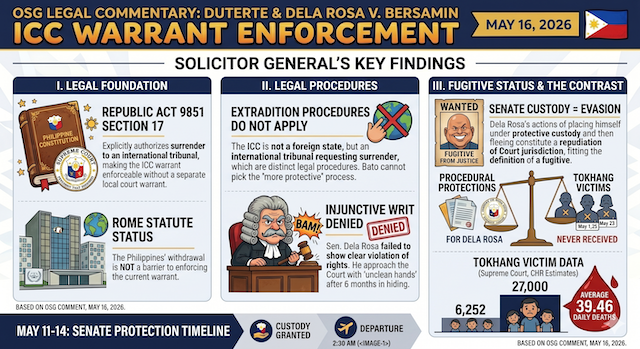
- The ICC warrant against Bato is enforceable in the Philippines without a separate Philippine court warrant. Section 17 of Republic Act 9851, the country’s law penalizing crimes against humanity, genocide, and war crimes, already authorizes surrender to an international tribunal that is conducting its own investigation. The Philippines does not need to be a current Rome Statute party for this to work.
- The Rules on Extradition Proceedings do not apply. The ICC is not a foreign state asking for extradition. It is an international tribunal asking for surrender, and the two are different legal procedures. Bato cannot select the more protective process when the law uses a different one.
- Bato is not entitled to an injunctive writ. He has shown no clear right being violated, and he comes to the Court with unclean hands after six months in hiding.
The OSG goes further than that. It argues that Bato’s conduct meets the legal definition of a fugitive from justice under Vallacar Transit v. Yanson, which the Supreme Court itself decided in November 2025. A person who flees with knowledge of a publicly issued warrant, then uses judicial remedies only when convenient, is, in the OSG’s reading, repudiating the Court’s jurisdiction over himself.
Download the (G.R. No. 278747) comment
The contrast the OSG draws
The hardest passage in the Comment is also the most direct. The OSG itself draws the contrast: Tokhang victims were killed by police, never put through a court, while Bato is now asking the Supreme Court for the procedural protections they never received.
The numbers cited in the Comment range from the official figure of 6,252 deaths to the Commission on Human Rights estimate of 27,000. The Supreme Court took judicial notice in Almora v. dela Rosa (2018) of 20,322 deaths over a 17-month period. That works out to an average of 39.46 deaths every day during the time Bato was PNP Chief.
These are the people who do not get to file Urgent Manifestations with the Supreme Court.
What the Senate did
On May 11, Bato resurfaced from six months of hiding to cast the decisive thirteenth vote installing Sen. Alan Peter Cayetano as Senate President. Cayetano was the Foreign Affairs Secretary who deposited the Philippines’ instrument of withdrawal from the ICC in 2018. The same Senate then placed Bato under “protective custody” and announced it would not hand him over without a Philippine court order.
Two nights later, the acting Senate Sergeant-at-Arms fired a warning shot at NBI agents on the premises. The Office of the Ombudsman has since suspended him. By the early hours of May 14, Bato was gone.
The OSG’s filing makes the Senate’s role plain. Protective custody and a leadership vote bought Bato time. He used the time to disappear.
The shelter and the question
Sen. Cayetano said the Senate will not surrender Bato without a Philippine court order. The Solicitor General has now told the Supreme Court that no such order is needed, that the ICC warrant is enforceable on its own under Republic Act 9851, and that the man the Senate is shielding has already forfeited any standing to ask the courts for help.
“The law was never intended to provide an excuse for evasion,” the OSG writes. Bato is treating it as one. The OSG notes his stated reasons for returning May 11 included not only the leadership vote but the Senate’s anticipated role in Sara Duterte’s impeachment trial. The question is whether Senate President Cayetano, the architect of the 2018 ICC withdrawal who now extends protection to the man named in its warrant, intends to seat a fugitive from justice when the impeachment court convenes.
About The Author

Noemi Lardizabal-Dado
Noemi Lardizabal-Dado is a content strategist with over 19 years of experience in blogging, content management, citizen advocacy, and media literacy, and over 30 years in web development. Otherwise known as @MomBlogger on social media, she believes in making a difference in the lives of her children by advocating for social change that benefits the greater good.
She is a co-founder and a member of the editorial board of Blog Watch . She is a resource speaker on media literacy, social media, blogging, digital citizenship, good governance, transparency, parenting, women’s rights, wellness, and cyber safety.
Her personal blogs such as aboutmyrecovery.com (parenting) , pinoyfoodblog.com (recipes), techiegadgets.com (gadgets) and benguetarabica.coffee keep her busy outside of Blog Watch.
Disclosure:
I am an advocate. I am NOT neutral. I will NOT give social media mileage to members of political clans, epal, a previous candidate for the same position and those I believe are a waste of taxpayers' money.
I do not support or belong to any political party. I was part of accredited media covering the Office of the Vice President and Leni Robredo as she ran as a presidential aspirant in the 2022 National and local elections.
On August 5, 2021, YouTube announced that I was selected as one of 50 Program participants of its Creator Program for Independent Journalists
She was a Senior Consultant for ALL media engagements for the PCOO-led Committee on Media Affairs & Strategic Communications (CMASC) under the ASEAN 2017 National Organizing Council from January 4 -July 5, 2017. Having been an ASEAN advocate since 2011, she has written extensively about the benefits of the ASEAN community and as a region of opportunities on Blog Watch and aboutmyrecovery.com.
Organization affiliation includes Consortium on Democracy and Disinformation
Updated June 6, 2022

The Solicitor General called Bato what he is: a fugitive from justice
At 2:30 in the morning of May 14, Sen. Ronald “Bato” dela Rosa walked out of the Senate building with Sen. Robinhood Padilla. He has not been seen since. His own wife later apologized for what she called his escape.
Two days later, the Office of the Solicitor General filed a Comment with the Supreme Court that did not soften any of this. The OSG called Bato a fugitive from justice. It asked the Court to deny his petition for an injunction against arrest under the International Criminal Court warrant.
What the Solicitor General actually said
The Comment in Duterte and Dela Rosa v. Bersamin (G.R. No. 278747), signed by Solicitor General Darlene Marie Berberabe and dated May 16, 2026, makes three points worth reading in plain language.
The OSG goes further than that. It argues that Bato’s conduct meets the legal definition of a fugitive from justice under Vallacar Transit v. Yanson, which the Supreme Court itself decided in November 2025. A person who flees with knowledge of a publicly issued warrant, then uses judicial remedies only when convenient, is, in the OSG’s reading, repudiating the Court’s jurisdiction over himself.
Download the (G.R. No. 278747) comment
The contrast the OSG draws
The hardest passage in the Comment is also the most direct. The OSG itself draws the contrast: Tokhang victims were killed by police, never put through a court, while Bato is now asking the Supreme Court for the procedural protections they never received.
The numbers cited in the Comment range from the official figure of 6,252 deaths to the Commission on Human Rights estimate of 27,000. The Supreme Court took judicial notice in Almora v. dela Rosa (2018) of 20,322 deaths over a 17-month period. That works out to an average of 39.46 deaths every day during the time Bato was PNP Chief.
These are the people who do not get to file Urgent Manifestations with the Supreme Court.
What the Senate did
On May 11, Bato resurfaced from six months of hiding to cast the decisive thirteenth vote installing Sen. Alan Peter Cayetano as Senate President. Cayetano was the Foreign Affairs Secretary who deposited the Philippines’ instrument of withdrawal from the ICC in 2018. The same Senate then placed Bato under “protective custody” and announced it would not hand him over without a Philippine court order.
Two nights later, the acting Senate Sergeant-at-Arms fired a warning shot at NBI agents on the premises. The Office of the Ombudsman has since suspended him. By the early hours of May 14, Bato was gone.
The OSG’s filing makes the Senate’s role plain. Protective custody and a leadership vote bought Bato time. He used the time to disappear.
The shelter and the question
Sen. Cayetano said the Senate will not surrender Bato without a Philippine court order. The Solicitor General has now told the Supreme Court that no such order is needed, that the ICC warrant is enforceable on its own under Republic Act 9851, and that the man the Senate is shielding has already forfeited any standing to ask the courts for help.
“The law was never intended to provide an excuse for evasion,” the OSG writes. Bato is treating it as one. The OSG notes his stated reasons for returning May 11 included not only the leadership vote but the Senate’s anticipated role in Sara Duterte’s impeachment trial. The question is whether Senate President Cayetano, the architect of the 2018 ICC withdrawal who now extends protection to the man named in its warrant, intends to seat a fugitive from justice when the impeachment court convenes.
Related Posts
The political implications of ending the second DDS probe after just one hearing
Millennials: From ‘couch potatoes’ to street warriors; from Katipunan to Luneta (Part 1)
Something’s Fishy with Kabataan Party List’s Petition
About The Author
Noemi Lardizabal-Dado
Noemi Lardizabal-Dado is a content strategist with over 19 years of experience in blogging, content management, citizen advocacy, and media literacy, and over 30 years in web development. Otherwise known as @MomBlogger on social media, she believes in making a difference in the lives of her children by advocating for social change that benefits the greater good. She is a co-founder and a member of the editorial board of Blog Watch . She is a resource speaker on media literacy, social media, blogging, digital citizenship, good governance, transparency, parenting, women’s rights, wellness, and cyber safety. Her personal blogs such as aboutmyrecovery.com (parenting) , pinoyfoodblog.com (recipes), techiegadgets.com (gadgets) and benguetarabica.coffee keep her busy outside of Blog Watch. Disclosure: I am an advocate. I am NOT neutral. I will NOT give social media mileage to members of political clans, epal, a previous candidate for the same position and those I believe are a waste of taxpayers' money. I do not support or belong to any political party. I was part of accredited media covering the Office of the Vice President and Leni Robredo as she ran as a presidential aspirant in the 2022 National and local elections. On August 5, 2021, YouTube announced that I was selected as one of 50 Program participants of its Creator Program for Independent Journalists She was a Senior Consultant for ALL media engagements for the PCOO-led Committee on Media Affairs & Strategic Communications (CMASC) under the ASEAN 2017 National Organizing Council from January 4 -July 5, 2017. Having been an ASEAN advocate since 2011, she has written extensively about the benefits of the ASEAN community and as a region of opportunities on Blog Watch and aboutmyrecovery.com. Organization affiliation includes Consortium on Democracy and Disinformation Updated June 6, 2022