Who decided your electric bill should fund the government’s social programs?
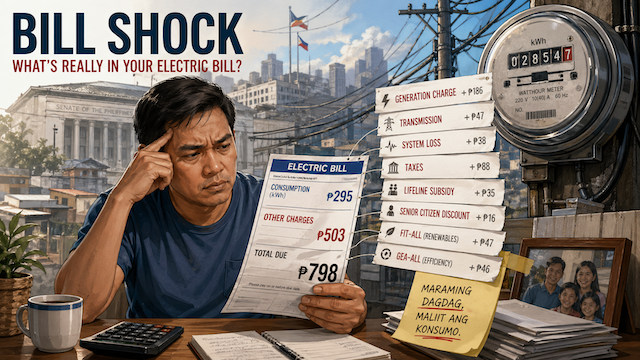
Carlan Marie Vizcarra posted her Meralco bill on social media last week. Her actual electricity consumption came to P295. The “other charges” on the same bill totaled P503. Her final amount due: P798.
She is not alone. Jun Ignacio reported a bill of P14,704.31 despite no additional appliances and a house that was closed over Semana Santa. Ivy Ocon flagged over P4,000 in additional charges, with nearly P1,000 attributed to taxes alone. Hazel, a residential customer interviewed by GMA’s 24 Oras Weekend, saw her bill jump from P5,560 to P7,013 even though she believed her consumption was similar to last year’s.
The Facebook page “Malditang Ina” asked the question now circulating in group chats and comment sections across the country: Why are ordinary consumers shouldering government subsidies through their electricity bills?
What’s actually in your bill (and how much of it is Meralco’s)
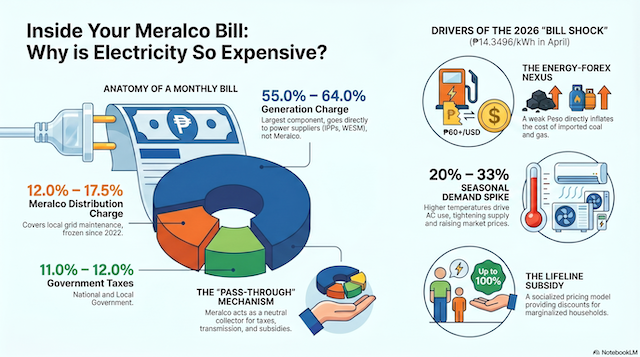
Here is what most consumers don’t realize: only about 12% to 17% of a Meralco bill goes to Meralco. That portion, the distribution charge, pays for the power lines and substations that deliver electricity to your home. It has not changed since it was reduced in 2022.
The rest, roughly 83% to 88% of your bill, goes elsewhere.
The generation charge, which covers the cost of electricity purchased from power plants, accounts for 55% to 64% of the total. It is a pass-through: Meralco collects it and remits it to the power suppliers. The transmission charge (8% to 10%) goes to the National Grid Corporation of the Philippines. Government taxes take another 11% to 12%. And then there are the line items that triggered the current firestorm: system loss, lifeline subsidy, senior citizen discount, FIT-All, and GEA-All.
Meralco Vice President Joe Zaldarriaga has repeated the company’s position in multiple briefings: “We act solely as collection agents for these costs. These do not form part of our revenues in any way.”
The ERC backed him up on April 29, stating that all the charges in question are “imposed in accordance with existing laws and policies.”
That is technically correct. It also sidesteps the question that consumers are actually asking.
The laws behind the line items
Every contested charge traces back to a specific law or regulation. The lifeline subsidy is mandated by Republic Act No. 11552, which amended Section 73 of the Electric Power Industry Reform Act (RA 9136). Under ERC Resolution No. 2 (Series of 2026), a uniform national subsidy charge of P0.01 per kWh is collected from all non-lifeline consumers. That money funds a 100% discount on electricity for Pantawid Pamilyang Pilipino Program (4Ps) households consuming 50 kWh or less per month, a 35% discount for those consuming 51 to 70 kWh, and a 20% discount for those consuming 71 to 100 kWh.
The senior citizen discount is required under RA 9994, the Expanded Senior Citizens Act. Distribution utilities provide at least 5% off the bills of senior citizens who consume 100 kWh or less, and that cost is spread across all other ratepayers.
The Feed-in Tariff Allowance (FIT-All), at P0.2011 per kWh, funds renewable energy projects under the Renewable Energy Act of 2008. The Green Energy Auction Allowance (GEA-All), introduced in January 2026 at P0.0371 per kWh, supports newer RE projects chosen through competitive bidding.
The system loss charge recovers the cost of electricity lost during delivery, including losses from illegal connections and meter tampering. The cap is 8.5%, set by the ERC in 2010. Meralco says it operates well below that, but compliant households still pay for electricity someone else stole.
None of these charges are new. But for many consumers, April 2026 was the first time they looked closely enough to notice.
Why April blew the lid off
Two things happened at once. The overall residential rate climbed to P14.3496 per kWh, an increase of P0.5335 from the previous month. That translates to roughly P107 more on a 200 kWh bill. The main driver was the peso, which hit P60.748 against the dollar in late March. Because the Philippines imports approximately 80% of its energy as coal and liquefied natural gas, and because power supply agreements with plants like First Gas Sta. Rita and San Lorenzo are dollar-denominated, a weaker peso raises the generation charge even when actual energy consumption stays flat.
On top of the forex hit, the dry season pushed demand up. Philippine household electricity consumption historically rises by 20% to 33% during summer months. That tightened supply margins in the Luzon grid, spiking prices on the Wholesale Electricity Spot Market.
But the peso and the heat are not what made this bill shock different from the ones in 2020 or 2024. What changed is that the new lifeline subsidy discount structure under RA 11552 also took effect in April. That made the lifeline and senior citizen line items more visible at the worst possible time, during the same billing cycle as a rate hike.
The combination sent consumers to social media not to complain about the total (they do that every summer) but to ask, for the first time, what each line meant.
What netizens are asking (and what it means)
The conversation online has moved past venting. On Threads, users are identifying the authors of the laws behind the charges. On Facebook, consumers are emailing Meralco directly and posting the replies. One user confirmed that the company acknowledged the lifeline and senior citizen charges are passed on to all customers, adding that under the law, consumers do not need to be individually informed.
That response captures the core tension. The charges are legal. They are also invisible to most people until they’re not. And the funding mechanism, a cross-subsidy collected through utility bills, is a policy choice, not a natural law.
Representative Chel Diokno has pointed out a specific gap: under RA 9994, electric companies are already allowed to claim senior citizen discounts as tax deductions. If the utility is already being compensated through reduced tax liabilities, passing the cost to consumers amounts to double recovery. That argument is now part of the legislative record.
The refund, and why it doesn’t answer the question
The ERC ordered Meralco to accelerate the refund of P14.17 billion in over-recoveries. The original timeline was 36 months. The new timeline is 12 months, raising the refund rate from P0.1189 to P0.2511 per kWh. The first credits hit bills in May 2026.
Senator Risa Hontiveros framed the mismatch: the refund arrives in installments while the rate hike landed all at once. Consumers adjust their household budgets every day that the overcharges go unrefunded. The system absorbs shocks slowly but distributes them instantly.
The refund will soften May bills. It does not change the structure.
What the Senate is doing (starting tomorrow)
Senator Bam Aquino filed Senate Resolution No. 375, directing the Senate Committee on Energy to review “the design, targeting, and financing of the subsidy-related charges and mandated discounts” under the EPIRA. His position: cross-subsidy charges should be partially, if not fully, funded through the national budget instead of through consumer bills.
Senator Sherwin Gatchalian, who chairs the Senate energy committee, has confirmed that the Senate’s ad hoc PROTECT (Proactive Response and Oversight for Timely and Effective Crisis Strategy) committee will take up the bill shock complaints on Wednesday, April 30.
Energy Secretary Sharon Garin has acknowledged that any amendments to these programs must go through Congress. The laws are the laws. Changing them requires lawmakers to act.
Meanwhile, Malacanang announced that President Marcos will ask Congress to urgently pass an “Uplift” (Unified Package for Livelihoods, Industry, Food, and Transport) law to address the energy and price shocks tied to the Middle East conflict.
What you can do right now
Read your bill, line by line. The Meralco website and the My Meralco App break down each charge. Know which portion is Meralco’s (distribution, roughly 12% to 17%) and which portions are pass-through costs going to generators, the grid operator, and the government.
Check if you qualify for the lifeline rate. If you are a 4Ps beneficiary or live below the poverty threshold set by the Philippine Statistics Authority, you may be eligible for up to 100% discount on electricity consumption of 50 kWh or less. Registration is available through your local DSWD office, valid for three years. As of late 2024, only about 6.73% of eligible 4Ps households had registered.
File a complaint if your bill doesn’t add up. You can reach Meralco through the My Meralco App, their Facebook page, the hotline at 16211, or via text at 0920-971-6211. For regulatory complaints, contact the ERC directly.
Ask your representative where they stand on Senate Resolution 375. The question is simple: should social programs be funded through electricity bills or through the national budget? Your district representative has a position on this, or should.
Follow the Senate PROTECT committee hearing on April 30. That hearing will determine whether the current cross-subsidy model stays, gets modified, or gets replaced. It is the nearest decision point with real consequences for your next bill.
The hearing is tomorrow
The bill shock conversation started with screenshots and frustration. It has now reached the Senate floor. The charges are legal. The question was never whether they were legal. The question is whether funding the government’s social programs through every household’s electricity meter is the right policy, and whether Congress will revisit that choice while 8.1 million Meralco customers wait for an answer.
The Senate PROTECT committee meets tomorrow, April 30. The senators will hear from the ERC, from Meralco, and from the lawmakers who authored the subsidy laws. We already know what consumers are saying. Now it is the Senate’s turn to explain what it plans to do about it.
About The Author

Noemi Lardizabal-Dado
Noemi Lardizabal-Dado is a content strategist with over 19 years of experience in blogging, content management, citizen advocacy, and media literacy, and over 30 years in web development. Otherwise known as @MomBlogger on social media, she believes in making a difference in the lives of her children by advocating for social change that benefits the greater good. She is a co-founder and a member of the editorial board of Blog Watch . She is a resource speaker on media literacy, social media, blogging, digital citizenship, good governance, transparency, parenting, women’s rights, wellness, and cyber safety. Her personal blogs such as aboutmyrecovery.com (parenting) , pinoyfoodblog.com (recipes), techiegadgets.com (gadgets) and benguetarabica.coffee keep her busy outside of Blog Watch. Disclosure: I am an advocate. I am NOT neutral. I will NOT give social media mileage to members of political clans, epal, a previous candidate for the same position and those I believe are a waste of taxpayers' money. I do not support or belong to any political party. I was part of accredited media covering the Office of the Vice President and Leni Robredo as she ran as a presidential aspirant in the 2022 National and local elections. On August 5, 2021, YouTube announced that I was selected as one of 50 Program participants of its Creator Program for Independent Journalists She was a Senior Consultant for ALL media engagements for the PCOO-led Committee on Media Affairs & Strategic Communications (CMASC) under the ASEAN 2017 National Organizing Council from January 4 -July 5, 2017. Having been an ASEAN advocate since 2011, she has written extensively about the benefits of the ASEAN community and as a region of opportunities on Blog Watch and aboutmyrecovery.com. Organization affiliation includes Consortium on Democracy and Disinformation Updated June 6, 2022